
How do we use this responsibly in higher education? Across Washington’s 34 community and technical colleges, that question sparked the creation of Gutierrez & Lethcoe’s AI Essentials in Education (AI-Ed)—a statewide professional-learning course developed under the Washington State Board for Community and Technical Colleges (SBCTC)—by Joni Gutierrez, Ph.D., and Ronald (Ron) Lethcoe, M.Ed., Co-Chairs of the eLearning Council (ELC) AI Task Force.
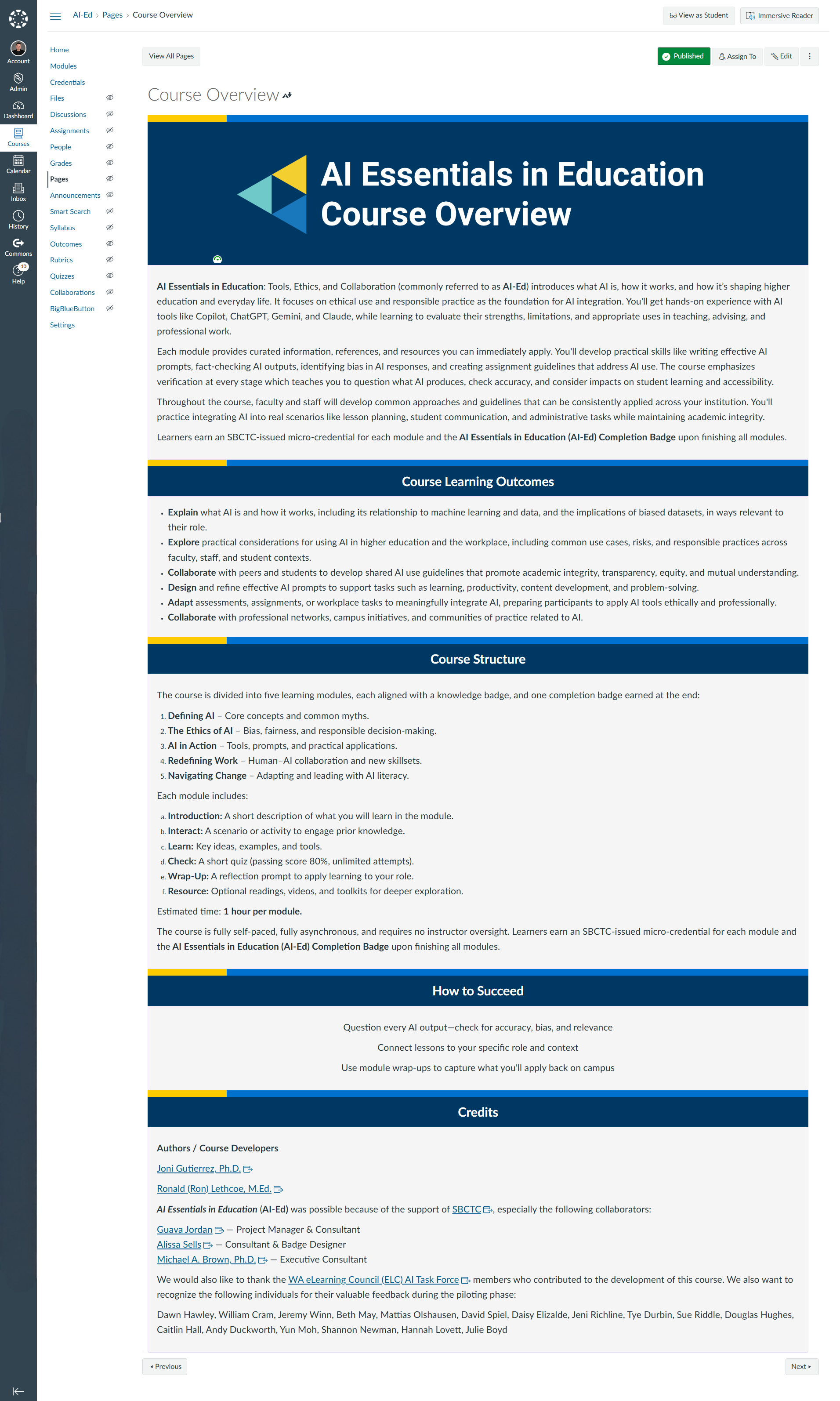
Course Overview
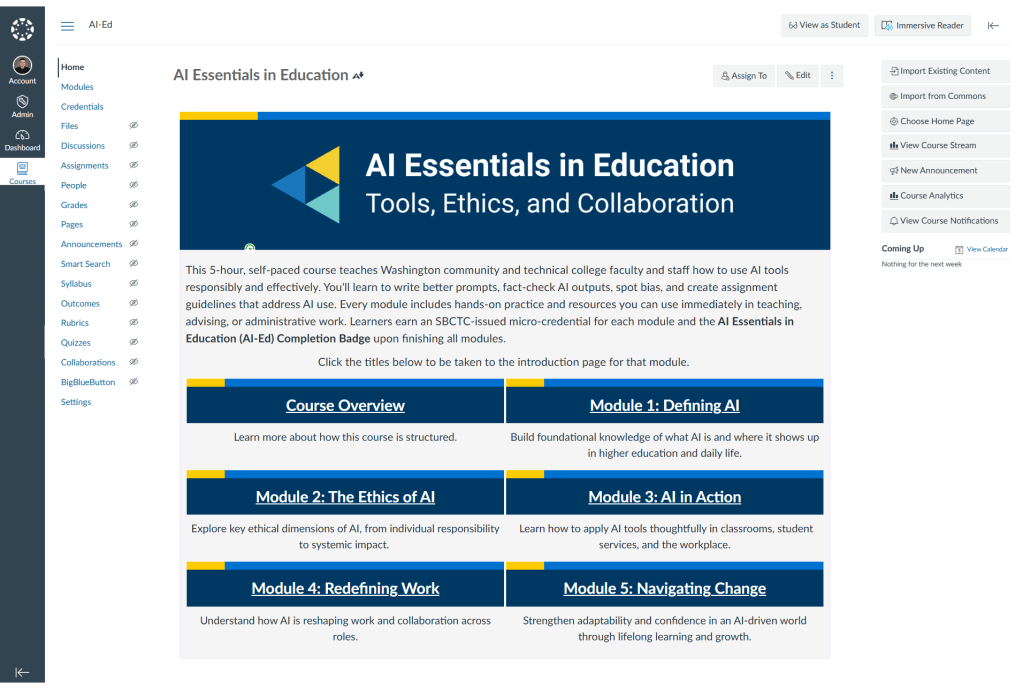
AI Essentials in Education: Tools, Ethics, and Collaboration
Commonly referred to as AI-Ed, this SBCTC course provides a foundational understanding of artificial intelligence and its growing role in higher education. Designed for community and technical college faculty and staff, this fully asynchronous, self-paced course explores how AI supports teaching, learning, and productivity while emphasizing critical thinking, ethics, and human-centered collaboration.
Learners progress through five one-hour modules:
- Defining AI – Core concepts and common myths
- The Ethics of AI – Bias, fairness, and responsible decision-making
- AI in Action – Tools, prompts, and practical applications
- Redefining Work – Human–AI collaboration and emerging skillsets
- Navigating Change – Adapting and leading with AI literacy
Learners earn an SBCTC-issued micro-credential for each module and the AI Essentials in Education (AI-Ed) Completion Badge upon finishing all modules. By the end of the course, participants are able to evaluate AI outputs critically, use AI tools responsibly, and engage confidently in system-wide conversations about AI in higher education.
A System-wide Conversation
From its inception, Gutierrez & Lethcoe’s AI-Ed was designed not as a tutorial on tools but as a shared conversation across roles—faculty, staff, and administrators—about what it means to live and work alongside intelligent systems.
Hosted in Canvas LMS and fully asynchronous, the course follows a deliberate rhythm: each module introduces a theme, presents interactive activities that model critical engagement, and concludes with practical, printable resources that support continued exploration. The structure feels both consistent and expansive, creating a through-line of ethical reflection that deepens with every step.
Module 1 – Defining AI: What It Is and How It Works
AI-Ed begins by grounding learners in reality. Artificial intelligence is already embedded in higher education, yet few can explain how it truly works. This opening module walks participants through the anatomy of AI—how models are trained on massive datasets, how they detect and reproduce patterns, and why their outputs, however fluent, are probabilistic rather than sentient.
The interactive “AI Mythbusters” exercise invites learners to confront common misconceptions—that AI thinks, learns, or understands—and reveals what’s actually happening beneath the interface: prediction, pattern, and probability.
Through guided explanations and examples from education and everyday life, participants explore bias in training data, the limits of model “understanding,” and why hallucinations occur. The accompanying Essential AI Vocabulary handout translates these ideas into shared, plain-language definitions, giving every college employee—from instructor to administrator—a foundation for clear, responsible discussion.
By the end, learners understand that AI is neither magic nor menace, but a tool shaped by human choices.
Module 2 – The Ethics of AI: Bias, Fairness, and Transparency
The second module shifts focus from what AI is to what it means. Here, ethics becomes both the language and the method of learning.
Two original frameworks anchor this exploration.
Gutierrez’s AEIOU Ethos reframes responsible AI through five principles—Accessible, Equitable, Inclusive, Open, and Universal—inviting learners to apply them in concrete ways. These principles echo the mission of public higher education, asking vital questions: Who can access this tool? Who is represented in its data? Can its reasoning be explained, revised, or refused?

Lethcoe’s AI Usage Tags work in parallel with the Ethos with a simple but powerful visual system. Green means encouraged, yellow means limited, red means prohibited. What began as classroom guidance has evolved into a cultural framework for transparency, empowering faculty and students to discuss AI use openly and consistently across institutions.

Through case studies and reflection, participants learn that ethics is not a checklist—it’s a conversation that demands openness, context, and shared accountability.
Module 3 – AI in Action: Tools, Prompts, and Practical Applications
By the third module, the course bridges concept and practice. In the interactive scenario “Navigating the Quarter,” learners play through real academic moments—balancing teaching duties, time constraints, and student needs—while deciding when and how to involve AI.
They test prompts, critique outputs, and analyze when automation supports learning and when it risks diminishing it. The key realization is that AI literacy is not technical fluency but discernment. Every output must be reviewed, contextualized, and revised.
The accompanying Top 5 AI Prompts for Faculty handout distills that discernment into practical form, offering adaptable examples for feedback, summaries, and planning—each paired with the reminder that judgment can’t be automated.
By the end, participants can articulate both the potential and the limits of generative AI as an educational partner.
Module 4 – Redefining Work: Human–AI Collaboration and Emerging Skillsets
This module turns reflection inward. As AI becomes woven into professional routines, what happens to human work?
Participants explore how automation can support—but never replace—the empathy, ethics, and adaptability that define education. Through mapping exercises, they categorize tasks according to their relationship with AI: automated, augmented, or authentically human.
The Should I Use AI for This Task? decision guide turns those insights into a practical tool for reflection, helping faculty and staff balance efficiency with intention.
What emerges is a new definition of collaboration—one in which human and machine capacities complement each other, guided by shared values and clarity of role.
Module 5 – Navigating Change: Adapting and Leading with AI Literacy
The final module steps back to consider longevity. How can institutions and individuals keep learning responsibly as AI evolves?
Participants complete a short adaptability quiz, reflect on their relationship with change, and explore sustainable ways to stay current. The Best Resources for Higher Ed Faculty to Stay Current on AI in Education handout turns that reflection into a practical roadmap for professional growth.
This closing section reframes AI literacy as a lifelong practice. It reminds participants that leadership in this space doesn’t require constant novelty—it requires continuous curiosity, humility, and a willingness to learn together.
What Emerges
Across Washington’s colleges, Gutierrez & Lethcoe’s AI Essentials in Education (AI-Ed) has become more than a course. It’s a shared foundation for responsible innovation—bridging technical understanding with ethical reflection. Faculty adapt its frameworks for syllabi; staff use its tools to streamline communication; administrators reference its principles in policy development.
What began as a professional-learning initiative is evolving into a system-wide culture of digital literacy and ethical collaboration.
AI-Ed doesn’t claim to master the technology—it helps people master their relationship with it. It reminds us that while machines can generate language, only humans can decide what those words should mean.

 Joni Gutierrez, Ph.D.
Leave a comment