
How do you compress years of research, dense theoretical analysis, and a complex film theory framework into a single image?
That was the challenge I faced when I revisited my doctoral dissertation. My PhD thesis explores Siegfried Kracauer’s cinematic realism through Husserlian phenomenology, drawing on my own film practice and the films of Lino Brocka as case studies.
A significant contribution that emerged toward the end of that work is the Integrated Quadrant Model of Kracauerian Cinematic Realism (IQMKCR)—a way of mapping how the modern subject encounters reality through cinema across four dimensions: the Everyday, the World, Life, and Nature.
It’s a layered, abstract model. Explaining it on the page is one thing; helping people see it is another. But now, working at the intersection of creativity and technology, I had a new tool to bridge that gap: Gemini Pro.
The Collaboration
I approached Gemini with a simple goal: translate a long, text-heavy argument into a clear, accurate visual map.
This wasn’t a quick “make me a graphic” task. First, the AI had to understand the structure of the IQMKCR. I provided the full dissertation and asked Gemini to identify the foundation of the model: the central modern subject, the four quadrants, and the Kracauerian tropes associated with each dimension of experience.
The first drafts were too generic—symmetrical diagrams that missed the lived texture and phenomenological depth of Kracauer’s realism. They captured the shape, but not the substance.
So I refined the prompts. I asked Gemini to include the specific tropes from my research—The Quotidian, The Refuse, The Transient, The Fortuitous, The Flow of Life, The Indeterminate, and The Spiritual Life Itself—and place them in their correct experiential quadrants: bodily, egoic, intersubjective, and essential.
Only then did the model begin to take on the conceptual weight the theory requires.
Unleashing “Nano Banana”
To get the level of detail I wanted, I asked Gemini Pro to leverage its most advanced image-generation engine—internally nicknamed “Nano Banana.”
The instruction was simple:
Create a visualization that is accurate, nuanced, and modern—something that reflects the bridge between analog film theory and contemporary AI visualization.
The final result is the infographic shown below.
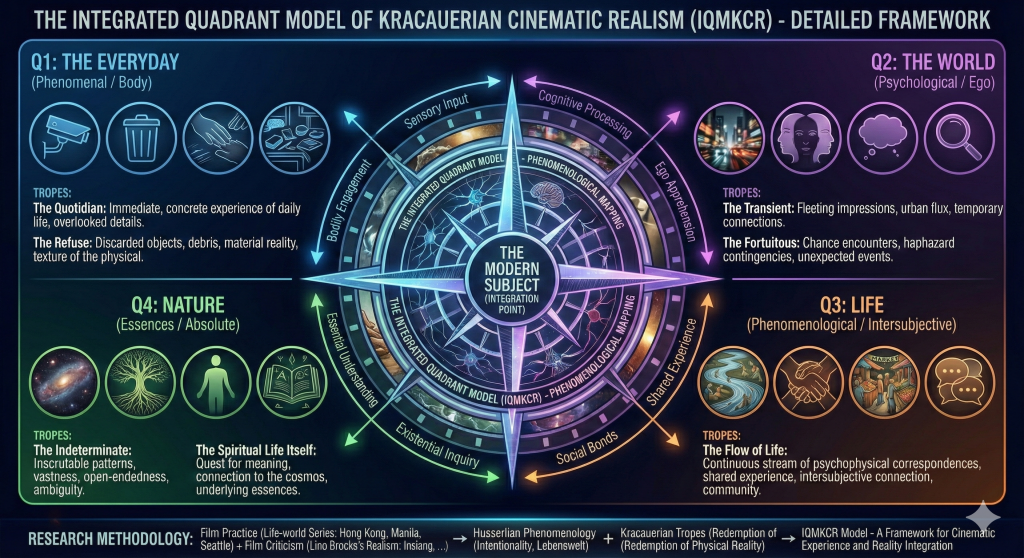
The Result: The IQMKCR Mapped
The visualization translates the core structure of my model into a single, accessible image.
At the center is the Modern Subject—the integration point where all modes of experience converge. Radiating outward are the four quadrants:
Q1: The Everyday (Phenomenal / Body)
Concrete physical reality, overlooked details, and the texture of the ordinary. Here we find The Quotidian and The Refuse.
Q2: The World (Psychological / Ego)
Urban flux, fleeting impressions, and subjective interpretation. This quadrant includes The Transient and The Fortuitous.
Q3: Life (Phenomenological / Intersubjective)
Shared experience, intersubjective bonds, and the social field. Represented by The Flow of Life.
Q4: Nature (Essences / Absolute)
Depth, meaning, and the search for underlying essences. This includes The Indeterminate and The Spiritual Life Itself.
At the bottom, the methodology bar ties everything together: phenomenology, Kracauerian tropes, film practice, film criticism, and the construction of cinematic experience as an integrated framework.
A New Way to See Theory
Working with AI on this project showed me something important: AI isn’t just a generator. It’s a synthesizer.
Through iterative dialogue—summarizing, refining, challenging weak drafts—the AI helped turn a dense, abstract theoretical model into something visual and shareable without losing its conceptual integrity.
It gave me a new way to see my own work.
And that, I think, is one of the most exciting possibilities of AI: not replacing the human act of thinking, but expanding how we understand what we’ve already created.

 Joni Gutierrez, Ph.D.
Leave a comment