
By Joni Gutierrez, Ph.D. & Ronald Lethcoe, M.Ed.
Artificial intelligence is now part of the everyday fabric of education. It appears in writing tools, tutoring systems, assessment workflows, accessibility supports, and institutional decision-making. The question educators face is no longer whether AI will be present, but how its presence will shape what we value, how we teach, and what kinds of learners education ultimately helps form.
At moments like this, it is easy to default to efficiency, scale, or risk mitigation. But education is not a logistical system to be optimized. It is a deeply human endeavor grounded in relationships, meaning-making, and growth. Without clear principles, decisions about AI risk becoming reactive, fragmented, or misaligned with the very purposes education exists to serve.
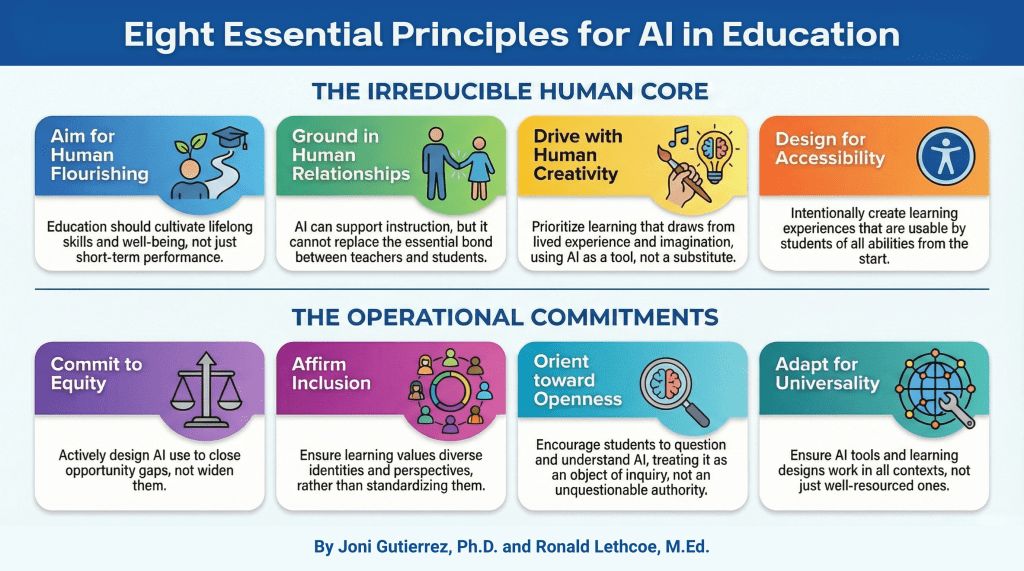
The Eight Essential Principles for AI in Education
The Eight Essential Principles for AI in Education offer a human-centered framework for navigating this shift. The first four principles articulate the irreducible human core of education in the age of AI: flourishing, relationships, creativity, and accessibility. These are not optional values or downstream considerations; they define what makes education meaningfully human.
The remaining four principles translate that human core into operational commitments for design and practice, drawing from the AEIOU Ethos: Equity, Inclusion, Openness, and Universality. Together, the eight principles form a coherent lens for designing, evaluating, and using AI in ways that support learning rather than subordinate it.
1. Aligned with Human Flourishing
Human flourishing is about education that leads toward the future we want. It points to a future in which humanity not only addresses the problems that challenge us, but also imagines and builds ways of living that allow people to thrive rather than merely survive.
Education is always oriented toward futures we cannot fully predict or even imagine. For that reason, its purpose cannot be reduced to short-term performance or task completion. What matters is that learning cultivates values, meaning-making, and durable skills that learners can draw upon across changing contexts and throughout their lives. When learning is aligned with human flourishing, it supports students in becoming whole persons and contributes to a humanity capable of flourishing alongside them.
2. Grounded in Human Relationships
The student–teacher relationship is one of the most essential relationships in human experience. Learning does not occur in isolation; it emerges through trust, mentorship, dialogue, and care. Any approach to education in the age of AI must therefore remain human-centered at this relational core.
AI can support instruction, feedback, and organization, but it cannot replace the relational bond that anchors learning. Human-centered learning recognizes that relationships are not incidental to education; they are foundational. When teaching is grounded in human relationships, students feel seen, supported, and challenged in meaningful ways. These relationships are also one of the primary ways human flourishing is sustained over time.
3. Driven by Human Creativity and Lived Experience
AI can simulate creativity by recombining patterns found in existing data. Human creativity, by contrast, draws from lived experience, cultural context, imagination, and reflection. It is shaped by identity, memory, emotion, and interpretation.
Learning that supports human flourishing must therefore prioritize creativity rooted in lived experience. When education relies too heavily on AI-generated outputs, it risks reducing creativity to imitation rather than meaning-making. Human-centered learning designs invite students to draw on their own perspectives and experiences, using AI as a support rather than a substitute. In this way, creativity remains a human act—one that connects learning to identity, purpose, and possibility.
4. Designed for Accessibility
Accessibility is foundational to what makes education human. It ensures that learners—including learners with disabilities—can participate meaningfully regardless of ability, language, device, or connectivity, through intentional, design-first practices. It begins by questioning assumptions about the “ideal” learner and instead designing for the full range of human variation.
Many AI tools presume continuous internet access, new devices, or advanced technical literacy, and often fail to account for disabled users unless accessibility is intentionally designed in. A human-centered approach removes these barriers by offering flexible pathways, multiple modes of engagement, and clear support. Accessibility is not a retroactive accommodation; it is a foundational design principle grounded in disability access and universal design.
5. Committed to Equity
Equity focuses on outcomes, not just access. Without intentional design, AI can amplify existing inequalities by disproportionately benefiting learners who already hold structural advantages.
An equity-centered approach asks who benefits most from AI-enabled learning and who may be left further behind. It recognizes that technological neutrality often conceals deeper power imbalances. Designing for equity means scaffolding use, building skills deliberately, and ensuring that AI expands opportunity rather than compounding disparity.
6. Affirming of Inclusion
Inclusion concerns whose identities, perspectives, languages, and ways of knowing are valued within learning environments. AI systems trained on dominant norms can marginalize nonstandard dialects, cultural expressions, or alternative forms of knowledge.
Affirming inclusion means designing learning experiences that validate diversity rather than standardize it away. It invites learners to critically engage with AI outputs, question whose voices are centered, and make intentional decisions about when to accept, adapt, or resist AI-generated content.
7. Oriented toward Openness
Openness emphasizes transparency, explainability, and shared inquiry. When AI systems operate as black boxes, learners are encouraged to treat outputs as authoritative and unquestionable.
A human-centered approach resists this passivity. Orientation toward openness encourages interrogation, verification, and understanding of limitations. It positions AI not as an authority, but as an object of inquiry—supporting the development of critical AI literacy rather than unexamined dependence.
8. Adaptable for Universality
Universality extends accessibility beyond individual learners to broader contexts. It asks whether learning designs and AI systems function effectively across diverse cultural, institutional, and infrastructural environments.
Universally designed learning works not only in well-resourced settings, but also in contexts shaped by limited bandwidth, older devices, shared spaces, and competing life demands. Designing for universality produces more resilient, flexible systems that benefit everyone, everywhere.
The Eight Essentials: From Principles to Practice
Together, these eight principles form a coherent framework for human-centered learning in the age of AI. The first four articulate what must remain irreducibly human in education: flourishing, relationships, creativity, and accessibility. The remaining four translate that human core into concrete commitments for equity, inclusion, openness, and universality in design, policy, and practice.
Rather than prescribing specific tools or drawing rigid lines of prohibition, the Eight Essential Principles offer a way of thinking. They help educators ask better questions, design more intentional learning experiences, and move beyond reactive responses to emerging technologies. In a period of rapid change, holding fast to the human core of education is not resistance to innovation—it is how innovation becomes meaningful.

 Joni Gutierrez, Ph.D.
Leave a comment