
How to Use This Guide
This article is designed as a pedagogical resource for students and creators navigating the shift from traditional cinematography to generative AI. Each section includes a slide from the AI Cinematic Realism framework. Educators are encouraged to use these modules to facilitate classroom discussions on the transition from indexical “evidence” to emotional authenticity in the post-camera era.
Welcome to a new understanding of images. The very definition of “realism” in moving images is undergoing a profound transformation. This article, drawing directly from my book AI Cinematic Realism (2026), provides a foundational framework for understanding, critiquing, and creating within this exciting new paradigm.
These concepts are designed to empower creators to move beyond outdated metrics and embrace the unique possibilities of AI-generated cinema.
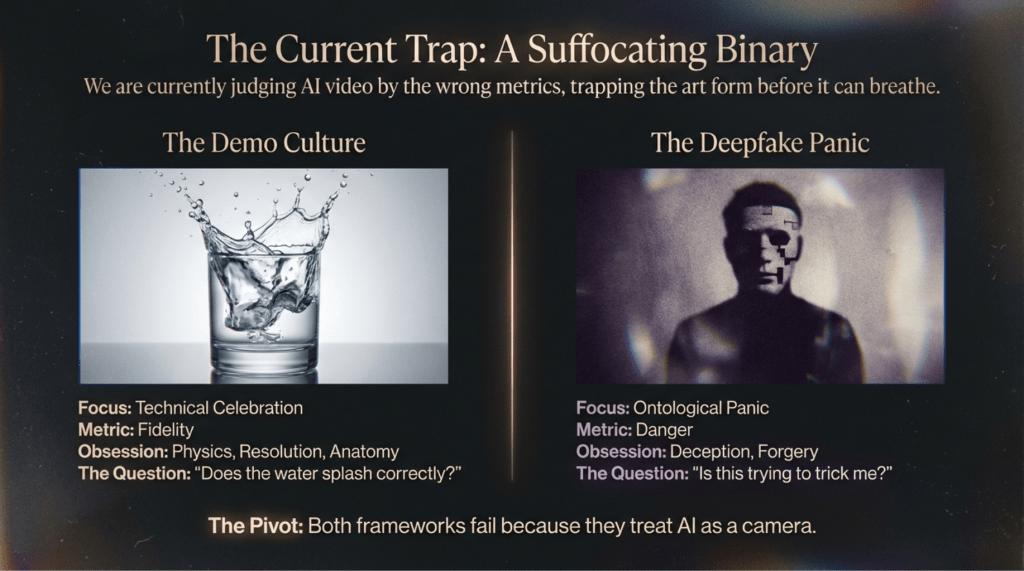
1. Beyond the Current Trap: A Suffocating Binary
The discussion around AI-generated video often falls into two restrictive categories: “Demo Culture” and “Deepfake Panic”. On one side, we celebrate technical fidelity, obsessing over whether a splash of water looks “real”. On the other, we’re gripped by ontological panic, fearing deception and forgery. Both frameworks fail because they treat AI as a camera.
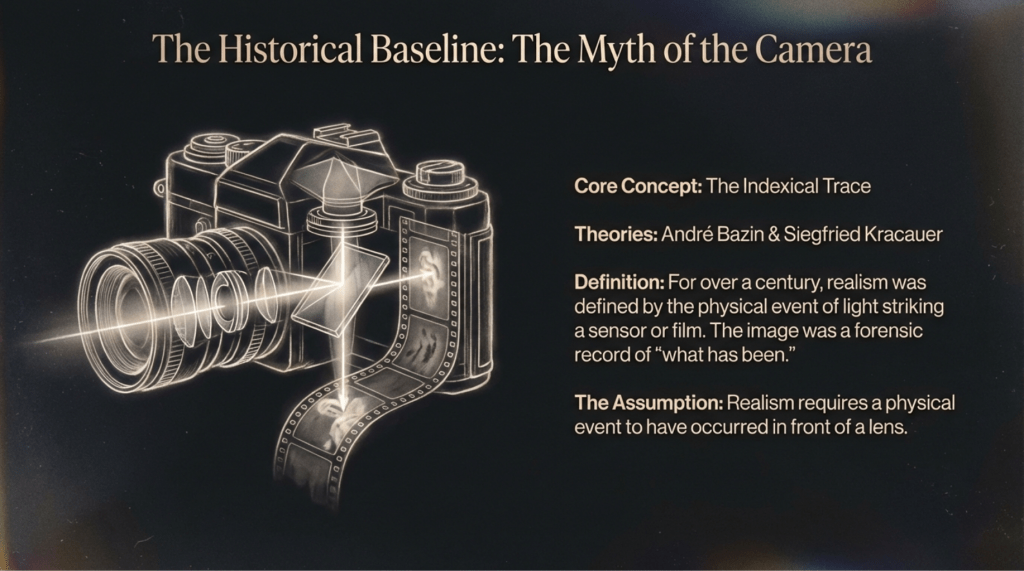
2. The Historical Baseline: The Myth of the Camera
For over a century, our understanding of realism has been anchored to the Indexical Trace—the idea that an image is a forensic record of “what has been” based on light striking a sensor or film. Theories from André Bazin to Siegfried Kracauer cemented the assumption that realism requires a physical event to have occurred in front of a lens.
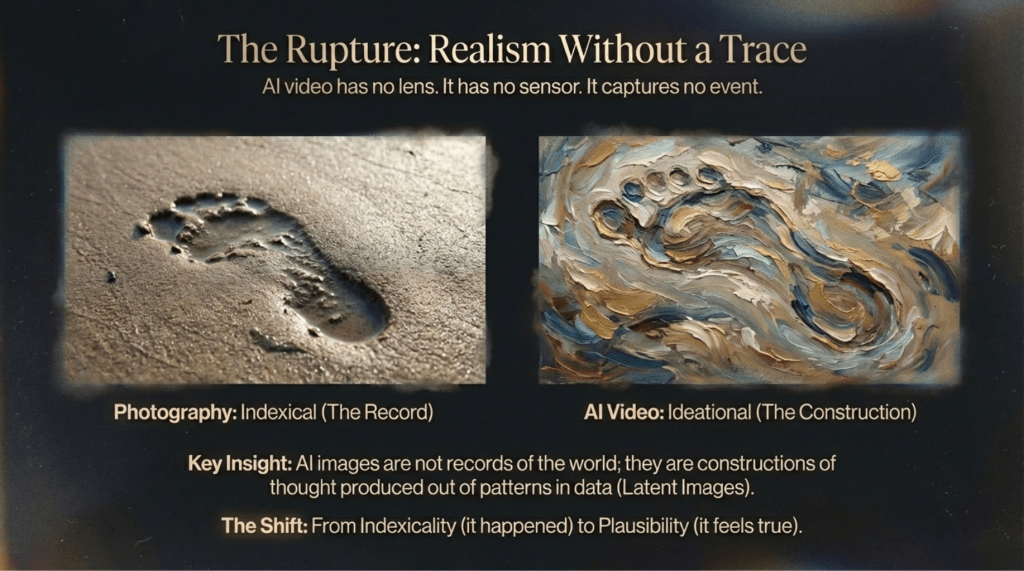
3. The Rupture: Realism Without a Trace
AI video fundamentally ruptures this baseline. It captures no event; it is an ideational construction produced out of patterns in data. The shift is profound: from Indexicality (it happened) to Plausibility (it feels true).
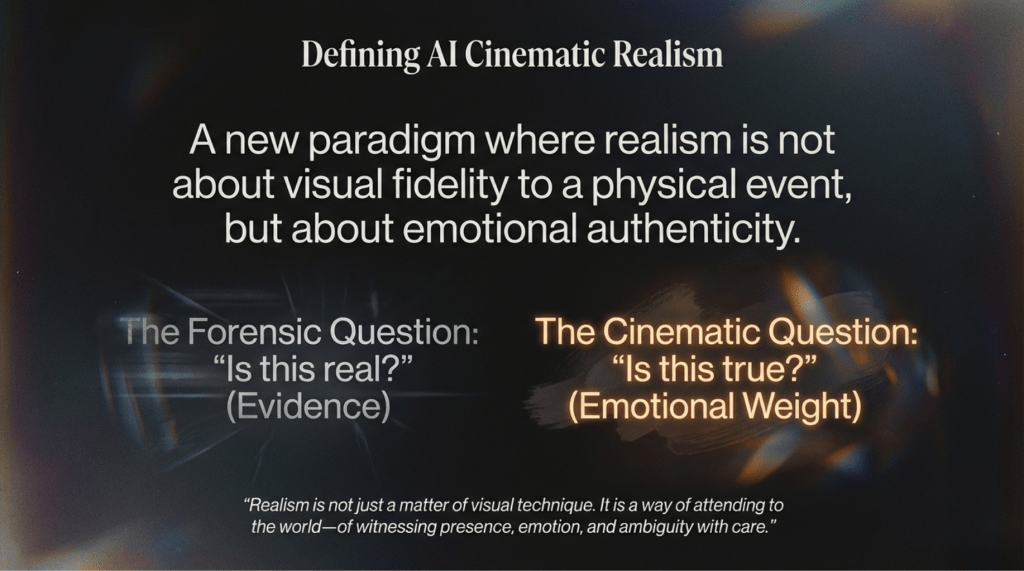
The core question shifts from a forensic “Is this real?” (Evidence) to a cinematic “Is this true?” (Emotional Weight).
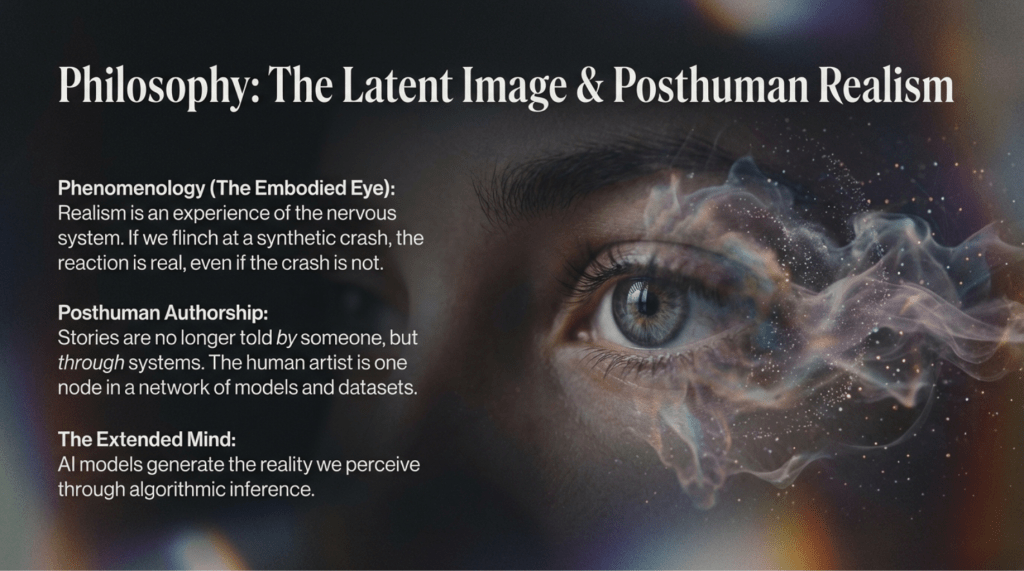
4. Philosophy: The Latent Image & Posthuman Realism
Our engagement with AI extends into the philosophical. The Embodied Eye teaches us that realism is an experience of the nervous system—if we flinch at a synthetic crash, the reaction is real. Furthermore, Posthuman Authorship suggests that stories are no longer told by someone, but through systems, where the human artist is one node in a network of models and datasets.
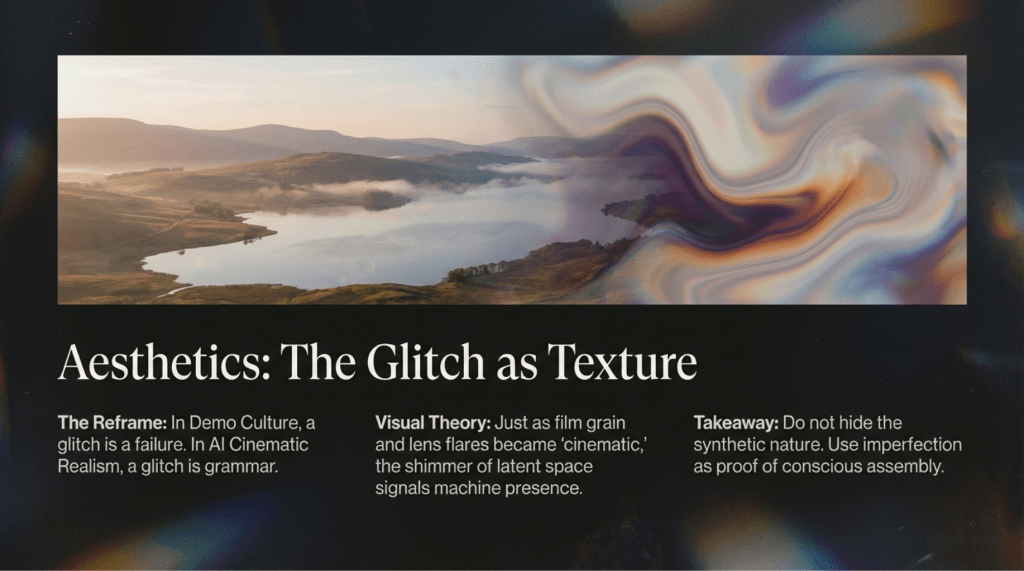
5. Aesthetics: The Glitch as Texture
In AI Cinematic Realism, a “glitch” is not a failure; it is grammar. Just as film grain became “cinematic,” the shimmer of latent space signals machine presence. We should not hide the synthetic nature but use imperfection as proof of conscious assembly.
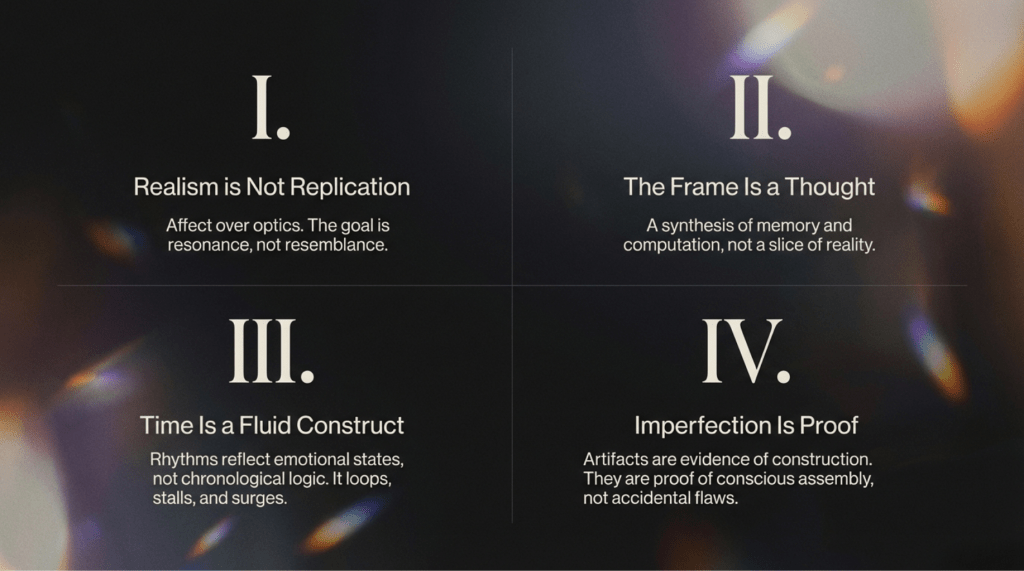
6. The Manifesto: Principles I – IV
My manifesto outlines the core tenets of this shift, focusing on resonance over resemblance. These are the structural foundations of a new creative ethos:
- I. Realism is Not Replication: The goal is resonance, not resemblance.
- II. The Frame Is a Thought: A synthesis of memory and computation, not a slice of reality.
- III. Time Is a Fluid Construct: Rhythms reflect emotional states rather than chronological logic.
- IV. Imperfection Is Proof of Conscious Assembly: Artifacts are evidence of conscious assembly, not accidental flaws.
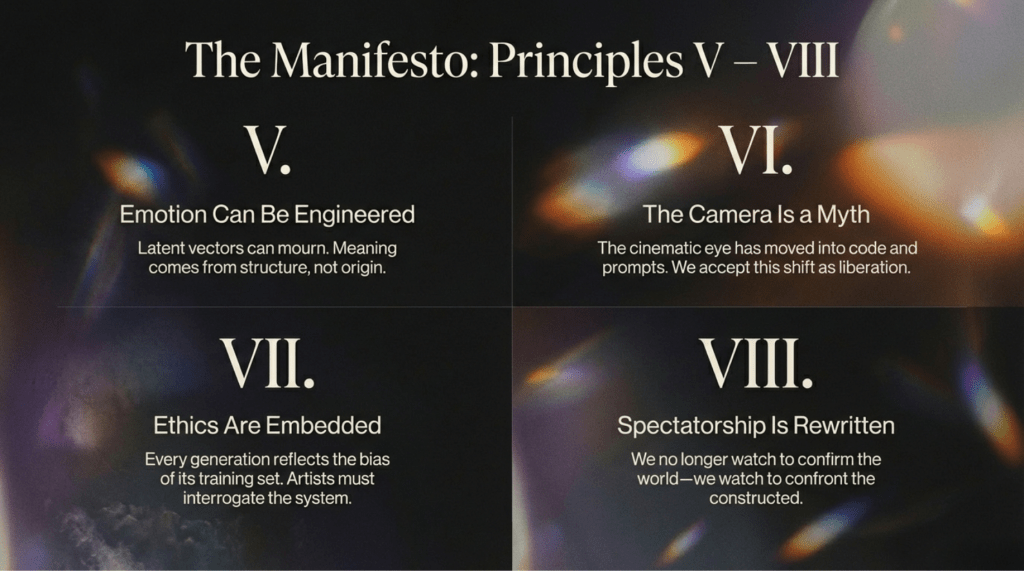
7. The Manifesto: Principles V – VIII
The shift continues with a focus on engineering meaning and accepting the liberation from the lens:
- V. Emotion Can Be Engineered: Meaning comes from structure, not origin.
- VI. The Camera Is a Myth: The cinematic eye has moved into code and prompts.
- VII. Ethics Are Embedded: Every generation reflects the bias of its training set; artists must interrogate the system.
- VIII. Spectatorship Is Rewritten: We watch to confront the constructed, not to confirm the world.
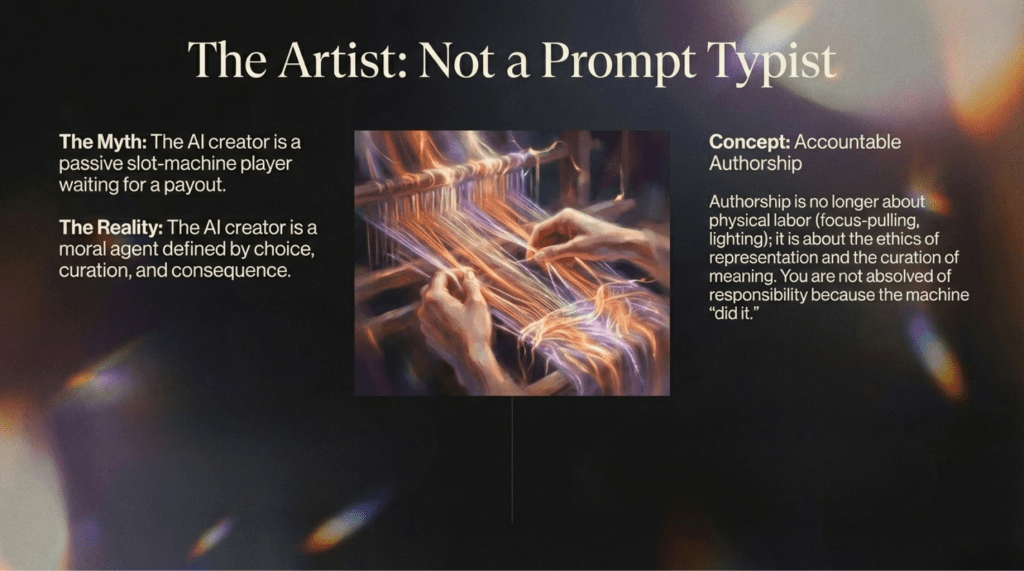
8. Accountable Authorship: The Artist as Moral Agent
The AI creator is not a passive player but a moral agent defined by Accountable Authorship. It is not about physical labor like focus-pulling, but the ethics of representation and the curation of meaning. You are not absolved of responsibility because “the machine did it”.
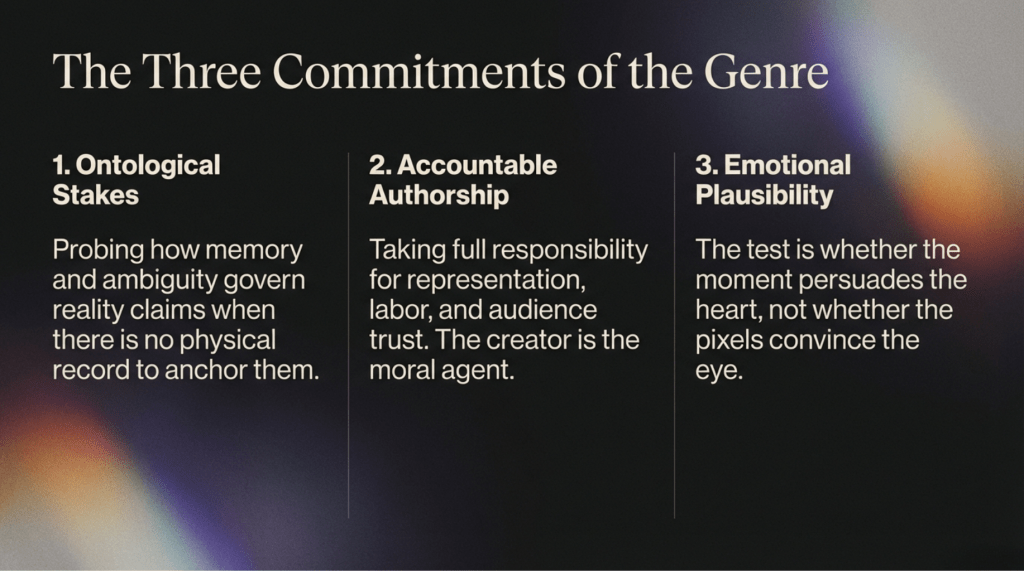
This leads to the Three Commitments of the Genre:
- Ontological Stakes: Probing how memory governs reality claims.
- Accountable Authorship: Taking full responsibility for representation and labor.
- Emotional Plausibility: Persuading the heart, not just the eye.
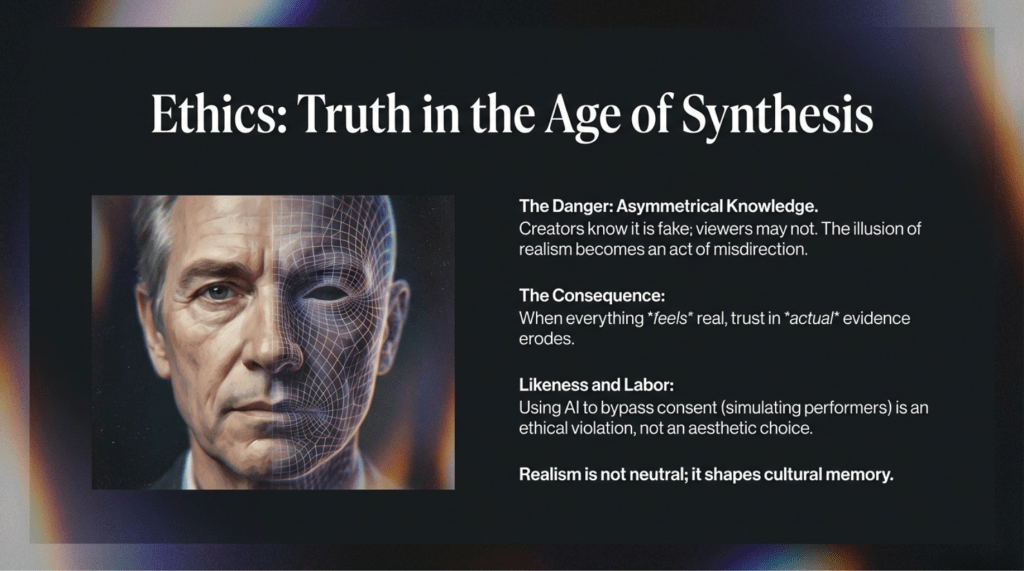
9. Ethics: Truth in the Age of Synthesis
The danger of this era is Asymmetrical Knowledge—creators know it is fake, but viewers may not. Using AI to bypass consent is an ethical violation. Realism is not neutral; it shapes cultural memory.
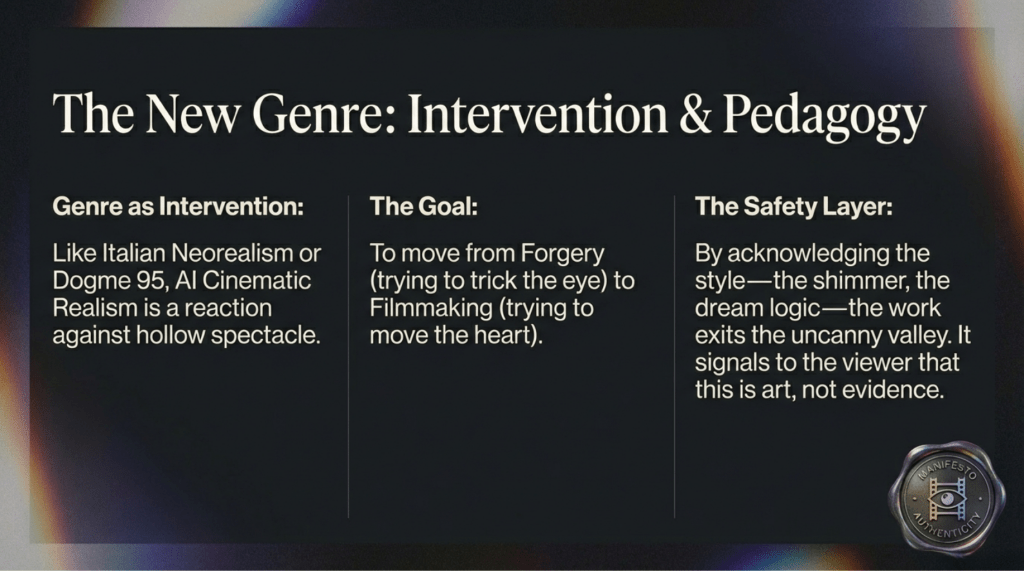
10. The New Genre: Intervention & Pedagogy
Like Italian Neorealism or Dogme 95, AI Cinematic Realism is a reaction against hollow spectacle. The goal is to move from Forgery (tricking the eye) to Filmmaking (moving the heart).
11. The Paradigm Shift: A Summary
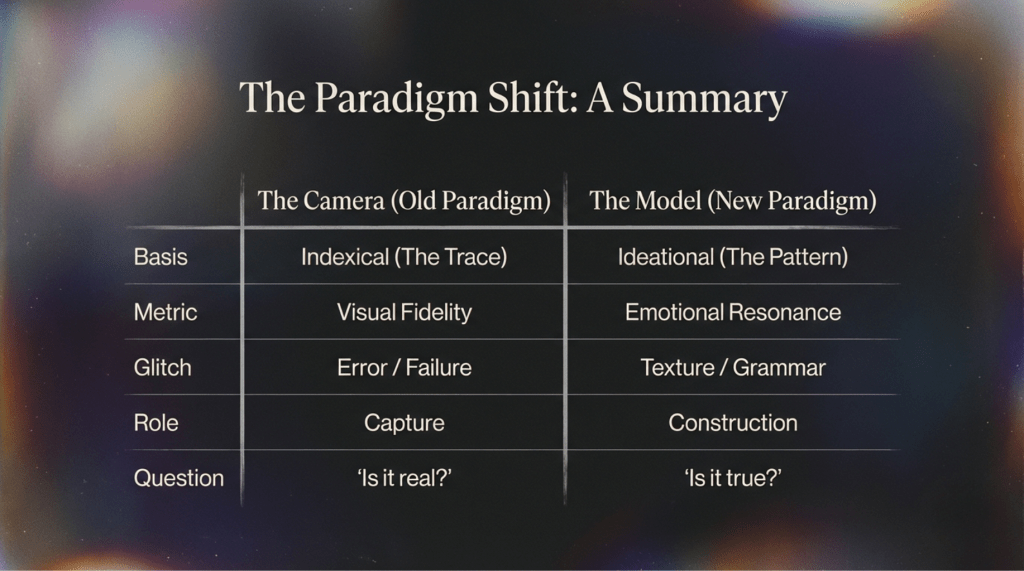
The shift from traditional cinematography to AI Cinematic Realism is best understood as a transition from the camera to the model. While the camera relies on an indexical basis, serving as a forensic trace of physical reality, the model operates on an ideational basis, generating images from learned patterns in data. This fundamental change shifts our primary metric for success from visual fidelity to emotional resonance. Even errors in the image are reframed; what was once considered a technical failure or glitch in the old paradigm is now recognized as texture or grammar within the new. Ultimately, the role of the creator has moved from the act of capture to the act of construction, changing our central inquiry from a forensic “Is it real?” to a cinematic “Is it true?”.
12. Conclusion: The Realism of the Future
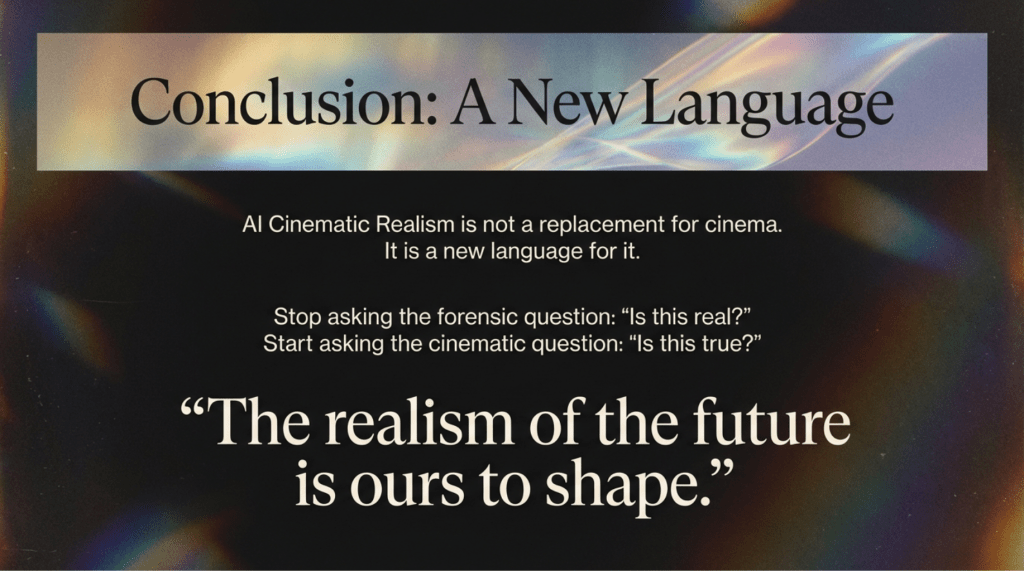
AI Cinematic Realism represents a fundamental shift in our visual culture. Stop asking the forensic question: “Is this real?” and start asking the cinematic question: “Is this true?”. The realism of the future is ours to shape.
Continue the Journey
The concepts explored here are just the beginning. To dive deeper into the aesthetics, ethics, and philosophy of the post-camera image, you can find the full text of AI Cinematic Realism (2026) available in both paperback and Kindle editions on Amazon.
Let’s redefine what it means to witness, create, and believe in the age of synthesis.

 Joni Gutierrez, Ph.D.
Leave a comment