
Articles
-
AI‑generated images feel cinematic not because they imitate cameras, but because they activate the perceptual, environmental, and authorial structures that organize cinematic meaning. The Ideational Frame identifies these inherited logics and reveals how they resolve into the three‑strata model, forming the conceptual foundation of AI Cinematic Realism.
-
The series concludes by examining resonant flow and the psychology of the moving observer. By applying the kinetic logic of Kubrick’s follow shot and the visual rhythm of Sam Mendes, the filmmaker transforms a generated sequence into an immersive, lived experience that prioritizes Cinematic Truth over mere recording.
-
This article examines how the “position” of a non-existent camera defines power dynamics and importance. By applying the logic of low-angle shots from Ishmael Bernal’s Himala and the canted angles of Brian De Palma, the filmmaker transforms synthetic frames into psychological vantages that assign emotional and narrative weight.
-
This article examines how the “lens” in synthetic media functions as a profound choice in psychological and spatial relationship. By applying the historical logic of wide-angle immersion from Roma and the telephoto compression of Saving Private Ryan, the filmmaker manipulates depth to serve the narrative’s emotional core within the latent space.
-
This article explores how classical composition functions as a “construction of thought” within synthetic frames. By applying the geometric precision of Kurosawa and the visual metaphors of Bong Joon Ho, the filmmaker organizes the latent space to guide spectator attention and manifest emotional subtext with the same narrative precision as a captured image.
-
This article explores the transition from directing physical actors to orchestrating a synthetic presence. By applying Bergman’s blocking and the visual rhythm of Sam Mendes, the filmmaker ensures that every gesture in the latent space carries the weight of a lived experience and Accountable Authorship.
-
This article transitions from structural worldbuilding to the expressive surfaces of costume and lighting. It explores “authoring illumination” as a mathematical intent, applying classical principles like low-key lighting and directionality to achieve Emotional Plausibility through synthetic techniques like adaptive textures.
-
This article examines the shift from discovering “found” locations to authoring latent geographies. By tracing environmental control from Titanic’s realism to Caligari’s expressionism, it demonstrates how AI filmmakers can design non-Euclidean spaces where physical laws are dictated by narrative theme rather than physics.
-
This article explores the shift from mechanical “capture” to “statistical synthesis” in AI filmmaking . By applying the classical lineage of mise-en-scène—from theater to masters like Ozu—it establishes a new framework where the ideational frame serves as a deliberate manifestation of thought and Accountable Authorship.
-
Joni Gutierrez, Ph.D., is a scholar-practitioner pioneering the AI Cinematic Realism (2026) framework. By bridging Kracauerian realism with synthetic media, he establishes a rigorous theoretical foundation for ethical authorship and the preservation of cinematic truth, grounded in over a decade of phenomenological research.
-
This article traces a research arc from analogue investigations of the Lebenswelt to the emergence of AI Cinematic Realism. It shows how Kracauerian tropes migrate across media, shifting realism from indexical redemption of physical reality to synthetic emotional plausibility while preserving phenomenology as the core method and evaluative standard.
-

AI‑generated cinema isn’t a degraded imitation of film—it’s a new mode of truth built from emotional plausibility, not photographic capture. This essay uses On This Day… 1776 to explore how synthetic imagery challenges assumptions about realism, showing how plausibility, authorship, and machine texture reshape what feels convincing on screen.
-

Grounded in AI Cinematic Realism, my work redefines cinema in the Age of AI. Through accountable authorship and the AEIOU Ethos, I advance a human-centered approach to generative media—arguing that the future of the moving image rests not on technical fidelity alone, but on truth, equity, and ethical responsibility.
-

Discover the Four Pillars of AI Cinematic Realism, a framework for Conscious Assembly in a post-camera era. By anchoring synthetic time, impossible geometries, and literalized psyches in rigorous structural logic, this framework moves beyond replication to expand the cinematic imagination and define a new standard for synthetic truth.
-
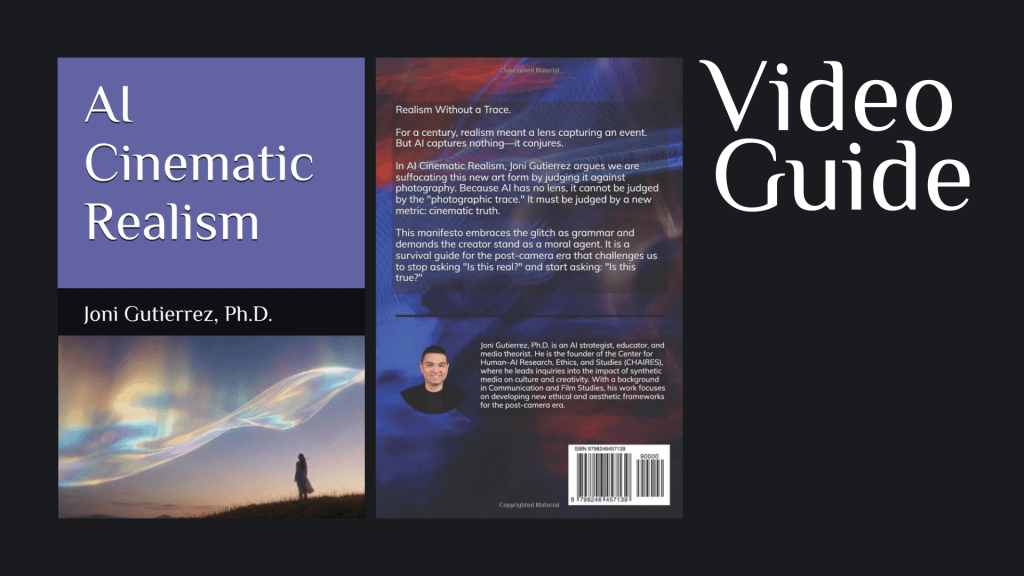
A short video introduction to AI Cinematic Realism, based on concepts from my 2026 book. This guide includes the full transcript and slide visuals, offering an accessible overview of the shift from camera‑based truth to cinematic truth in the age of AI.
-
Explore the new paradigm of AI Cinematic Realism (2026). This teaching guide reframes the generative image as an ideational construction, shifting the cinematic question from a forensic “Is it real?” to an emotionally authentic “Is it true?” for the post-camera era.
-

AI Cinematic Realism marks a shift from capturing reality to composing it. As filmmakers blend synthetic and filmed worlds, new workflows, visual grammars, and creative freedoms emerge. This piece explores how AI is reshaping cinematic practice—from pre‑vis to hybrid authorship—and redefining what realism can mean on screen.
-

A new framework for understanding realism in the age of AI. This article argues that cinematic realism no longer depends on photographic truth but on emotional plausibility—how images feel, cohere, and resonate. It redefines realism through cognition, atmosphere, and human–AI co‑authorship.
-

This essay argues that AI Cinematic Realism introduces a new language for the moving image—one grounded in presence, affect, and authorship rather than photographic proof. It calls for cross-disciplinary collaboration to shape ethical, expressive cinema beyond deception and forensic realism.
-

This essay examines how AI-generated realism reshapes ethics, trust, and responsibility. It explores asymmetrical knowledge, synthetic performers, labor rights, and cultural memory, arguing that in an age where images can feel real without being recorded, realism must be understood as an ethical practice—not just an aesthetic one.
-

This essay argues that AI Cinematic Realism is a genre defined by intention, responsibility, and ethical authorship—not automation. Rejecting the myth of the “prompt typist,” it frames the AI creator as a moral agent accountable for meaning, representation, and emotional plausibility in synthetic cinema.
-

This essay reframes glitches and imperfections in AI-generated media as expressive texture rather than technical failure. It argues that realism in synthetic cinema emerges not from polish or fidelity, but from embracing the shimmer, instability, and dream logic of latent space across platforms and screens.
-

This manifesto outlines eight principles for AI Cinematic Realism, reframing realism as emotional resonance rather than replication. It proposes a new grammar for synthetic cinema—one that embraces generative systems, machine presence, ethical awareness, and redefined spectatorship in an era where images are constructed, not captured.
-

This essay reframes cinematic realism as a phenomenon of perception rather than indexical truth. Drawing on phenomenology and philosophy of mind, it explores how AI-generated images can feel real without referring to the world, and how realism shifts in an era of generative systems and posthuman authorship.
-

This essay traces the historical link between cinematic realism and the photographic trace—from the Lumière brothers to Kracauer and Bazin—then examines how AI-generated images rupture that foundation. It argues that AI cinema replaces indexical truth with plausibility, reshaping how realism and trust are understood.
-

This essay challenges the idea that realism in AI-generated cinema is about visual accuracy or photographic fidelity. It introduces AI Cinematic Realism as a new framework—one rooted in emotional truth, narrative meaning, and the human experience of images created without a camera, lens, or recorded event.
-
We are trapped in a binary debate: is AI video a tech demo or a deepfake? This piece proposes a “Third Space”—AI Cinematic Realism—where glitches become grammar and the goal shifts from fooling the eye to moving the heart.
-
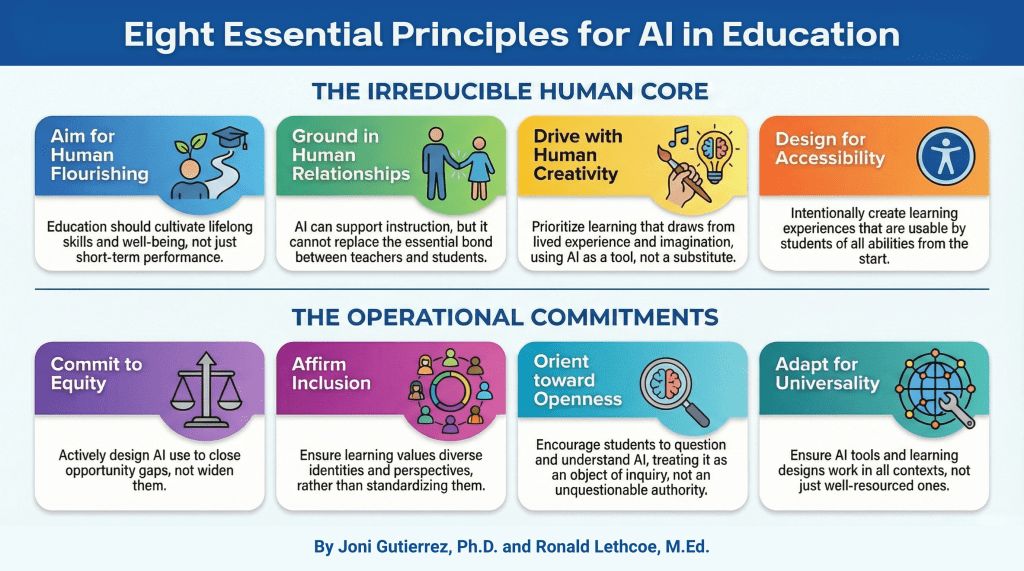
As artificial intelligence becomes embedded in education, the question is no longer whether AI will be present, but how it will shape what we value, design, and prioritize in teaching and learning. This article introduces the Eight Essential Principles for AI in Education, a human-centered framework that clarifies what must remain irreducibly human while translating…
-

I recently revisited my PhD research and used AI to turn one of its most complex ideas—a four-quadrant model of cinematic experience—into a clear, modern infographic. This project became an experiment in collaboration: AI helping make dense theory visual, accessible, and newly meaningful.
-

A single figure stands steady as the room around them shifts—lines, geometry, and light rearranging in continuous motion. A study in presence under changing conditions, created with Google Flow (Veo 3.1).
-

CHAIRES — the Center for Human–AI Research, Ethics, and Studies — explores how intelligence, in both human and artificial forms, reshapes culture, creativity, and responsibility. Through research, creative practice, education, and policy, CHAIRES studies what it means to live, think, and create in the presence of intelligent systems.
-
Developed by Gutierrez & Lethcoe for Washington’s community and technical colleges, AI Essentials in Education (AI-Ed) is a statewide Canvas course that helps faculty and staff use AI tools responsibly through five modules on ethics, collaboration, and human-centered innovation.
-

Artificial intelligence is transforming higher education — but responsible innovation requires more than new tools. The AEIOU Ethos outlines five practical principles for designing and governing AI with accessibility, equity, inclusion, openness, and universality at its core.
-
The CHAIRES Manifesto reimagines human–AI collaboration as a space for creativity, ethics, and shared understanding. It’s about how we choose to learn, create, and evolve together — keeping humanity at the heart of intelligence.
-

In the age of AI, educators are reimagining what it means to create knowledge. As information becomes instantly accessible, our most valuable contributions come from lived experience — original insights that connect learning to life and help solve real-world problems.
-
CHAIRES began not with a grand plan, but with a spark — a question of where people could reflect on AI not just as technology, but as part of the human story. This behind-the-scenes essay shares how a simple idea grew into the Center for Human–AI Research, Ethics, and Studies: a space to ask bold…
-

What makes an AI-generated image feel real? This essay introduces AI Cinematic Realism as a genre of ethical authorship—where realism is judged not by polish, but by emotional plausibility, ontological stakes, and accountable agency. It’s not a style to imitate, but a genre to invent.
-
AI Cinematic Realism explores how artificial intelligence is reshaping the very foundations of cinematic realism. From Kracauer and Bazin’s indexical image to today’s generative platforms like Sora, Runway, Gemini, and MidJourney, this article argues for a new interdisciplinary field bridging film studies, philosophy, ethics, and media practice. It calls for collaboration to understand realism in…
-

This piece is drawn from my responses to a set of questions prepared by the Alumni Relations Team of the University of the Philippines (UP) PUGAD Sayk, a student organization. These responses are drawn from memory, gratitude, and the lessons I continue to carry with me today. Interview Transcript 1. Kindly introduce yourself I’m Joni…
-

Artificial intelligence is reshaping how we work, collaborate, and make decisions. For leaders, this shift isn’t just about mastering new tools — it’s about navigating ethical questions, guiding teams through change, and ensuring that innovation remains anchored in human values. That conviction shaped the design of AI & Leadership: Tools, Ethics, and the Future of…
-

Digital accessibility is not a checkbox—it’s a commitment to making learning spaces usable and welcoming for everyone. At Tacoma Community College (TCC), I created and developed the Introduction to Digital Accessibility (iDA, pronounced “ai-duh”) course to give educators a practical foundation in accessibility standards and tools. More importantly, the course helps participants connect those standards…
-

We often talk about artificial intelligence as if it were an abstract tool or a neutral engine: input, output, done. But when we interact with it daily—sometimes for hours—the relationship becomes less mechanical and more personal. In those moments, the promise and the friction of human–AI collaboration reveal themselves not in grand breakthroughs, but in…
-

Accessibility ensures that everyone — regardless of ability — can fully, equally, and independently access information, interact with content, and use services. In the digital era, it means designing proactively so barriers are removed before they appear, rather than scrambling to fix them later. When something is accessible, it means people with disabilities can access…
-

A Living Record of My Scholarship, Criticism, and Creative Research This page serves as a central record of my published work across film studies, media and cultural studies, and creative research. It includes peer-reviewed journal articles, book chapters, encyclopedia entries, and reviews—covering cinematic realism, Southeast Asian and Philippine cinema, independent filmmaking, migration studies, internet culture,…
-
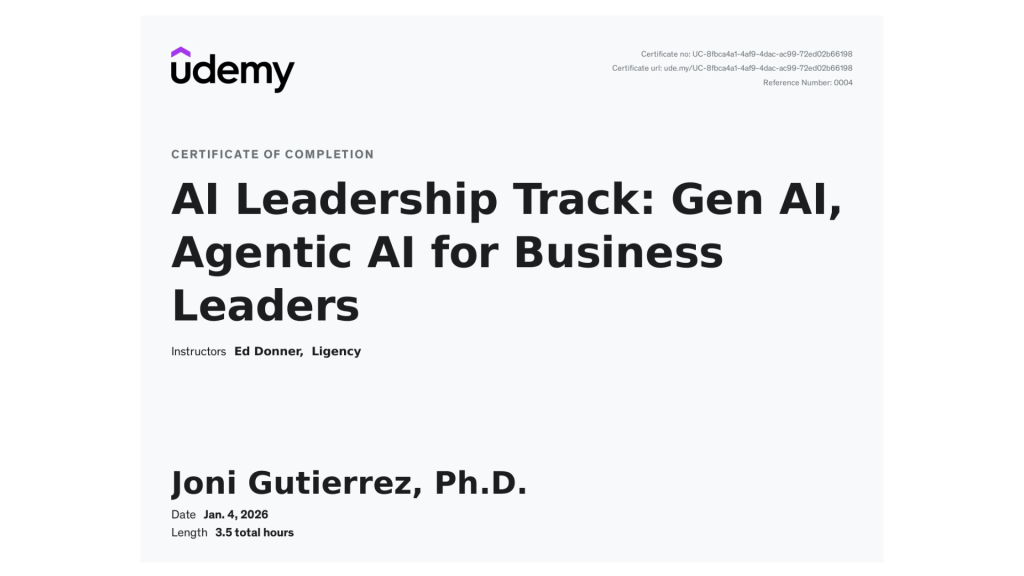
A continuously updated record of my certifications and trainings in AI: AI LEADERSHIP TRACK: GEN AI, AGENTIC AI FOR BUSINESS LEADERS – Udemy – January 2026 DESIGNING AUTONOMOUS AI – University of Washington, via Coursera – September 2025 GEMINI FOR GOOGLE WORKSPACE Career Certificate – Google Cloud, via Coursera – September 2025 AGENTIC AI: A…
-

Your AI gave the commencement speech. What if? AI: Dear Class of 2025 is a 50-second microshort created with Gemini Veo 3. Written and produced by Joni Gutierrez.
-

Prompted is a 32-second microshort created with Gemini Veo 3—subtle, strange, and completely AI-generated. Written and produced by Joni Gutierrez
-
After completing my PhD dissertation, “Investigating Kracauerian Cinematic Realism Through Film Practice and Criticism: Life-World Series (2017) and Selected Films of Lino Brocka,” I knew its length and density made it challenging for most people to engage with. Like many academic projects, it existed as a long, detailed document in a repository. Recently, I decided to…
-
For my final project in the Canvas Certified Educator (CCE) program, I wanted to bring together two worlds I know well: the close reading of cinema and the thoughtful integration of AI in learning design. The result is a Canvas module for film studies students that teaches scene analysis with AI support—balancing technological assistance with…
-
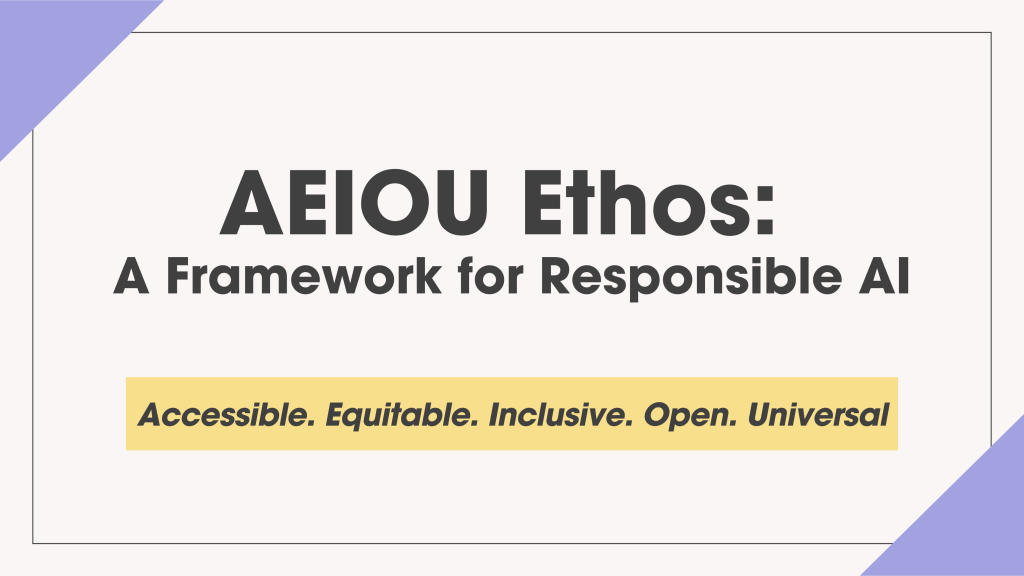
Welcome to AEIOU Ethos: A Framework for Responsible AI. This is a human-centered approach to designing and deploying ethical, inclusive, and impactful artificial intelligence. Why Responsible AI? Artificial intelligence is transforming every part of our lives—how we work, learn, communicate, and make decisions. But without careful guidance, AI risks deepening inequalities, reinforcing bias, and excluding…
 Joni Gutierrez, Ph.D.