
Slide Deck
AI Cinematic Realism names a new framework for thinking about the moving image in the post-camera era. The central argument is simple but far-reaching: once images are no longer captured through a lens, realism can no longer be judged only by photographic standards. We need a different language—one that takes seriously emotional truth, cinematic presence, and the synthetic image as a legitimate site of meaning.
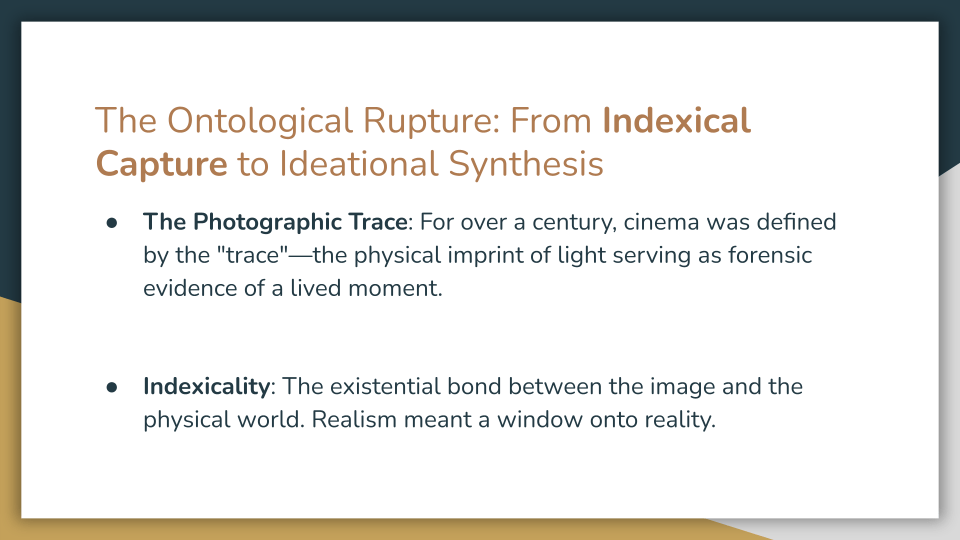
For over a century, cinema drew its realism from what film theory called the photographic trace. Light touched film or a sensor, and the image carried an indexical bond to the world. That is what made cinema feel like evidence. In traditional realism, the image was understood as a window onto reality because something had physically stood before the lens.
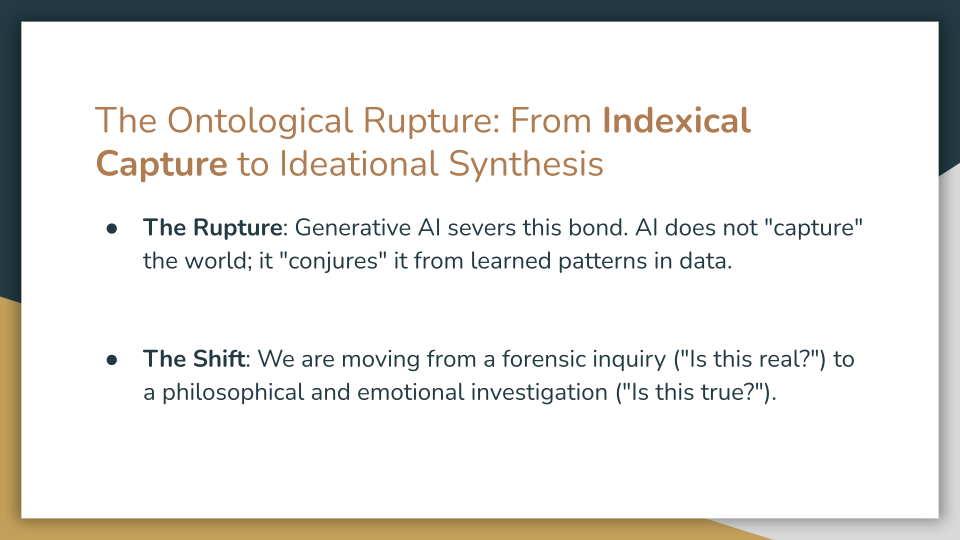
Generative AI breaks that bond. It does not capture the world; it conjures images from learned patterns in data. That is the rupture. From that rupture comes a shift in how we ask questions about images. Instead of asking the forensic question, “Is this real?”, we move toward the cinematic and philosophical question, “Is this true?” The issue is no longer whether the image is indexically anchored, but whether it carries emotional, narrative, or experiential truth.
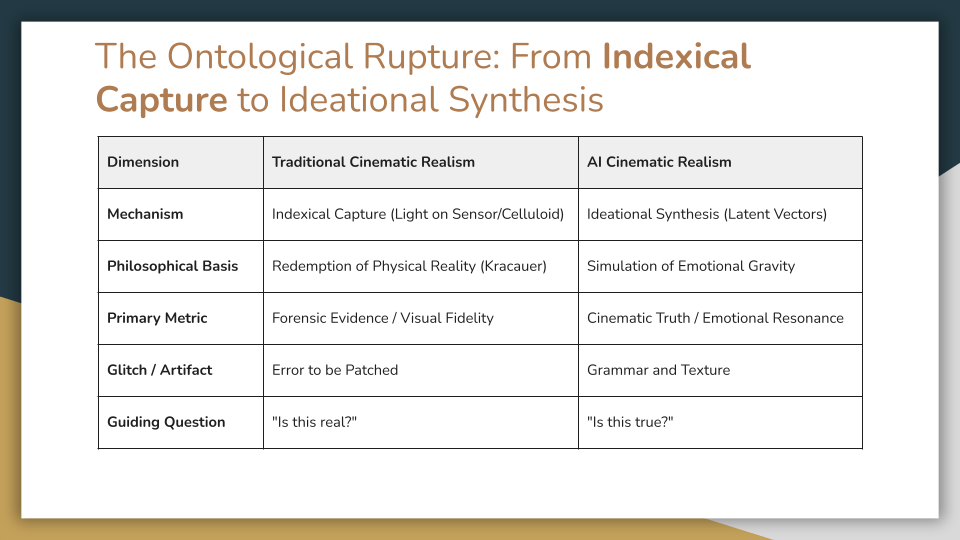
The contrast becomes very clear when traditional cinematic realism is placed beside AI Cinematic Realism. The mechanism shifts from indexical capture to ideational synthesis. The philosophical basis moves from Kracauer’s redemption of physical reality to the simulation of emotional gravity. The primary metric changes from forensic evidence and visual fidelity to cinematic truth and emotional resonance. Even the glitch changes meaning: in one framework it is an error to be patched, while in the other it becomes grammar and texture. That is why the guiding question changes from “Is this real?” to “Is this true?”
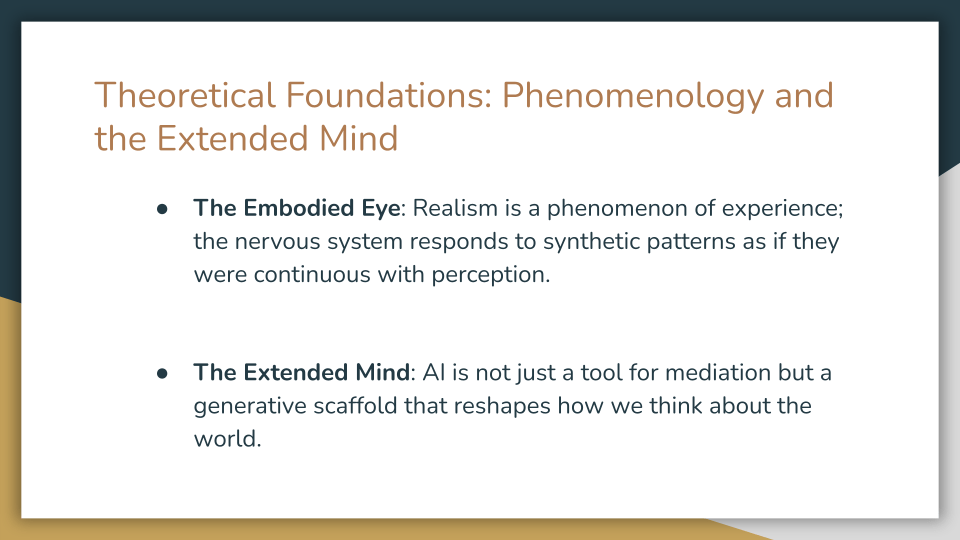
If AI cinema no longer rests on indexical capture, then realism has to be rethought through experience. Phenomenology helps us see that realism is not just a property of the image but a phenomenon of perception. We respond to synthetic images with our nervous systems, our memory, and our affect. The idea of the extended mind pushes this further. AI is not merely a tool that helps us represent reality; it becomes a scaffold that reshapes how reality is imagined, organized, and felt.
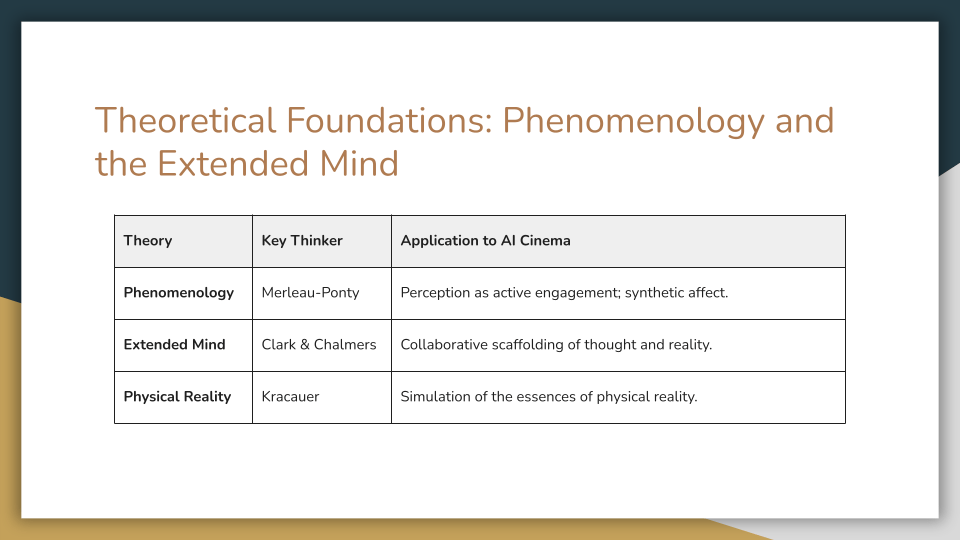
The philosophical lineage becomes more precise here. Merleau-Ponty helps us understand perception as active engagement, which matters because synthetic affect can still be experienced as real. Clark and Chalmers help explain how thought extends into tools and systems, including generative systems that co-produce images and ideas. Kracauer remains important because he names the older dream of physical reality, even as AI forces us to ask what happens when that reality is simulated rather than recorded. Together, these thinkers show that AI cinema is not the failure of realism, but its transformation.
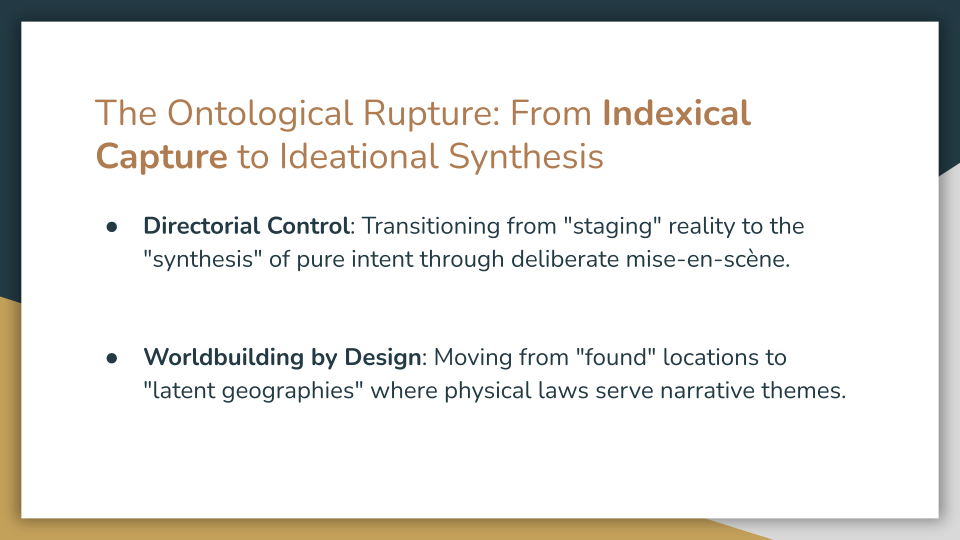
The ontological shift introduced by AI is not only philosophical; it also reshapes craft. Directorial control no longer means staging a preexisting reality before a camera. It becomes the synthesis of intent through deliberate mise-en-scène inside a generative system. In the same way, worldbuilding is no longer limited to found locations in the physical world. It moves into latent geographies, where space itself can be designed so that physical laws, textures, and environments serve narrative themes. What changes here is not the disappearance of cinematic authorship, but its migration into ideational construction.
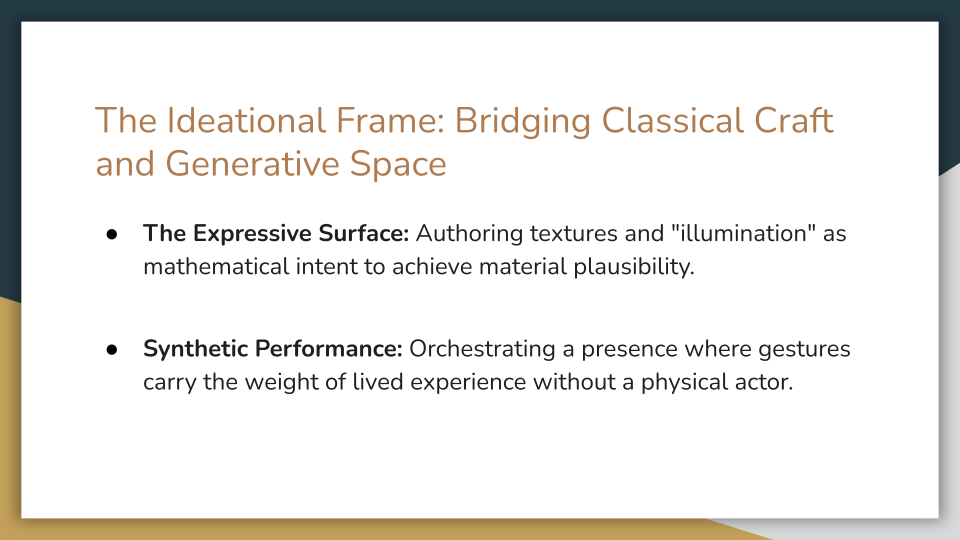
Classical film craft remains deeply relevant, but it is reconfigured through generative practice. Expressive surface becomes material plausibility—textures, grime, glow, and atmosphere. Performance shifts from directing actors to orchestrating presence. The point is not that AI abandons cinema’s past, but that it inherits and translates it into a new generative grammar.
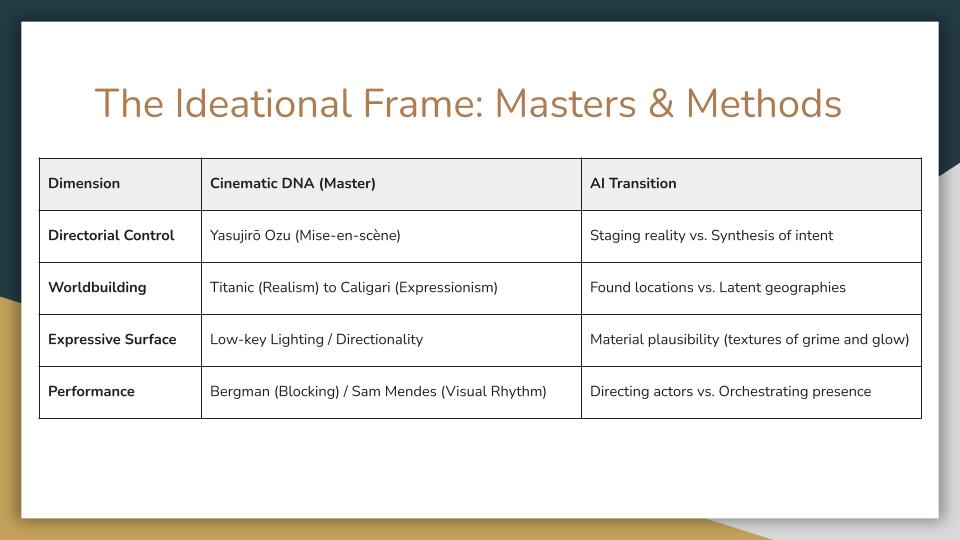
The bridge between classical craft and generative space becomes especially clear in expressive surface and synthetic performance. In AI cinema, textures and illumination are not simply recorded; they are authored as mathematical intent. Surface becomes part of the emotional architecture of the scene. Performance no longer depends entirely on a physical actor before a lens. Presence can be orchestrated through gesture, rhythm, and visual suggestion. What matters is not biological origin but whether the scene carries the weight of lived experience.
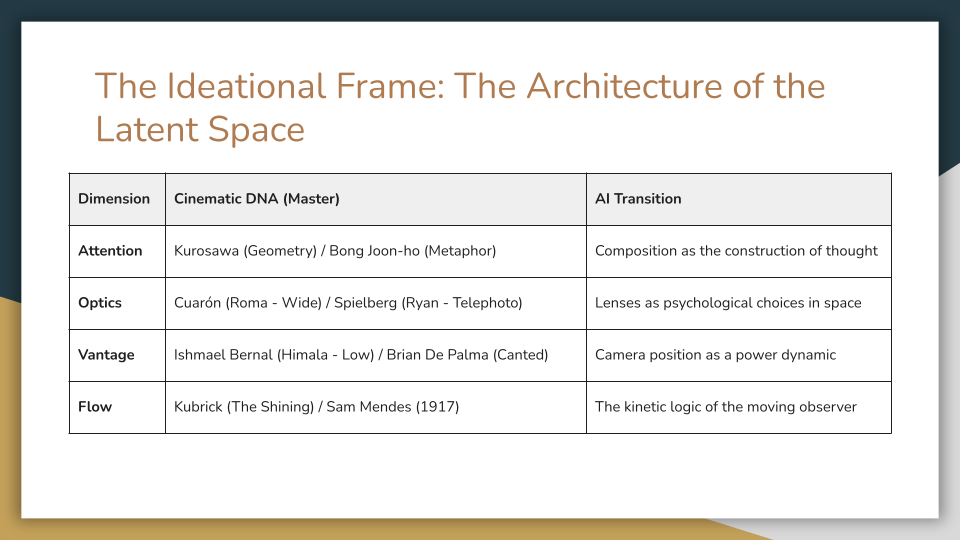
Once AI cinema is understood as ideational rather than indexical, the frame itself has to be redefined. Composition becomes the construction of thought. Attention is no longer just where the camera looks, but how the image organizes meaning. Optics become psychological choices in space rather than literal lens mechanics. Vantage becomes a power relation, and flow becomes the kinetic logic of a moving observer. Cinematic language survives, but it is rebuilt inside latent space.
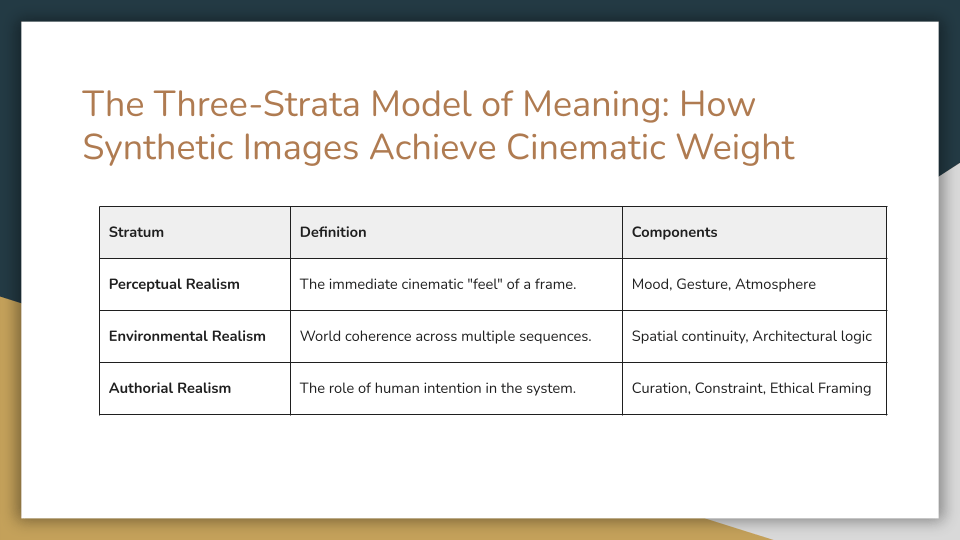
Meaning in AI Cinematic Realism accumulates across several levels. Perceptual realism is the immediate cinematic feel of a frame—its mood, gesture, and atmosphere. Environmental realism extends that effect across sequences through world coherence and spatial continuity. Authorial realism introduces the human layer: curation, constraint, and ethical framing. AI Cinematic Realism is not just about how an image looks, or even how a world hangs together. It is also about the shaping intelligence behind the work and the responsibility that comes with that shaping.
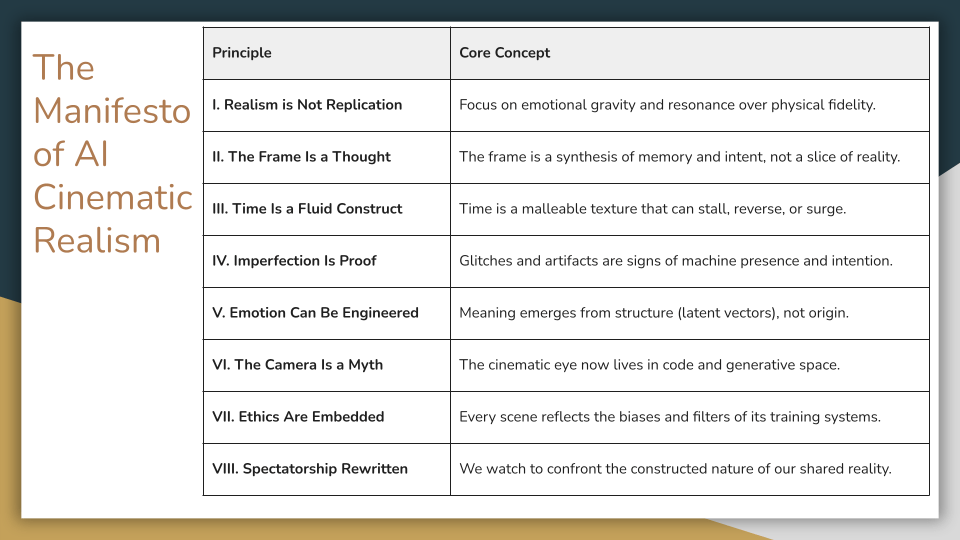
The manifesto condenses the field into eight principles. Realism is not replication. The frame is a thought, not a capture. Time is fluid. Imperfection is proof. Emotion can be engineered. The camera is a myth. Ethics are embedded. Spectatorship is rewritten. Taken together, these principles reject the idea that AI cinema should be judged by how perfectly it imitates photography. Instead, they define a medium that works through affect, construction, and conscious assembly.
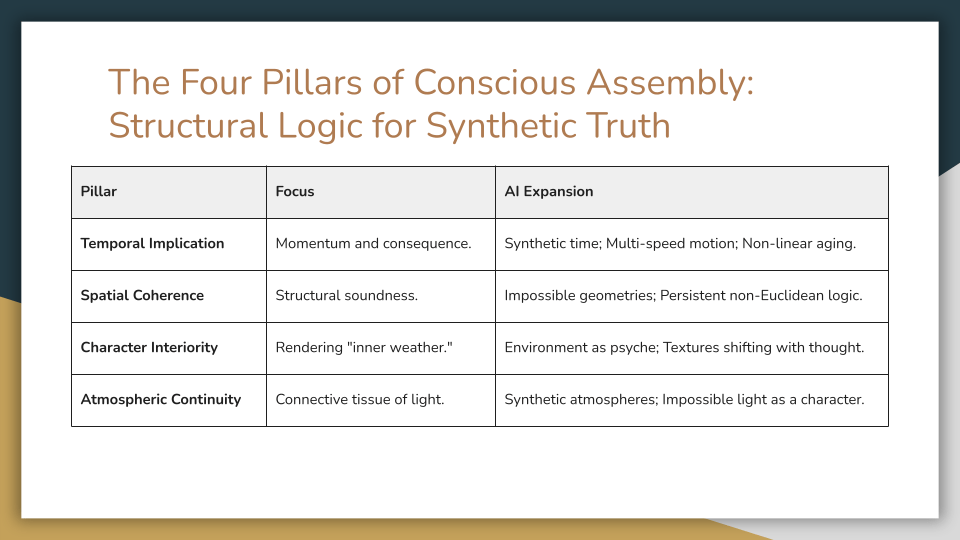
If AI Cinematic Realism is to do more than imitate the look of cinema, it needs structure. These four pillars provide that structure. Temporal implication gives synthetic time momentum and consequence. Spatial coherence gives the world internal logic, even when it bends physical laws. Character interiority allows environment and texture to register inner weather. Atmospheric continuity binds a sequence together through light, tone, and sensory connective tissue. Together, these pillars move the work away from polished demo aesthetics and toward synthetic truth with cinematic weight.
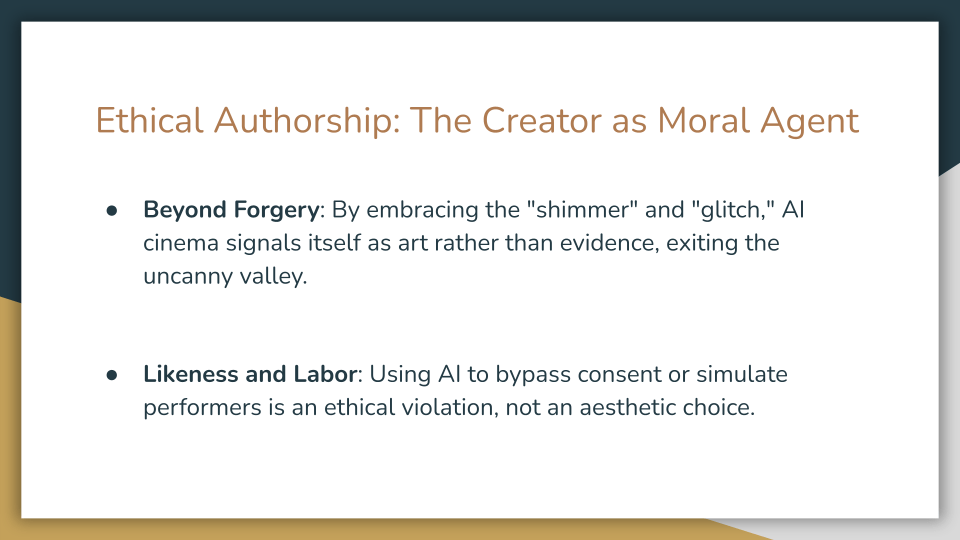
The argument becomes explicitly ethical here. Beyond forgery means AI cinema should not aspire to pass itself off as neutral evidence. Its shimmer and glitch can mark it as art rather than deception. Likeness and labor reminds us that synthetic media is never ethically neutral when it touches human performance, identity, or consent. Using AI to bypass performers or simulate people without permission is not an aesthetic move. It is an ethical violation. The creator remains responsible.
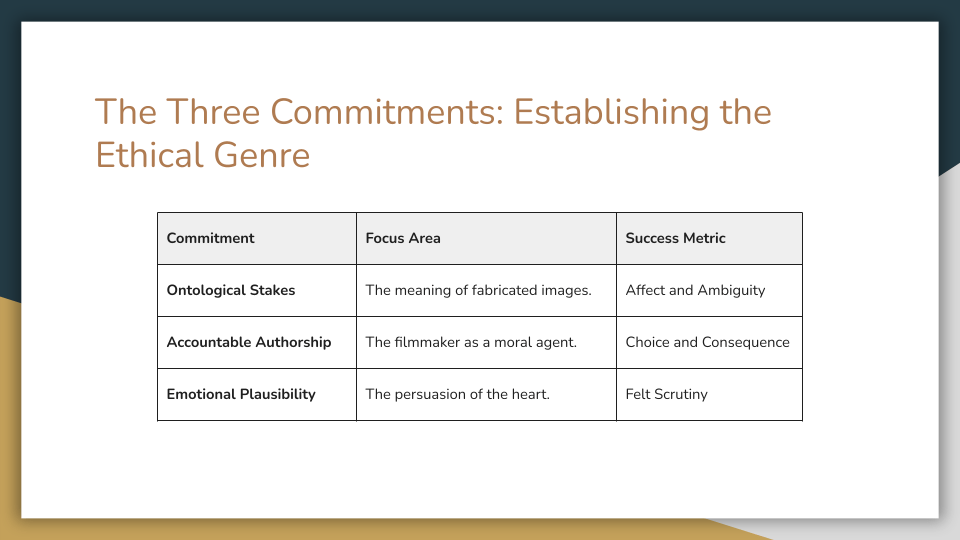
Three commitments define AI Cinematic Realism as an ethical genre. Ontological stakes asks what fabricated images must mean, and for whom. Accountable authorship insists that the maker is a moral agent whose choices have consequences. Emotional plausibility asks whether a scene holds under felt scrutiny—whether it persuades at the level of experience rather than merely impressing at the level of pixels. The success metrics here are not technical benchmarks. They are affect, consequence, and scrutiny.
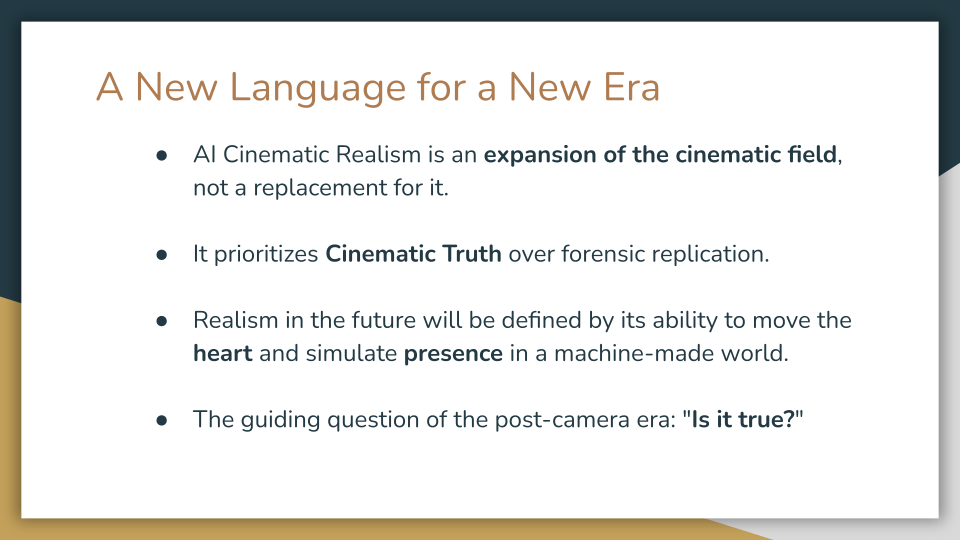
The conclusion is straightforward. AI Cinematic Realism expands the cinematic field; it does not replace it. It prioritizes cinematic truth over forensic replication. It proposes that realism in the future will be judged by its ability to move the heart and simulate presence in a machine-made world. That is why the guiding question of the post-camera era is not “Is it real?” but “Is it true?” This is not a retreat from cinema. It is a new language for cinema.


Leave a Reply