
I started a course on AI Strategy and Governance, and the opening rhythm was familiar enough: a video introduction and an overview of what the course would cover.
Then, right after that, something unexpected happened: I was invited into a dialogue with Coursera’s AI Coach.
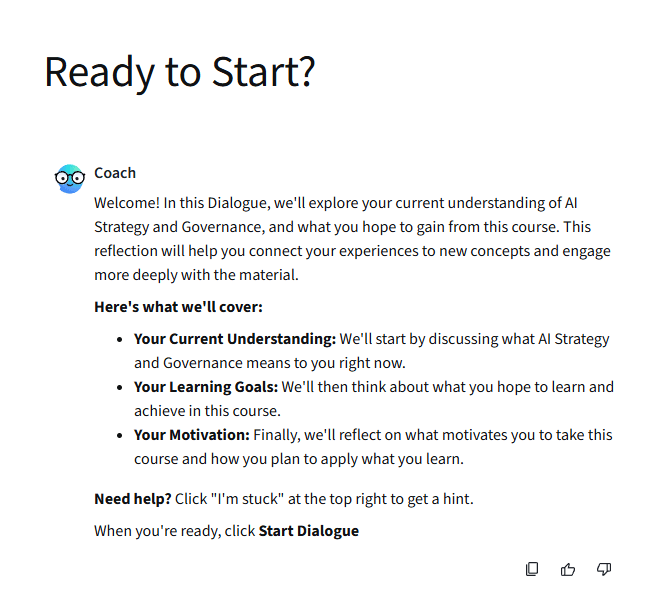
That caught my attention. Not because the interaction was flashy, but because it quietly signaled something important. Before the course asked me to absorb more content, it asked me to respond. Before it gave me a framework, it asked me to name my own. Before teaching me more about AI strategy and governance, it invited me to locate myself inside the subject.
That feels like a small but meaningful glimpse of teaching and learning in the age of AI.
The dialogue began with a simple question: What does “AI Strategy and Governance” mean to you in your own words? I described AI strategy as the intentional development and use of AI in an institution or organization, and governance as the formalization of that strategy through standards, guardrails, and policy. From there, Coach asked what I saw as one of the biggest challenges organizations might face when implementing a strong AI strategy and governance framework. My answer went to the human side: people who fear that their jobs will be “stolen from them” by AI.
That exchange was brief, but it mattered.
The course could have begun by giving me definitions. It could have started with readings, frameworks, expert commentary, and a quiz to check whether I remembered the right terms. Those things still have a place. But this opening did something different. It treated the learner not as an empty container waiting to be filled, but as someone already carrying assumptions, concerns, experiences, goals, and motivations.
That is good pedagogy.
One of the most promising uses of AI in education is not that it can deliver more information. We already have more information than we know what to do with. The promise is that AI, when designed well, can create more moments of active reflection. It can ask learners to pause, articulate what they think, and connect new material to what they already know.
In this case, Coach was not functioning as a replacement teacher or as a shortcut to an answer. It was acting more like a reflective partner. It asked me to define, clarify, connect, and explain. The conversation moved from my understanding of AI strategy and governance to my learning goals, then to my motivation for pursuing the field. By the end, the dialogue had touched on principles, laws, models of practice, ethical judgment, critical thinking, and human flourishing.
That is a lot of intellectual territory for a short interaction at the beginning of a course.
What interested me most was not the novelty of chatting with an AI tool. The novelty is already fading. We are quickly moving past the stage where the mere presence of AI feels surprising. What matters now is the design of the interaction.
Does AI make learning more passive or more active?
Does it simply move students through content, or does it help them become more aware of their own thinking?
Does it create the illusion of personalization, or does it actually invite the learner into a more meaningful relationship with the material?
Those are the questions worth asking.
In my exchange, Coach responded positively because I gave it fairly developed answers. That matters. A different learner might have needed more clarification, more scaffolding, or more encouragement. The point is not that every AI dialogue will automatically be profound. The point is that this kind of design creates an opening. It gives the learner a chance to speak before being spoken to.
That changes the posture of learning.
Instead of beginning with delivery, the course began with dialogue. Instead of starting with “Here is what you need to know,” it started with something closer to “What do you already understand, and why does this matter to you?”
That is a very different invitation.
We often talk about AI in education through narrow questions: Will students use it to cheat? Will teachers use it to grade faster? Will institutions use it to cut costs? Those questions are real, and we should not ignore them. But they do not capture the full picture.
The deeper question is how AI might change the experience of learning itself.
Learning is not just the transfer of information. It is the shaping of attention. It is the development of judgment. It is the slow process of becoming able to ask better questions. If AI is going to have a meaningful role in education, it should support those human capacities, not replace them.
That is why this small Coursera moment stayed with me.
I came to the course to learn about AI strategy and governance. Almost immediately, I was invited to practice something just as important: thinking with AI.
That may be one of the essential learning skills of our time. Not just how to prompt. Not just how to use a tool. Not just how to get an answer faster. But how to stay intellectually present in a world where machines can talk back.
The future of teaching and learning will not be defined by whether AI is present in the course. It will be defined by what kind of presence AI has.
Is it there to accelerate completion?
Is it there to automate feedback?
Is it there to simulate interaction?
Or is it there to help learners pause, think, connect, and grow?
When learning begins with dialogue, AI becomes more than a feature. It becomes part of the learning environment itself. That makes the design of these conversations a serious educational question.
Because in the age of AI, the most important thing may not be that machines can answer us.
It may be that they can help us hear ourselves think.


Leave a comment