
Introduction: The New Realism Crisis
Cinema has always been a negotiation between what is real and what feels real. From Méliès’ illusions to the digital excesses of the early 2000s, filmmakers have pushed the boundary between the camera’s indexical truth and the imagination’s synthetic possibilities. But with the rise of generative AI, that negotiation has entered a new phase—one where images no longer require cameras, sets, actors, or even physical light.
The result is a strange paradox: AI images often look more “cinematic” than cinema itself, yet they frequently lack the deeper structures that make cinematic worlds believable. They shimmer. They drift. They forget. They hallucinate. They feel like dreams that haven’t fully decided what they’re dreaming.
This is the realism crisis of our time. And AI Cinematic Realism (AICR) is the field emerging to address it.
1. The Birth of a Field
AI Cinematic Realism is not about photorealism. It is about felt reality—the sense that an image or sequence belongs to a coherent world with physics, history, intention, and meaning.
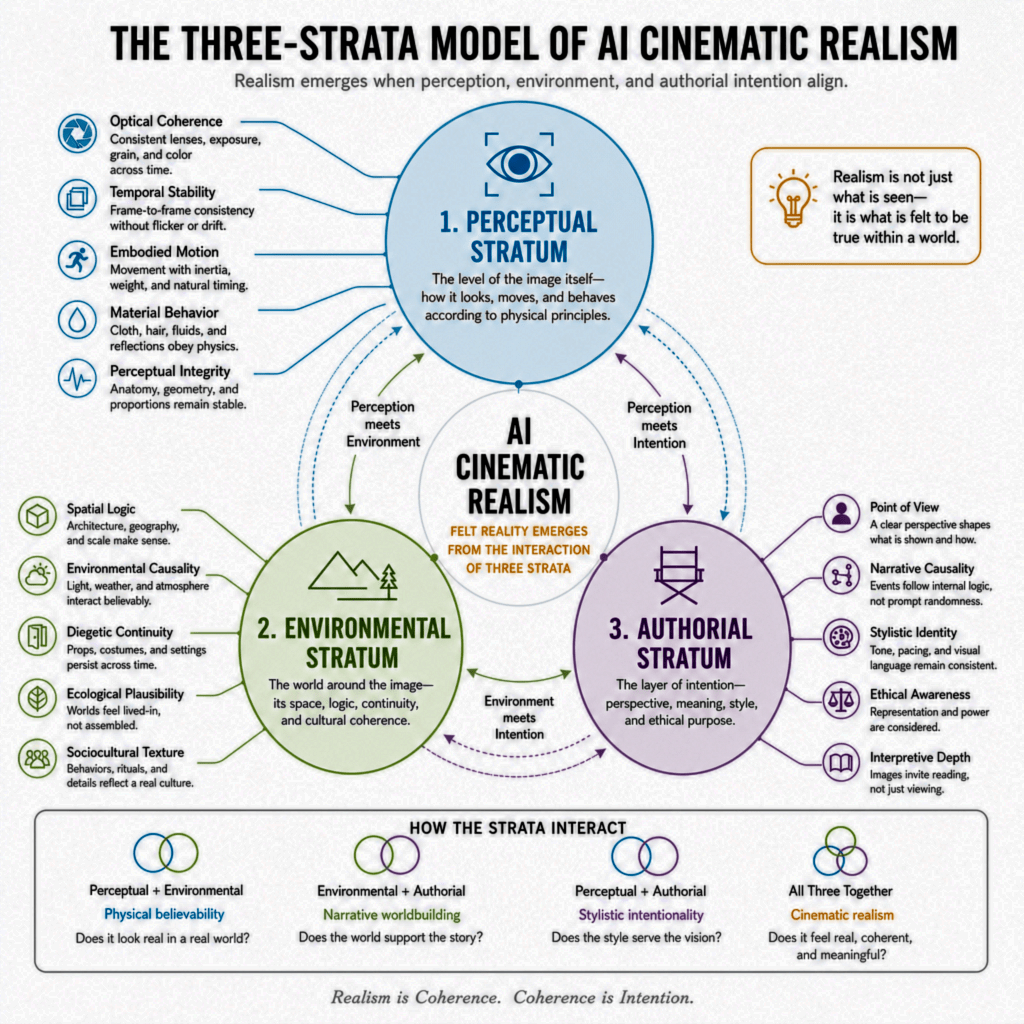
The field proposes that realism in AI-generated cinema emerges from the interaction of three strata:
- Perceptual Stratum — how the image behaves visually and physically
- Environmental Stratum — how the world around the image coheres
- Authorial Stratum — how intention, perspective, and meaning are expressed
These strata form the backbone of a new cinematic literacy—one that creators, educators, and researchers can use to evaluate and improve AI-generated moving images.
2. The Perceptual Stratum: When the Eye Knows Something’s Off
The perceptual stratum is the most immediate. It’s the level at which viewers notice flicker, identity drift, melting geometry, or the infamous “AI shimmer.” It’s where the physics of motion, the consistency of lenses, and the stability of anatomy either hold together—or fall apart.
Key Components
- Optical Coherence. AI images often simulate lenses without understanding them. True coherence requires consistent depth of field, exposure, grain, and chromatic aberration across time.
- Temporal Stability. Frame-to-frame consistency is the Achilles’ heel of generative video. Without it, characters morph, shadows flicker, and objects breathe unnaturally.
- Embodied Motion. Human movement is governed by inertia, micro-adjustments, and weight distribution. AI frequently approximates motion without embodying it.
- Material Behavior. Cloth, hair, fluids, and reflections must obey physics. When they don’t, the illusion collapses instantly.
Why It Matters
The perceptual stratum is where realism begins. If the eye rejects the image, the mind never gets a chance to believe the world.
3. The Environmental Stratum: Worlds That Hold Together
Even when AI gets the perceptual layer right, the environment often betrays the illusion. Rooms change size. Props teleport. Lighting contradicts itself. Cultures appear without internal logic.
The environmental stratum asks a simple question: Could this world exist independently of the prompt?
Key Components
- Spatial Logic. Architecture, geography, and object placement must remain consistent across shots.
- Environmental Causality. Weather, light, and atmosphere must interact with characters and objects.
- Diegetic Continuity. Costumes, props, and settings must persist across time.
- Ecological Plausibility. Worlds must feel lived-in, not assembled from fragments.
- Sociocultural Texture. Rituals, behaviors, and environmental storytelling must make sense.
Why It Matters
A world without internal logic cannot support narrative meaning. Environmental realism is the difference between a generated backdrop and a believable cinematic universe.
4. The Authorial Stratum: Intention in a Post-Photographic Age
The authorial stratum is the most elusive—and the most important. It concerns the presence of intention: point of view, narrative causality, stylistic identity, ethical positioning, and interpretive depth.
AI can generate images, but it cannot yet generate aboutness without guidance. This is where the human creator becomes indispensable.
Key Components
- Point of View. A coherent perspective that shapes what is shown and how.
- Narrative Causality. Events that follow internal logic, not prompt randomness.
- Stylistic Identity. Tone, pacing, and visual language that remain consistent.
- Ethical Awareness. Representation, power, and cultural stakes must be considered.
- Interpretive Depth. Images should invite reading, not just viewing.
Why It Matters
Without authorial intention, AI cinema becomes a collage of styles—technically impressive but emotionally hollow.
5. How the Strata Interact
Realism emerges not from any single stratum but from their interplay.
- Perceptual + Environmental → Physical believability
- Environmental + Authorial → Narrative worldbuilding
- Perceptual + Authorial → Stylistic intentionality
- All Three Together → Cinematic realism
A perfectly photoreal image can still be non-realistic if it lacks environmental logic or authorial intention. Conversely, a stylized or abstract image can feel deeply real if all three strata align.
6. The Field Guide Framework & Evaluation Rubric
To evaluate AI-generated cinema, the field guide proposes a three-part checklist.
Perceptual
- Stable anatomy
- Consistent optics
- Coherent motion
- Material realism
- Temporal continuity
Environmental
- Spatial coherence
- Environmental causality
- Diegetic continuity
- Cultural plausibility
- World history
Authorial
- Point of view
- Narrative logic
- Stylistic coherence
- Ethical awareness
- Interpretive depth
This framework can be used to critique outputs, guide prompt engineering, or structure classroom discussions.
To operationalize AICR in analysis and production, the following rubric offers a practical way to evaluate AI video scenes across the three strata. It can be used for critique, prompt iteration, or classroom discussion.
Rate each category from 1 to 5:
- 1 = weak or broken.
- 3 = workable but uneven.
- 5 = strong and convincing.
| Category | What to look for | Score |
|---|---|---|
| Perceptual realism | Texture, light, motion, anatomy, and material logic at the level of the frame. | 1–5 |
| Environmental realism | Spatial coherence, continuity, atmosphere, and world logic across the scene. | 1–5 |
| Authorial realism | Point of view, emotional intention, narrative implication, and thematic clarity. | 1–5 |
| Cinematic continuity | Whether shots feel like they belong to the same world, style, and temporal flow. | 1–5 |
| Ethical legibility | Whether the scene’s authorship, representation, and synthetic status feel responsibly handled. | 1–5 |
Scoring guide
- 20–25: Strong scene.
- 15–19: Promising, but needs refinement.
- 10–14: Visually interesting, but cinematic realism is unstable.
- Below 10: Rework needed.
Diagnostic questions
Use these questions to identify the weakest layer:
- Does the image feel physically and perceptually grounded at first glance?
- Does the world remain coherent from shot to shot?
- Does the scene imply a story, a viewpoint, or an emotional stake?
- Does the sequence feel like an authored cinematic experience rather than a set of isolated visuals?
- Would a viewer sense trust, ambiguity, or unease because of ethical or representational issues?
Revision prompts
- If perceptual realism is weak, revise lighting, motion, anatomy, and materials.
- If environmental realism is weak, fix continuity, geography, weather, and object relations.
- If authorial realism is weak, sharpen perspective, emotional stakes, and narrative function.
- If cinematic continuity is weak, align shot grammar, color palette, and temporal pacing across the sequence.
- If ethical legibility is weak, clarify intent, consent, and representational boundaries.
One-line use
A scene succeeds when it feels physically plausible, world-coherent, and meaningfully authored — not merely high-resolution.
7. Why This Matters Now
AI-generated cinema is accelerating faster than our critical vocabulary. We are entering a post-photographic era where images no longer require physical referents, and where authorship is distributed across humans, models, and systems.
AI Cinematic Realism offers a way to navigate this new terrain—one that honors the history of cinema while acknowledging the radical shift underway.
It is not a rejection of AI. It is a call for intentionality, coherence, and meaning in a medium that risks becoming visually impressive but conceptually shallow.
8. The Future of AI Cinematic Realism
The field is young, but its trajectory is clear:
- Realism benchmarks for multimodal models
- Standards for AI cinematic literacy
- Authorial signatures in synthetic cinema
- Ethical frameworks for generated worlds
- Integration into film schools and media programs
AI Cinematic Realism is not just a theory. It is a practice, a pedagogy, and a discipline in the making.
Conclusion: Toward a New Realism
Cinema has always evolved with technology. But the shift to generative imagery is not just a technical evolution—it is a philosophical one. It forces us to ask what realism means when the camera is no longer the arbiter of truth.
AI Cinematic Realism (AICR) offers an answer: Realism is not about what is real. It is about what feels real—perceptually, environmentally, and authorially.
And in that sense, the future of cinema is not synthetic. It is intentional.


Leave a Reply