
As part of the ongoing development of AI Cinematic Realism (AICR), I have been working toward evaluation tools that move beyond impressionistic judgment. This rubric is the first expanded standalone instrument to emerge from that work, built for critics, scholars, and filmmakers who need a shared vocabulary for assessing synthetic cinema.
AICR asks a different question from older realism frameworks. Instead of asking whether an image was captured by a physical camera, it asks whether an AI-generated scene produces a convincing cinematic experience through coherence, atmosphere, and authored meaning. In a media environment where images can be constructed rather than photographed, we need a way to evaluate realism that is rigorous enough for scholarship and practical enough for creative work.
A 40-point rubric offers one such method. It does not reduce realism to surface polish, nor does it abandon the question of realism altogether. Rather, it treats realism as a multi-layered achievement: something that emerges through perception, environment, time, character, mood, intention, emotion, and responsibility. That makes it especially useful for AI cinema, where a scene may look impressive at first glance but fail under sustained viewing.
The case for a rubric is straightforward. Generative systems have made it easy to produce imagery that appears cinematic, but appearance alone is not the same as cinematic realism. A frame can be sharply rendered and still feel unstable; a clip can be visually lush and still lack spatial logic; a sequence can be technically smooth and still feel emotionally empty. The rubric helps distinguish between those outcomes.
Why Realism Needs Reevaluation
Traditional discussions of realism in film were built around capture: light reflected off a world and inscribed itself onto film or a digital sensor. AI cinema changes that premise. The image may now be generated from learned patterns, synthetic reconstruction, or model-based inference rather than direct photographic recording. That shift does not make realism irrelevant; it makes realism more difficult and more interesting.
In this context, realism cannot be defined only as an indexical connection to the world. It must also include the viewer’s experience of coherence, the plausibility of the world on screen, and the sense that the scene has been shaped with intention. What matters is not only whether the image is “true” in a mechanical sense, but whether it is cinematically persuasive in an experiential one.
This is why a rubric is useful. It gives writers, critics, researchers, and filmmakers a shared vocabulary for evaluating what AI cinema is doing, not just what it looks like.
The 40-Point Framework
The rubric is built around eight core criteria, each scored from 1 to 5, for a total of 40 points. This structure keeps the framework simple enough for repeated use while still allowing enough precision to support meaningful critique.
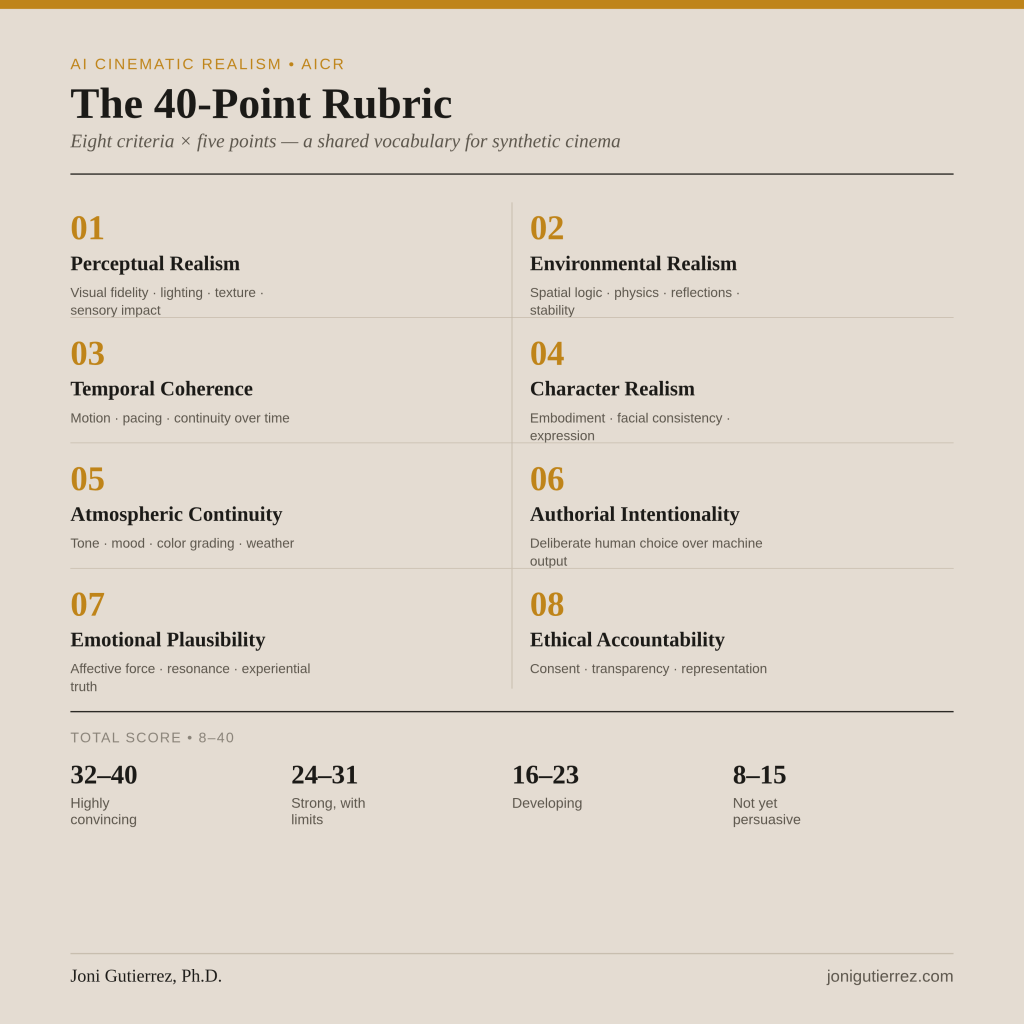
1. Perceptual Realism
Perceptual realism concerns the immediate believability of the image. It includes light, texture, composition, focus, motion quality, and the overall sensory impression the scene produces. A high score indicates that the frame is visually persuasive even under close inspection.
This criterion matters because the viewer’s first encounter with a scene is visual and affective. If the image breaks down instantly through artificial textures, unstable form, or inconsistent lighting, the cinematic experience never fully begins. A strong score here does not guarantee realism, but a weak score often undermines everything else.

2. Environmental Realism
Environmental realism asks whether the world on screen holds together. Do objects occupy space consistently? Does gravity behave plausibly? Are reflections, shadows, and spatial relationships stable across the scene? These questions matter because cinematic realism depends on the sense that the world has internal rules.
A convincing environment is more than a collection of attractive details. It feels inhabited, not assembled. When environmental realism is weak, the viewer senses that the scene has been composited from fragments rather than emerged as a coherent world.

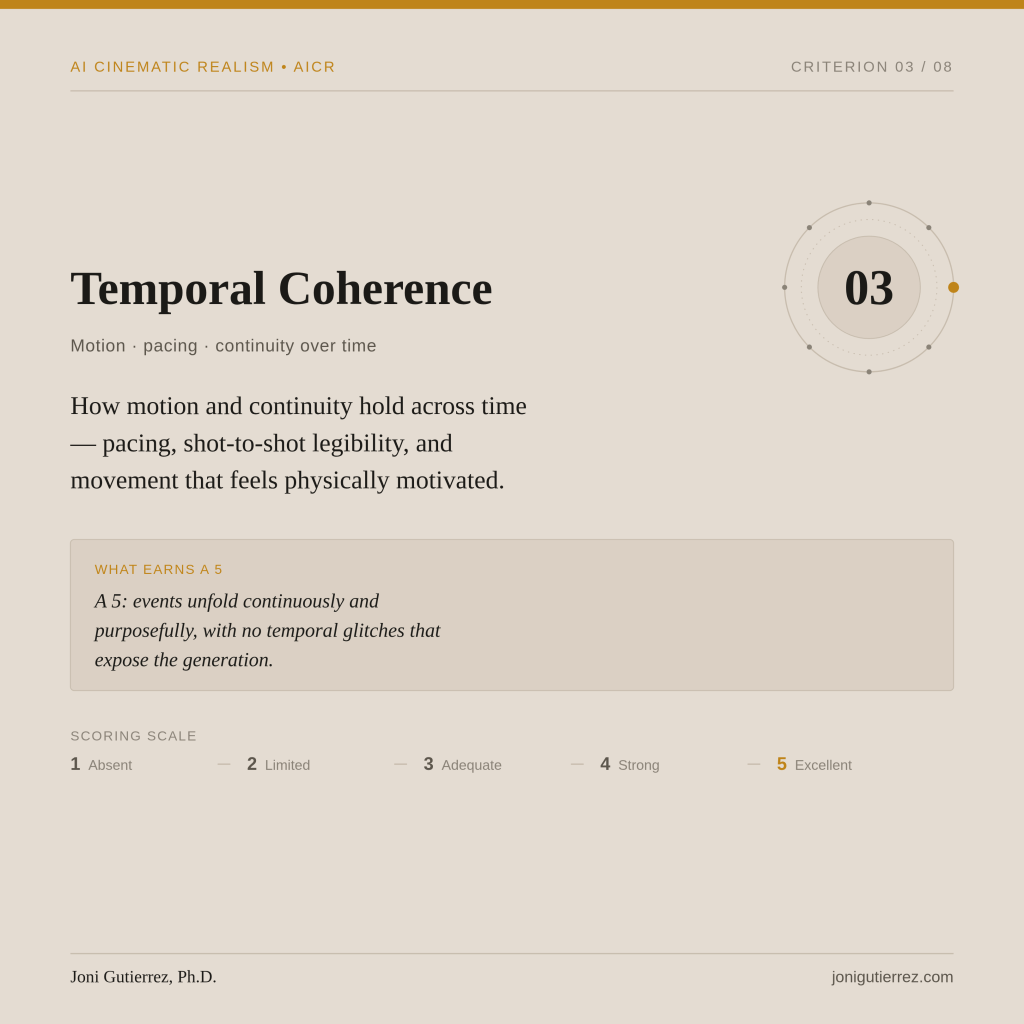
3. Temporal Coherence
Cinematic realism is not only spatial; it is temporal. This criterion evaluates motion, pacing, continuity, and shot-to-shot legibility. A scene may be visually plausible in a single frame and still fail when movement begins, especially if action becomes jittery, repetitive, or physically unmotivated.
High temporal coherence means events unfold in a way that feels continuous and purposeful. The viewer should not be distracted by temporal glitches that expose the underlying mechanism of generation. When time itself feels unstable, realism breaks at the sequence level.
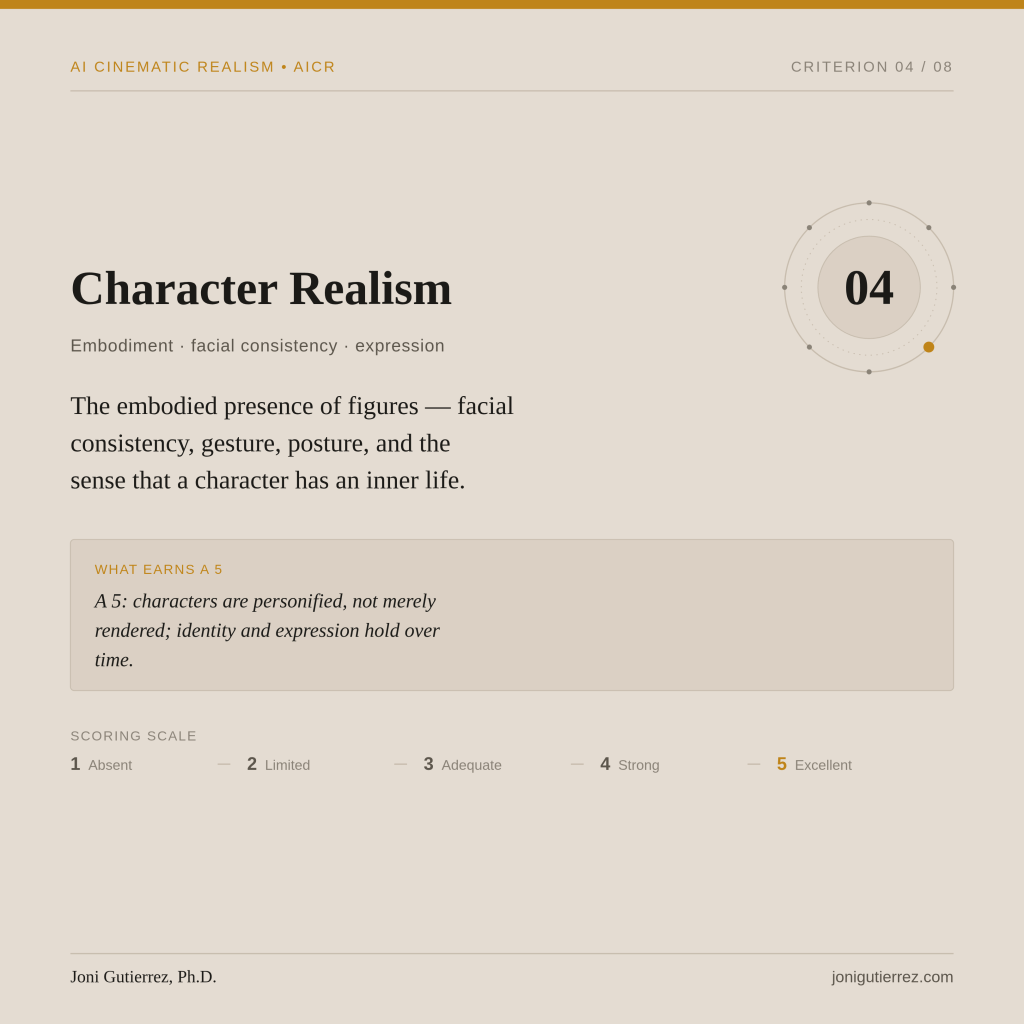
4. Character Realism
Character realism concerns the embodied presence of people or figures within the scene. It includes facial consistency, gesture, posture, expression, and the sense that a character has an inner life. In AI cinema, this is often where technical success and emotional failure diverge.
A strong score suggests that characters are not merely rendered but personified. Their bodies feel situated in the world, and their expressions convey intention rather than generic animation. Weak character realism often produces the familiar uncanny effect: faces that look correct in isolation but fail to sustain identity or emotional specificity over time.
5. Atmospheric Continuity
Atmosphere is one of the most important carriers of cinematic realism. Lighting, color, weather, haze, texture, and tonal design all work together to create a world that feels emotionally and aesthetically unified. A scene can be technically polished and still feel hollow if its atmosphere is inconsistent.
This criterion asks whether the mood holds across the frame and through the sequence. Strong atmospheric continuity does not merely decorate the image; it organizes the viewer’s perception. It gives the scene a felt logic that supports the realism of the whole.

6. Authorial Intentionality
AI-generated cinema often invites the assumption that the machine is doing the creative work. This criterion resists that assumption. Authorial intentionality evaluates whether the scene feels shaped by deliberate human choices in selection, prompting, editing, and framing. Realism here is not only about output, but about purpose.
A high score indicates that the work feels directed, not accidental. Formal choices should support meaning rather than simply showcase model capability. When intentionality is weak, the result may be visually impressive but creatively diffuse.

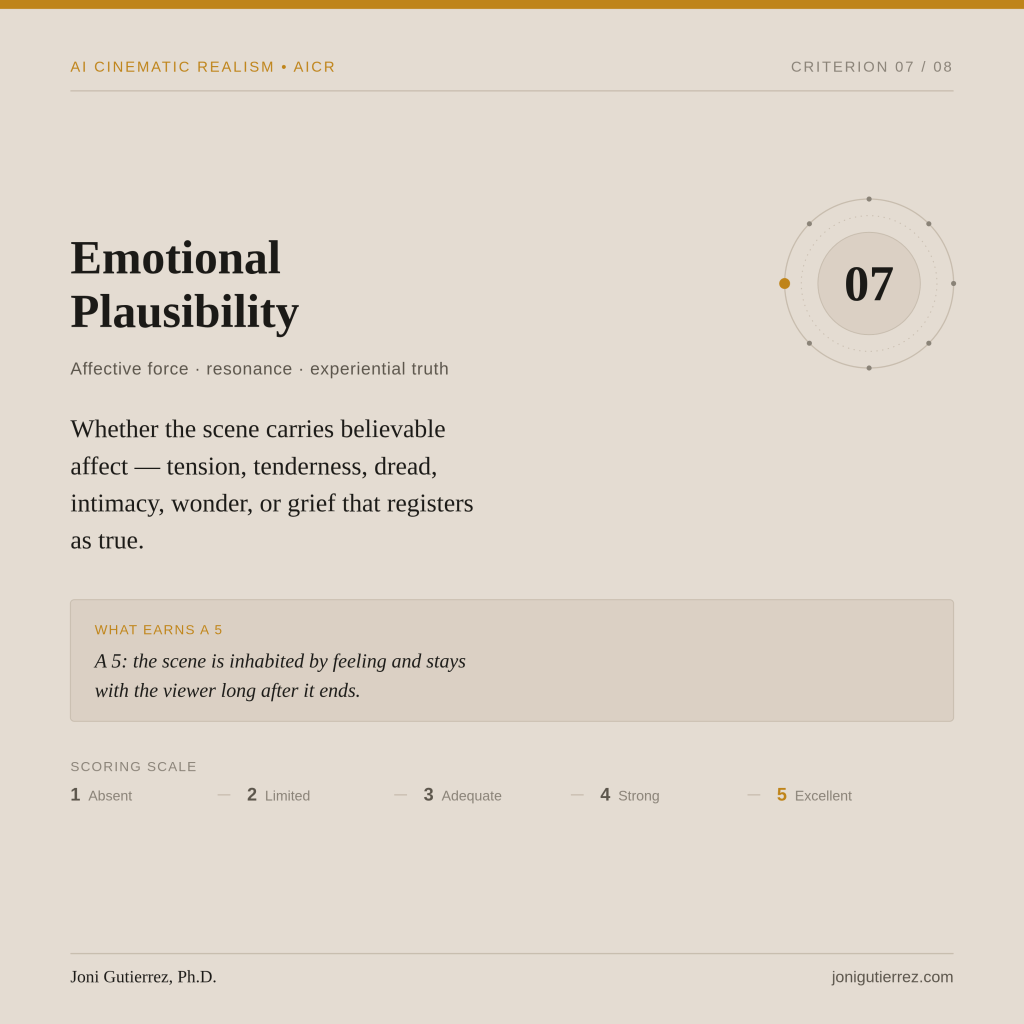
7. Emotional Plausibility
Emotion is a central dimension of realism in cinema. Even impossible events can feel real if they persuade us emotionally. This criterion asks whether the scene carries believable affect: tension, tenderness, dread, intimacy, wonder, or grief. It is less about literal accuracy than about experiential truth.
A scene with strong emotional plausibility stays with the viewer because it feels inhabited by feeling. By contrast, a scene can look flawless and still fail if nothing emotionally registers. In AI cinema, emotional plausibility is often the difference between mere spectacle and genuine meaning.
8. Ethical Accountability
No discussion of AI Cinematic Realism is complete without ethics. This criterion assesses whether the work is framed responsibly in relation to authorship, consent, representation, transparency, and the visible avoidance of unexamined harmful bias. AI cinema is never only an aesthetic object; it is also a product of choices that have social and cultural consequences.
A strong score indicates that the work actively acknowledges those responsibilities. A weak score suggests opacity, careless appropriation, or reliance on harmful stereotypes. Ethical accountability is essential because realism without responsibility risks becoming mere simulation.

Scoring and Interpretation
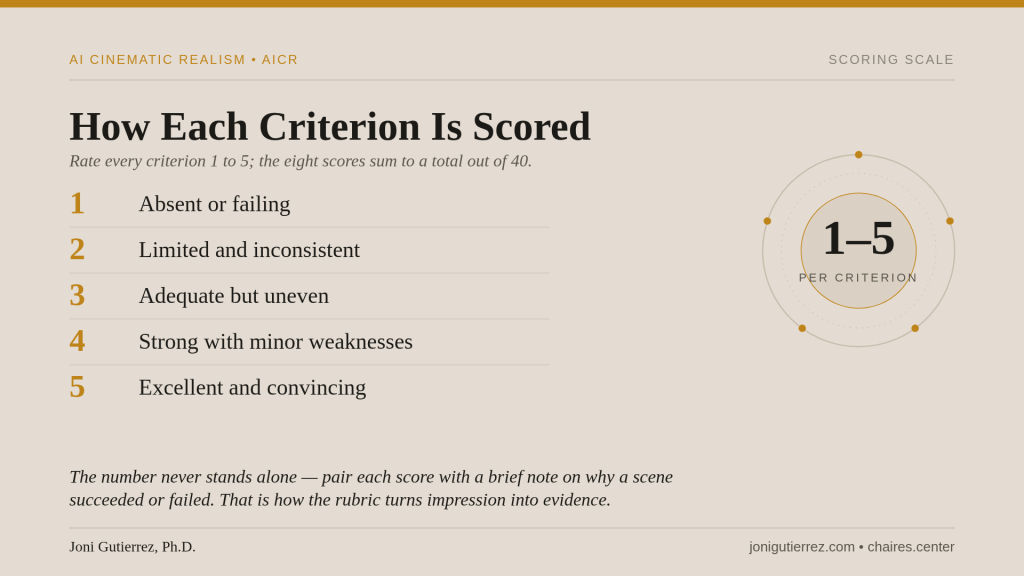
Each of the eight criteria is scored from 1 to 5:
- 1 = Absent or failing
- 2 = Limited and inconsistent
- 3 = Adequate but uneven
- 4 = Strong with minor weaknesses
- 5 = Excellent and convincing
The total calculated score is interpreted through four tiers:
32–40: Highly Convincing AI Cinematic Realism
The scene is immersive, coherent, and emotionally persuasive across all major dimensions. The technology dissolves completely.
24–31: Strong Realism with Noticeable Limitations
The piece is persuasive in bursts, but occasional spatial, temporal, or emotional artifacts interrupt the effect.
16–23: Developing Realism with Major Weaknesses
The work shows promise, but structural inconsistencies repeatedly undermine the cinematic world and require significant suspension of disbelief.
8–15: Not Yet Cinematically Persuasive
The scene fails to establish basic spatial, temporal, or narrative logic, remaining a collection of visual fragments.
This scale preserves nuance without overcomplicating the evaluation, making it flexible enough for classroom discussion, peer review, or production testing. The numerical score should never stand alone; brief qualitative notes should always accompany it so the evaluator can explicitly capture why a scene succeeded or failed.
How to Use It in Practice
The rubric works best when applied to a small set of standardized scenes. A quiet interior conversation, a moving exterior shot, and a physically complex interaction can reveal different kinds of strength and fragility. Together, they test whether a model or a specific workflow can sustain realism across mood, movement, and material interaction.
This is especially useful for comparing models, custom prompt structures, or post-production pipelines. Instead of asking whether one output generically “looks better,” the rubric pinpoints exactly where realism is being achieved and where it collapses. That makes it valuable not just for critique, but for active iteration.
For scholarship, the rubric also provides a bridge between theory and practice. It allows researchers to operationalize questions that have often remained abstract: what does realism mean when the image is entirely generated, how does authorship function in synthetic cinema, and what counts as cinematic truth after the camera? The rubric does not answer those questions once and for all, but it makes them measurable enough to discuss with precision.
A Final Argument
A 40-point rubric for AI Cinematic Realism (AICR) does more than rate images. It creates a disciplined vocabulary for thinking about synthetic cinema as a meaningful, human-centered aesthetic practice. It recognizes that realism in AI-generated work is not secured by photographic capture alone, but actively built through coherence, intention, and experience.
That shift matters because the future of cinema will not be judged only by what technology can produce. It will also be judged by what artists, scholars, and audiences decide counts as convincing, responsible, and cinematic. A rubric gives us a way to make that judgment explicit.


Leave a Reply