
Why AI literacy should develop educators’ capacity to decide when, why, and whether to use AI
AI literacy in higher education is often framed as a question of adoption: How do we help faculty use AI? How do we make them more comfortable with it? How do we move from resistance to experimentation?
I think those questions start in the wrong place.
The more important question is whether faculty are developing the professional judgment to decide when AI may support teaching and learning, when it may not, and what safeguards should guide its use.
That distinction matters. AI literacy should not require every educator to use artificial intelligence in the same way, integrate it into every course, or arrive at the same conclusions about its instructional value. Some faculty may actively incorporate AI into teaching. Others may focus on understanding its implications for students, establishing course expectations, evaluating risks, or deliberately choosing not to use it in particular contexts.
All of those can represent meaningful AI literacy.
Positioning the Framework
This is a practitioner framework, not a claim to have invented AI literacy, human-centered AI, or the idea that educators should sometimes choose not to use AI. Those ideas are increasingly visible across higher education and teacher-education research.
UNESCO’s AI Competency Framework for Teachers emphasizes human agency, ethics, AI foundations, pedagogy, and professional learning. EDUCAUSE similarly frames AI literacy around technical understanding, evaluation, practical application, and ethical considerations. More recent institutional guidance explicitly describes AI literacy as knowing both when to use AI and when not to use it. Research published in 2026 has also begun to treat deliberate non-use as a potentially reflective form of AI literacy rather than simple resistance.
What I offer here is an applied synthesis organized around one practical idea: faculty AI literacy should be developed and evaluated as professional judgment. The framework translates that idea into competencies, a flexible learning pathway, professional-development priorities, and reflection questions that institutions can adapt to their own context.
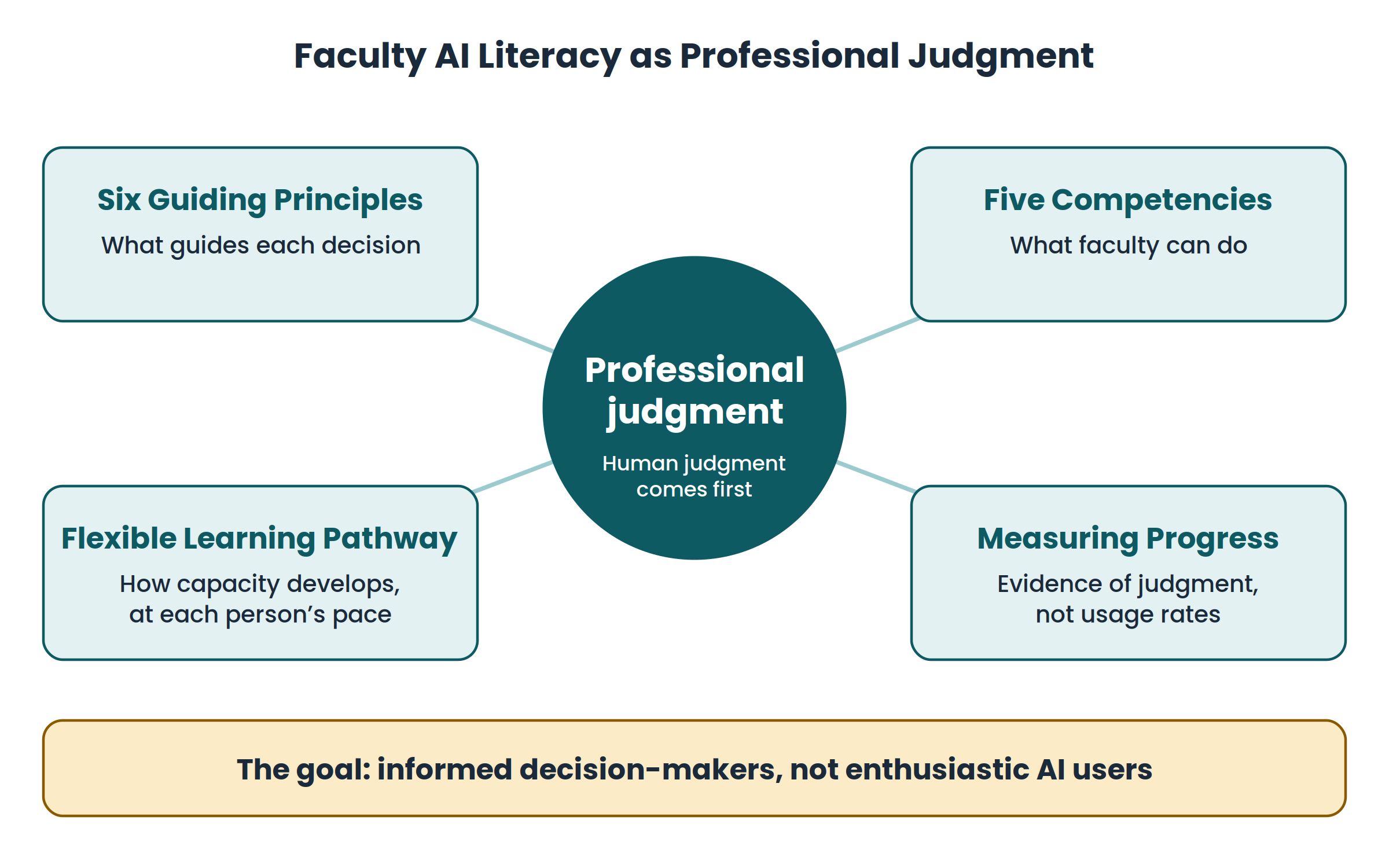
AI Literacy as Professional Judgment
At the center of the framework is a simple principle: human judgment comes first.
AI can assist with certain tasks, but faculty expertise, disciplinary knowledge, and instructional judgment remain central to teaching and learning. The purpose of AI literacy is therefore not technology adoption for its own sake. It is to support learning, critical thinking, engagement, accessibility, and student success when AI is used.
That means faculty development should create space for thoughtful experimentation while also making room for skepticism, boundaries, and non-use.
- What does this technology actually do well?
- Where are its limitations?
- Does its use support the learning outcome?
- What could be lost if part of the learning process is delegated to AI?
- What accessibility, privacy, equity, or academic-integrity concerns need to be considered?
- What still requires human verification and judgment?
The goal is not to produce enthusiastic AI users. The goal is to develop informed decision-makers.
Six Guiding Principles
Human Judgment Comes First
Faculty expertise, disciplinary knowledge, and instructional judgment remain central. AI may assist, but it does not displace professional responsibility.
Student Learning Drives Decisions
Technology should be evaluated in relation to learning, not novelty. The relevant question is not simply whether AI can perform a task, but whether its use contributes meaningfully to student learning.
Thoughtful Experimentation
Faculty should have opportunities to explore AI in low-risk ways while considering accuracy, privacy, accessibility, equity, academic integrity, and potential effects on students.
Critical Evaluation Matters
AI-generated outputs require review and verification. Faculty and students should learn to question, evaluate, and improve those outputs rather than treat them as authoritative.
Accessibility and Equity Are Shared Responsibilities
Accessibility and equitable participation should be considered whenever AI is used in teaching, assessment, course design, or the creation of instructional materials.
Multiple Paths Are Valid
Meaningful AI literacy may lead to active use, limited use, boundary-setting, or deliberate non-use. Literacy is demonstrated through the quality of the decision, not the quantity of AI use.
Five Faculty AI Literacy Competencies
1. Foundational Understanding
Faculty can:
- Describe basic AI capabilities and limitations.
- Recognize common strengths and weaknesses of generative AI.
- Discuss AI’s relevance to teaching, learning, and student work.
2. Responsible Use and Professional Judgment
Faculty can:
- Identify appropriate and inappropriate uses of AI.
- Consider privacy, accessibility, equity, and academic-integrity implications.
- Make informed decisions about AI use in their own courses.
3. Verification and Critical Evaluation
Faculty can:
- Review AI outputs critically.
- Verify information before use.
- Recognize inaccuracies, bias, omissions, and unsupported claims.
- Model evidence-based evaluation practices for students.
4. Accessibility, Equity, and Inclusion
Faculty can:
- Consider accessibility when using AI-generated materials.
- Recognize potential barriers and inequities.
- Evaluate whether AI-supported activities create unequal opportunities or expectations for students.
- Use institutionally supported accessibility resources and established standards and tools.
5. Instructional Decision-Making
Faculty can:
- Determine when AI supports learning outcomes.
- Determine when AI may undermine learning goals.
- Design learning experiences that strengthen critical thinking and human judgment.
- Make intentional decisions about student AI use when relevant to discipline and course goals.
A Flexible Faculty Learning Pathway
Faculty do not need to move through AI literacy at the same pace or toward the same destination. In this practitioner framework, I organize faculty development around three flexible stages.
Build Awareness
Develop foundational understanding of what AI is, what it can and cannot do, how it may affect students, and what basic responsibilities accompany its use.
Explore and Evaluate
Create opportunities for hands-on exploration while foregrounding verification, accessibility, equity, privacy, academic integrity, and disciplinary context.
Apply, Refine, or Establish Boundaries
Use AI purposefully, limit its use, refine an existing practice, establish clear boundaries, or choose deliberate non-use based on learning goals and professional judgment.
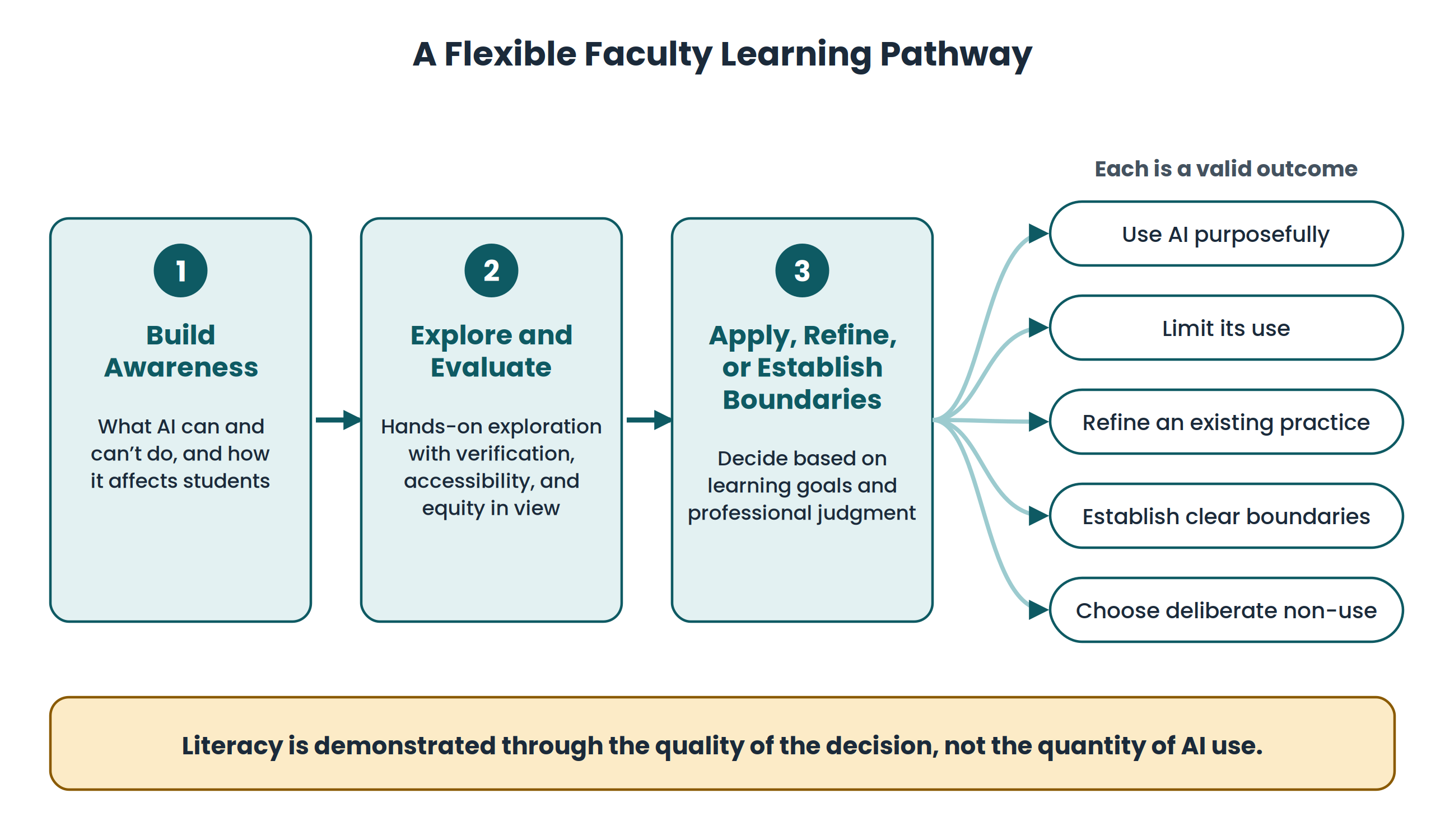
A maturity model that assumes everyone should ultimately become a more intensive AI user confuses literacy with adoption. They are not the same thing.
What Faculty Development Could Look Like
In the near term, institutions do not necessarily need large, elaborate AI training programs. A more realistic starting point is to establish shared foundations, create low-barrier opportunities for exploration, and share practical examples drawn from authentic teaching contexts.
Because faculty time is limited and confidence levels vary, professional development should emphasize flexibility, choice, and practical relevance.
- Short recorded demonstrations
- Self-paced modules
- One-page quick-start guides
- Practical tip sheets
- Example prompt collections
- Accessibility-focused examples
- Brief teaching-use showcases
- Short case studies highlighting both benefits and limitations
More intensive opportunities – such as workshops, learning circles, communities of practice, and peer mentoring – can grow over time for faculty who want deeper engagement.
Practical Applications, With Human Review
Faculty may choose to use AI for planning, generating examples, drafting discussion prompts, exploring alternative explanations, creating practice materials, or supporting student reflection.
But every one of those uses should remain subject to human review.
Accessibility is a particularly important example. AI tools may help identify potential accessibility concerns, simplify complex language, suggest alternative text, or propose different formats for information. But accessibility review remains a human responsibility, and AI-generated recommendations should still be checked against established accessibility standards and tools.
That distinction – assistance without abdication – is central to responsible human-AI collaboration.
Making Space for Skepticism
One of the most important parts of faculty AI literacy is creating legitimate space for hesitation.
Faculty may reasonably question whether AI improves learning, how it affects academic integrity, whether it weakens critical thinking, or whether it belongs in a particular discipline or assignment at all. Those questions should not automatically be interpreted as resistance to innovation.
Meaningful participation in AI literacy may include understanding how AI affects students, developing clear course expectations, recognizing risks and limitations, evaluating possible uses, or deciding not to use AI for a particular instructional purpose.
AI literacy can include informed non-use.
How Should We Measure Progress?
If AI literacy is about judgment rather than adoption, usage rates are a poor measure of success. Progress can instead be reflected in faculty demonstrating:
- Stronger understanding of AI capabilities and limitations
- Better evaluation of AI-generated outputs
- More intentional instructional decisions
- Greater attention to accessibility, equity, and privacy
- Increased confidence discussing AI with students
- Stronger alignment between AI-related decisions and learning outcomes
Useful reflection questions are equally practical:
- Where did AI add value?
- Where did it create problems?
- What required verification?
- How were learning, accessibility, and equity affected?
- What should I continue, revise, or stop doing?
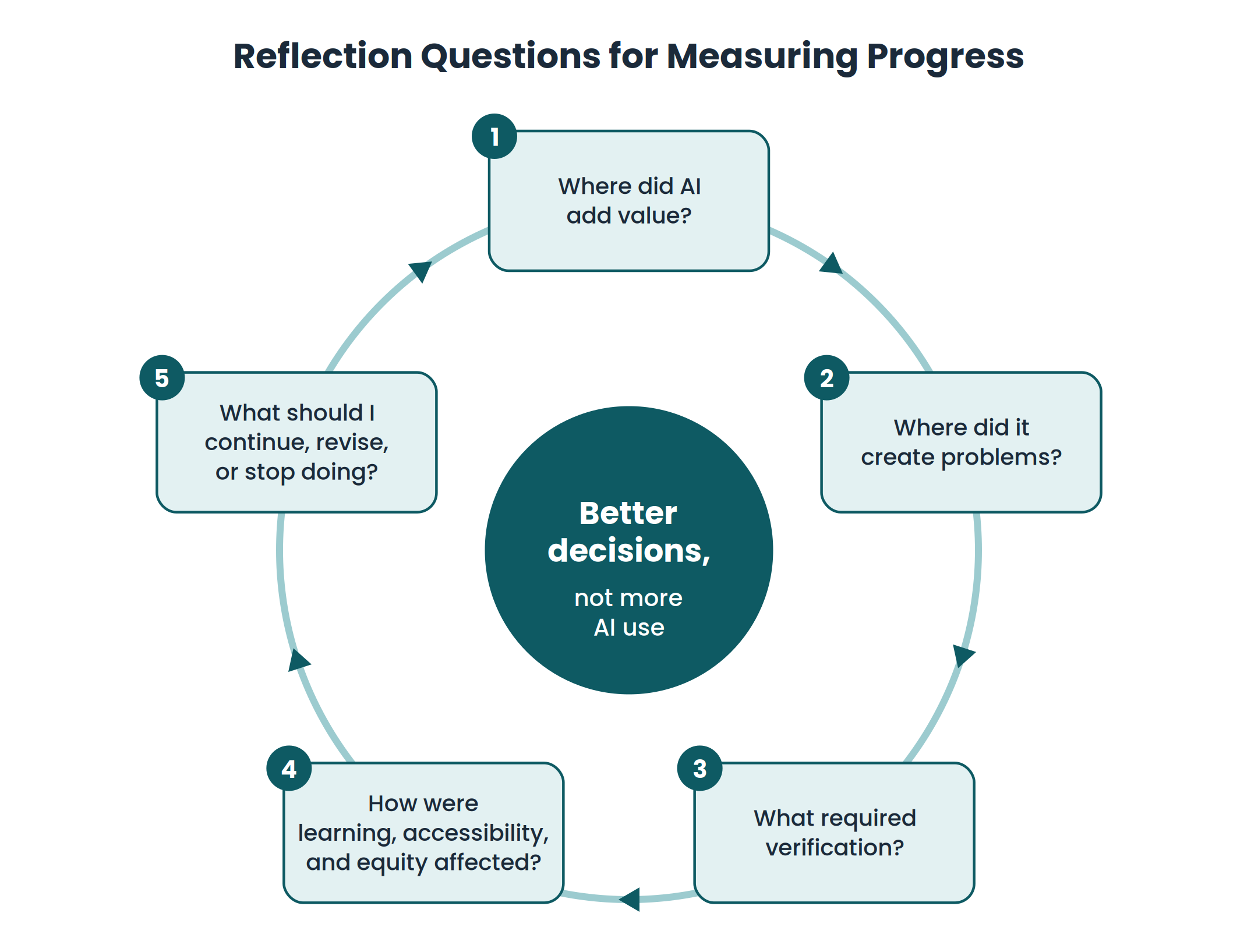
From Adoption Metrics to Better Decisions
The central argument of this framework is that institutions should resist treating AI literacy as an adoption campaign.
Faculty should be supported in asking both: How might AI help? And when might AI not be appropriate?
Accessibility, equity, privacy, academic integrity, verification, critical thinking, and human judgment should remain central regardless of the answer.
Success should ultimately be measured not by the amount of AI being used, but by the quality of the decisions educators make in service of student learning.
Author’s Note
This framework was originally developed as my culminating project for Instructure Learning Services’ Build AI Literacy and Governance in Education elective, which I completed as the final elective requirement for the Canvas Certified Technical Admin (CCTA) credential. It was informed by my professional work in faculty development, digital accessibility, educational technology, and responsible AI in higher education.
Selected Related Work
- UNESCO. AI Competency Framework for Teachers (2024).
- EDUCAUSE. AI Literacy in Teaching and Learning: A Durable Framework for Higher Education (2024).
- Penn State. AI Literacy Framework.
- Lindkvist, A., Curbo, S., & Hultgren, C. Choosing not to use generative AI in higher education: a mixed methods study of student reasoning, assessment design, and AI literacy (2026).
- Nguyen, A. et al. / teacher-education scoping review on AI literacy and professional judgment (2024).


Leave a Reply