
The question that launched AI Cinematic Realism (AICR) was deceptively simple: what does realism mean when there is no camera?
For over a century, cinematic realism rested on the indexical trace — the assumption that light had struck a sensor, that something had happened in front of a lens, that the image bore a physical relationship to the world it depicted. AI-generated images dissolve that assumption entirely. They are conjured from patterns in data, synthesized from statistical relationships, assembled without a lens, a sensor, or a captured event.
This is not a failure of realism. It is a transformation of it.
AI Cinematic Realism is a body of knowledge — 38 articles, a manifesto, a field guide, and a growing library of applied studies — dedicated to understanding what cinematic believability means in the post-camera era. The framework is built around three strata (Perceptual, Environmental, and Authorial), a shift in the central question of realism (from “Is it real?” to “Is it true?”), and a commitment to accountable authorship.
This article presents the AICR Social Series: twelve typographic cards distilling the core concepts of the framework for general audiences. Each card is designed as a standalone entry point into the body of work.
Figure 1 — The Central Question

The first card establishes the ontological shift at the heart of AICR. The question “Is it real?” is a forensic question — it asks about origin, about whether a camera was present, about the indexical relationship between image and world. AI images cannot answer that question satisfactorily because they were never captured.
The question that replaces it — “Is it true?” — is a cinematic question. It asks whether the image carries emotional weight, whether it constructs a believable world, whether it communicates something worth saying. This is the foundation on which the entire framework rests.
Figure 2 — Glitch as Texture
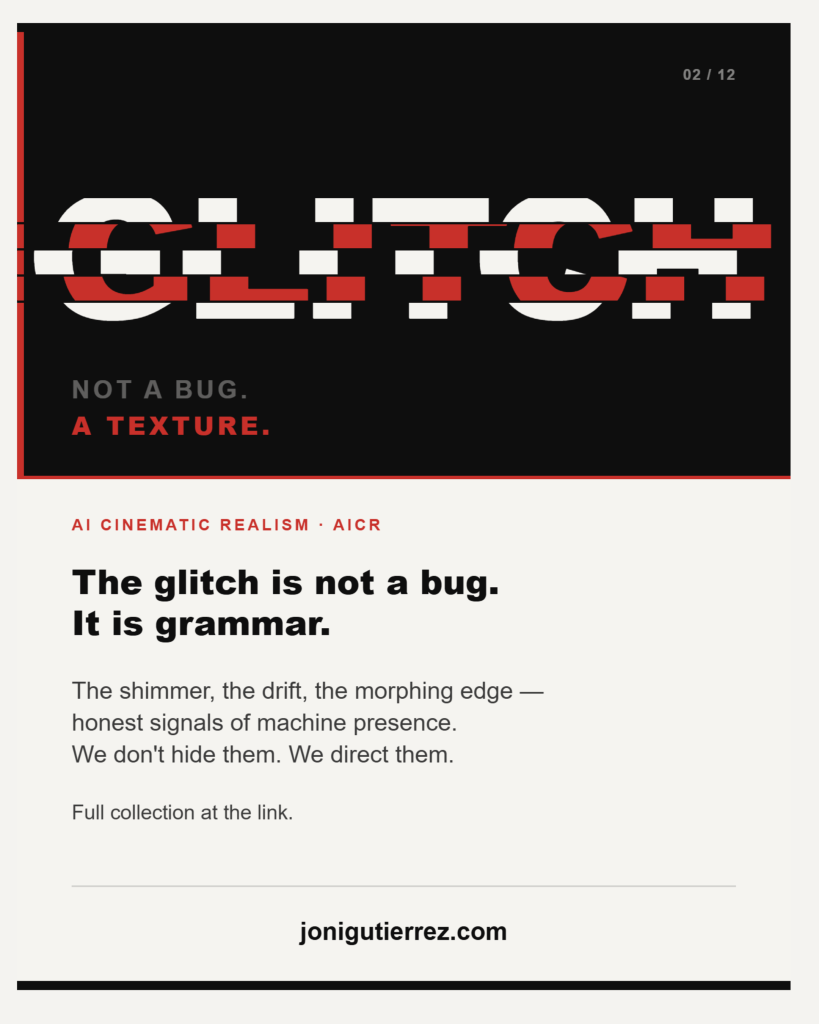
The second card addresses one of the most persistent misreadings of AI-generated cinema: the treatment of visual imperfections as failures.
In AI Cinematic Realism, the glitch is not a bug — it is grammar. The shimmer, the drift, the morphing edge at the boundary of a synthetic object are honest signals of machine presence. They are evidence of synthesis rather than capture. Just as film grain communicates the materiality of celluloid, and the handheld shake of Cinéma Vérité communicates the presence of a human operator, the characteristic artifacts of AI image generation communicate the medium’s own nature.
The practitioner’s task is not to eliminate these signals but to direct them — to use them purposefully as part of a conscious visual language.
Figure 3 — Accountable Authorship

The third card confronts the myth of the passive AI creator — the figure who enters a text string and waits for a machine to do the work.
AI Cinematic Realism insists on a different account of creative agency. The AI creator is a moral agent: someone who makes choices at every stage of the process — what to prompt, what to select, what to curate, what to publish. These choices carry consequences for representation, for labor, for the audience’s trust. Authorship in the post-camera era is not diminished by the involvement of a generative model. It is redistributed, reframed, and made newly accountable.
The machine did it is never an alibi.
Figure 4 — The Post-Camera Era
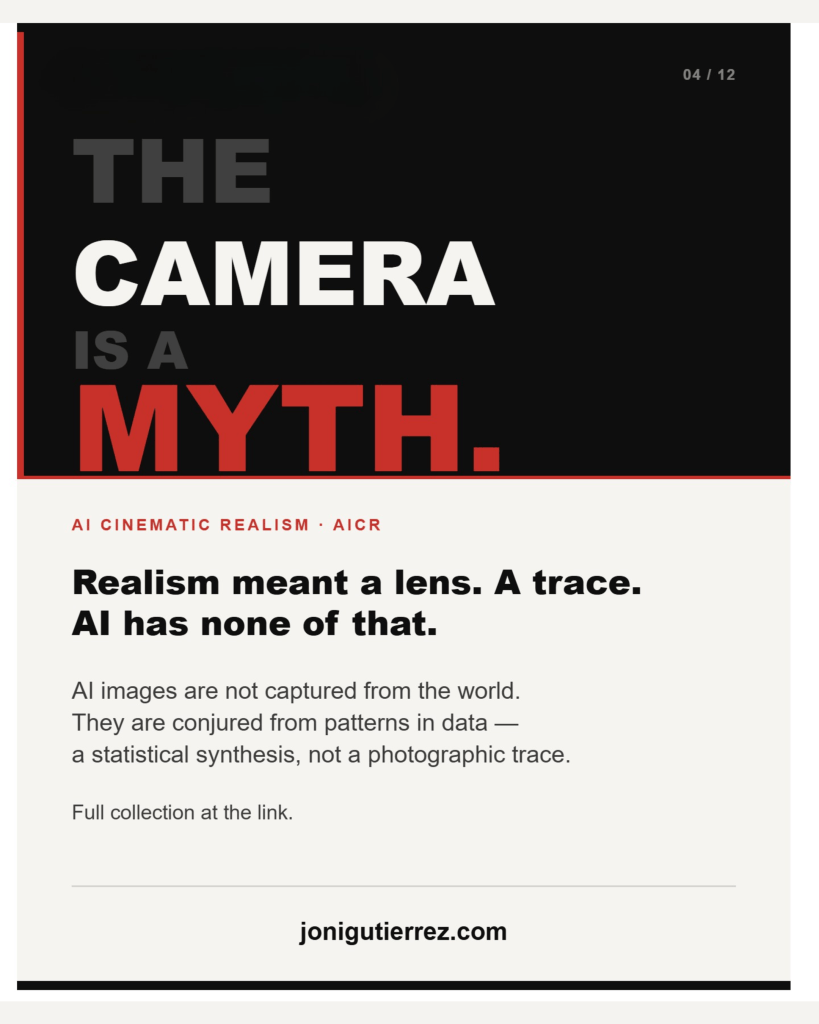
The fourth card names the ontological rupture directly. The camera — as the guarantor of photographic realism, as the instrument of the indexical trace — is a myth in the context of AI-generated images. AI has no lens. It has no sensor. There is no physical event that the image records.
This does not mean that AI images cannot be realistic. It means that the theory of realism must be rebuilt from different foundations — not on the physics of light and optics, but on the phenomenology of perception, the psychology of belief, and the ethics of representation.
Figure 5 — Emotional Plausibility

The fifth card introduces one of AICR’s core theoretical concepts: emotional plausibility as the new index of realism.
The nervous system does not wait for ontological verification before responding to an image. We flinch at a synthetic crash. We soften at a synthetic smile. The body’s response is real regardless of the origin of the stimulus. AI Cinematic Realism argues that this physiological and psychological fact — that synthetic images can produce genuine emotional responses — is not a vulnerability to be exploited but a responsibility to be honored.
Realism, in this framework, is not a property of the image. It is a phenomenon of the viewer. The question is not whether the image was captured — but whether it persuades the heart.
Figure 6 — The Perceptual Stratum

The sixth card introduces the first of AICR’s three strata — the organizational structure through which the framework evaluates cinematic believability.
The Perceptual Stratum addresses what the eye detects at the level of a single frame: whether light behaves according to physical logic, whether surfaces carry the appropriate material properties, whether motion feels embodied in space. This is the threshold level of realism. If the perceptual stratum fails — if the eye rejects the image — the mind never gets a chance to believe the world. The three components of perceptual realism are optical coherence, temporal stability, and material behavior.
Figure 7 — The Environmental Stratum
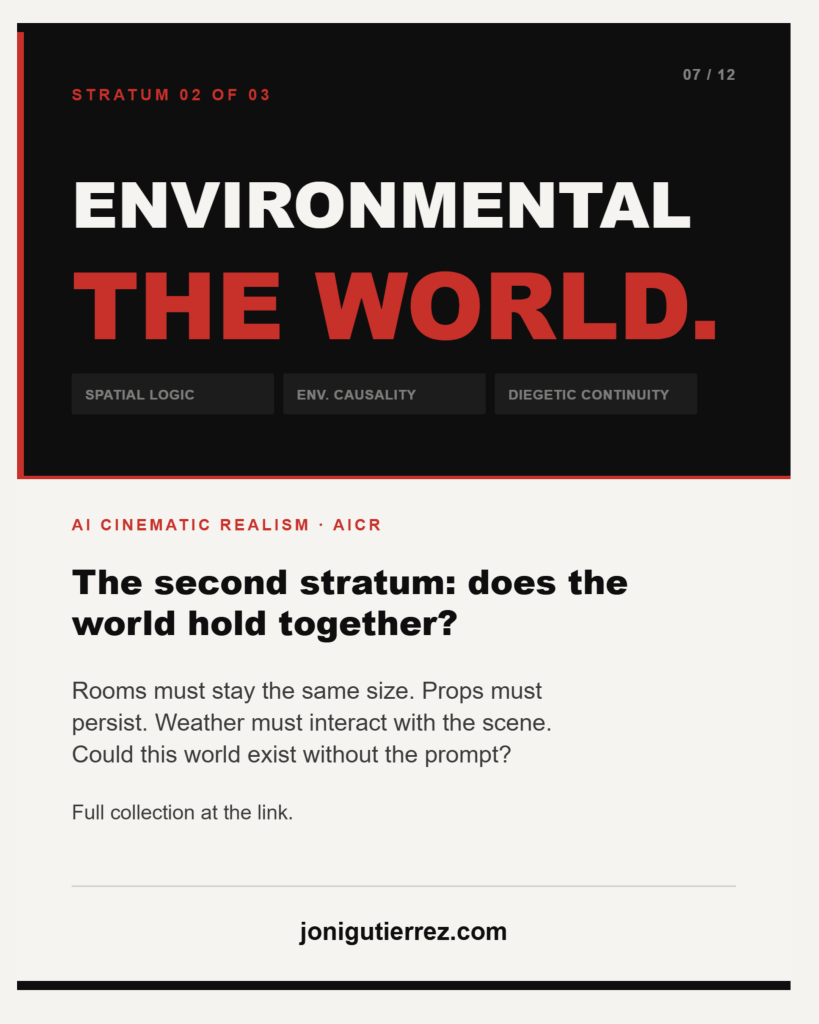
The seventh card addresses the second stratum: environmental realism, which concerns whether the world of the image holds together across time and space.
Where perceptual realism operates at the level of the frame, environmental realism operates at the level of the scene and the sequence. Rooms must maintain consistent dimensions. Props must persist across cuts. Weather must interact with the environment. Architecture must obey its own spatial logic. The world must feel inhabited rather than assembled from individually plausible fragments that do not cohere into a whole. The key diagnostic question: could this world exist independently of the prompt that generated it?
Figure 8 — The Authorial Stratum
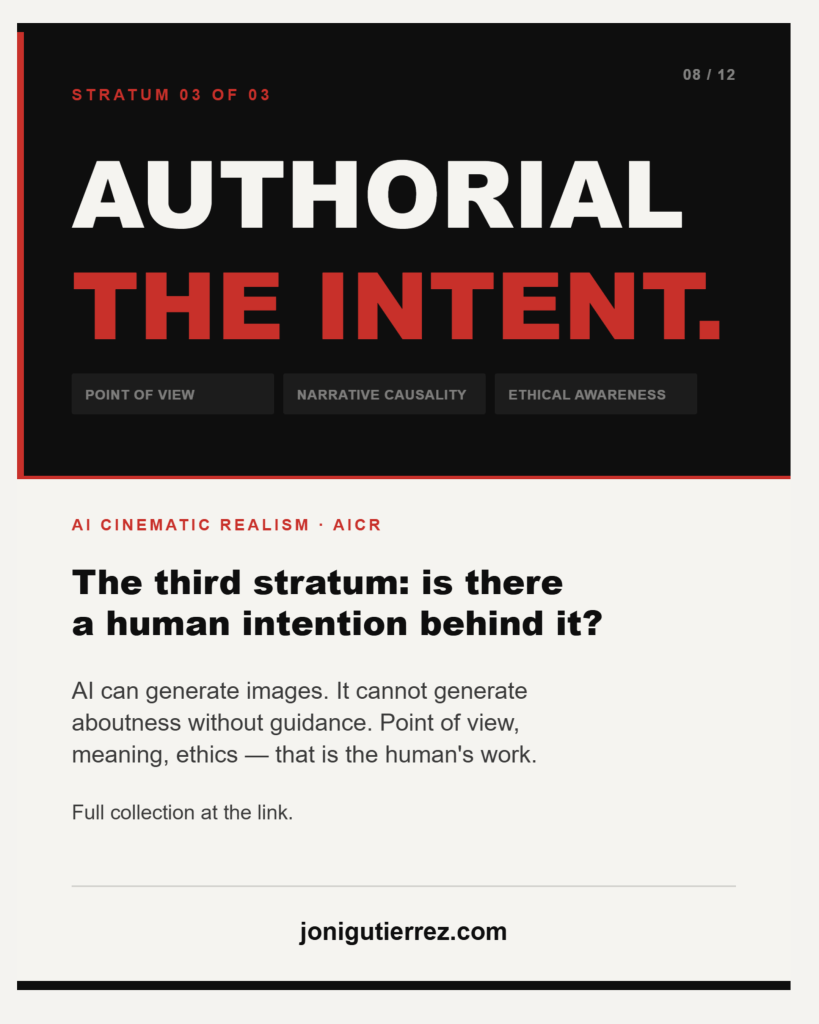
The eighth card completes the three strata with the most demanding: authorial realism — the presence of human intention in the work.
AI can generate images that satisfy perceptual and environmental realism. It cannot generate aboutness without guidance. Point of view, narrative causality, ethical awareness, interpretive depth — these are the dimensions along which a work either succeeds as a meaningful act of communication or fails as an impressive but hollow display of technical capability. The Authorial Stratum is where the moral agent becomes indispensable. Without authorial intention, AI cinema risks becoming a collage of styles: technically accomplished but existentially empty.
Figure 9 — The Manifesto

The ninth card draws from the Manifesto of AI Cinematic Realism — eight principles that define the framework’s ethical and aesthetic commitments.
The first principle — realism is not replication — establishes the governing logic: the goal is not resemblance to a photographic image but resonance with lived experience. The seven principles that follow address the nature of the frame, the fluidity of cinematic time, the role of imperfection as evidence of conscious assembly, the engineered nature of emotion, the myth of the camera, the embeddedness of ethics in every creative choice, and the rewriting of the relationship between image and spectator.
Figure 10 — The Lineage

The tenth card situates AICR within the longer history of cinematic realism — not as a rupture but as a continuation.
Every major realist movement in cinema defined itself by refusing the dominant spectacle of its era. Italian Neorealism refused the artifice of the studio system. Cinéma Vérité refused the scripted construction of documentary. Dogme 95 refused the technical excess of late twentieth century production. Each movement asked: what is cinema for? And each proposed a new answer grounded in a different account of the real.
AI Cinematic Realism is the next chapter — refusing both the hollow sheen of demo culture (AI reduced to a physics demonstration) and the paralysis of deepfake panic (AI treated only as a threat). It insists instead on emotional truth, conscious assembly, and accountable authorship.
Figure 11 — The Field Guide

The eleventh card introduces the AICR Field Guide — a practical evaluation rubric for AI-generated cinema organized around the three strata.
Each stratum is rated on a scale of one to five. A score of one indicates a complete failure at that level of realism; a score of five indicates that the stratum operates invisibly — that the work has fully absorbed the viewer into its world at that dimension. A scene succeeds as an act of AI cinematic realism when it achieves sufficient scores across all three strata simultaneously: when it feels physically plausible, world-coherent, and meaningfully authored.
The Field Guide is available in full here.
Figure 12 — The Close
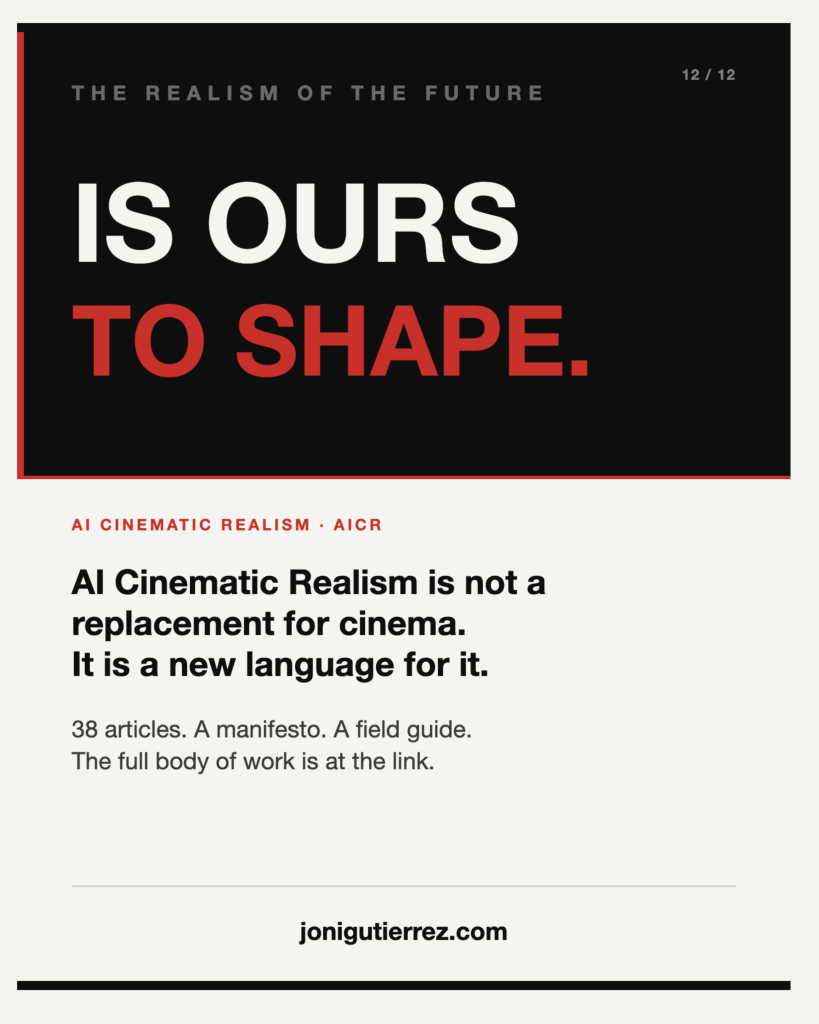
The twelfth and final card states the framework’s fundamental conviction: that the realism of the future is not determined by the capabilities of generative models, but by the choices of the people who work with them.
AI Cinematic Realism is not a replacement for cinema. It is a new language for it — one that inherits the full tradition of cinematic realism while accounting for the profound transformation that synthetic image generation represents. The framework exists to give that transformation a vocabulary: to move the conversation about AI-generated images beyond both uncritical enthusiasm and reflexive fear, toward a serious engagement with what these images mean, what they owe their audiences, and what they can honestly say.


Leave a Reply