
The Atrophy We’re Not Naming
Most of the anxiety about generative AI in education circles around a single word: cheating. Did the student write this, or did the machine? Can we detect it? Can we prevent it? These are real questions, but they orbit a smaller problem while a larger one goes unnamed.
The larger problem is atrophy. When a tool can generate a fluent paragraph, a plausible image, or a polished video in seconds, the faculties that used to be exercised in making those things quietly fall out of use. The student stops noticing. Stops testing whether a thing holds together. Stops asking what it means and who it’s for. The output arrives, impressive and immediate, and the slow human work that authorship requires never happens.
I came to this concern from an unexpected direction. For the last couple of years I’ve been developing a framework called AI Cinematic Realism (AICR) — originally a way to understand why so much AI-generated cinema looks stunning and feels hollow. But the longer I worked with it, the clearer it became that AICR was describing something larger than film. It was describing a discipline of attention. A way of seeing that generative tools threaten to make obsolete, and that education, for exactly that reason, now needs to teach on purpose.
This essay makes that case: that AI Cinematic Realism is not only a theory of synthetic cinema, but a pedagogy of intentional seeing — and that what it trains is precisely what an AI-saturated world is at risk of losing.
From Rubric to Pedagogy
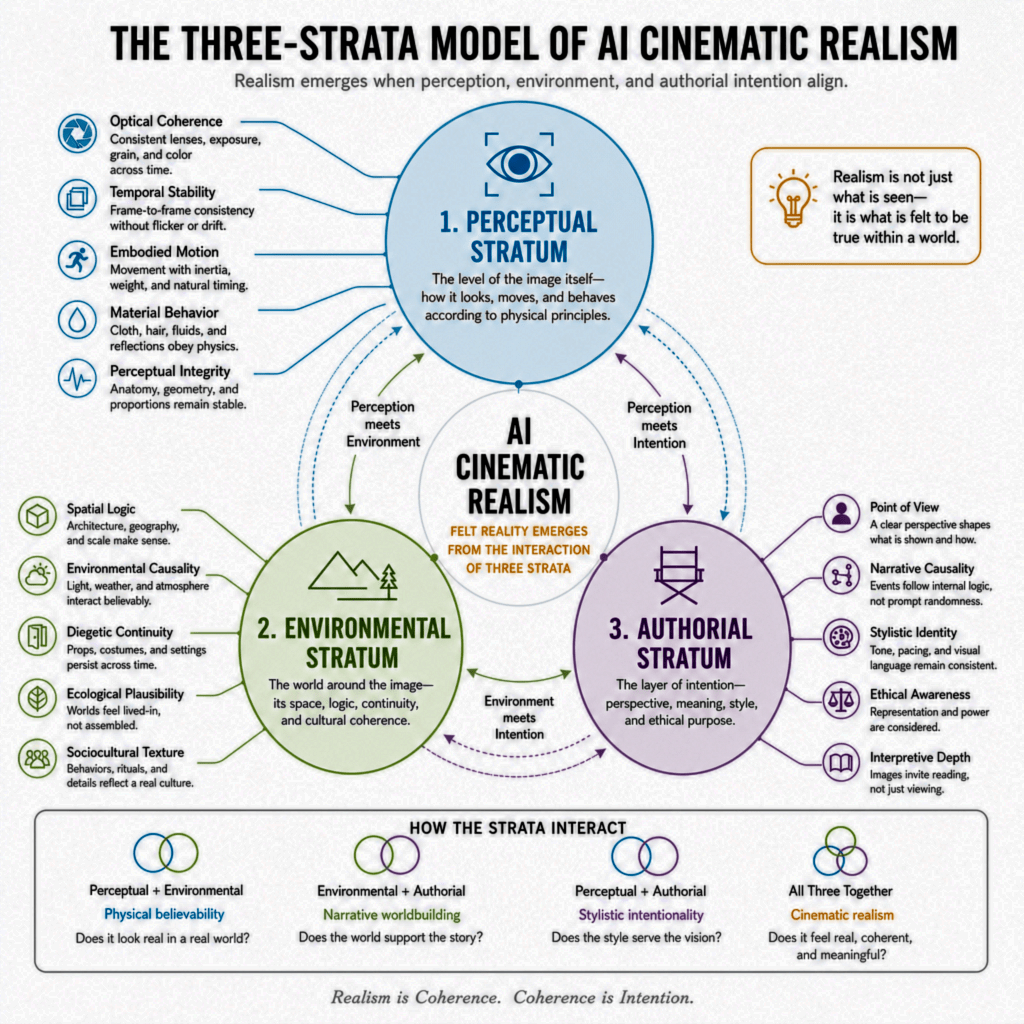
The core of AI Cinematic Realism, set out in full in the AI Cinematic Realism (AICR): Field Guide, is the Three-Strata Model: the claim that believable synthetic cinema emerges from the interaction of three layers — the Perceptual, the Environmental, and the Authorial. The Perceptual Stratum concerns what the eye catches in a single frame. The Environmental Stratum concerns whether the world holds together once things move. The Authorial Stratum concerns whether there is a human intention behind any of it.
As a tool for evaluating AI video, the model works as a rubric: score a scene across the three strata, find the weakest layer, revise. But something happens when you stop pointing the strata at the machine’s output and start pointing them at the student’s own attention. The three strata stop being a checklist and become a sequence of trained perceptions — a description of what an educated eye actually does.
To move through the strata is to practice three distinct disciplines. First, to notice — to catch what is off, what is inconsistent, what does not behave the way the world behaves. Second, to test coherence — to ask whether a thing holds together as a system, whether its parts imply one another, whether it could exist independently of the prompt that produced it. Third, to take responsibility for meaning — to insist that the work be about something, that it carry a point of view and an ethical stake.
Noticing. Coherence. Responsibility for meaning. Those are not film skills. They are the foundational faculties of an educated mind — and they are exactly the faculties that frictionless generation lets atrophy. This is the pedagogical turn at the center of this essay: the three strata of AICR are a curriculum for intentional seeing, and film is simply the medium where they happen to be most visible.
The Perceptual Stratum: Teaching Students to Notice
The first stratum is the most immediate. It is the level at which a viewer senses that something is wrong before they can say what — the flicker, the drift, the melting edge, the hand that has one finger too many. In AICR, this is where realism either begins or collapses: if the eye rejects the image, the mind never gets far enough to believe the world.
What makes this stratum pedagogically powerful is that it cannot be faked by attention’s absence. To catch the shimmer, you have to be looking. You have to slow down enough to register that the light is not behaving the way light behaves, that the motion has no weight behind it, that the fabric is moving like an idea of fabric rather than the thing itself. In a culture of infinite scroll and instant generation, this kind of looking is increasingly rare — and increasingly precious.
Teaching the Perceptual Stratum, then, is teaching the discipline of noticing. It is the practice of treating an image as something to be examined rather than consumed. And the habit transfers far beyond the screen. The student who learns to catch the inconsistency in an AI-generated frame is practicing the same attention that catches the flawed step in a proof, the off note in an argument, the detail in a primary source that does not fit the tidy narrative. Perceptual realism trains the eye, but what it really trains is the refusal to look past things.
This is why I treat the perceptual layer not as a technical preliminary but as the entry point to the whole pedagogy. Before a student can build a coherent world or author a meaningful one, they have to be willing to see clearly what is actually in front of them. Everything else depends on it.
The Environmental Stratum: Teaching Coherence Thinking
The second stratum raises the stakes from the frame to the world. An image can be perceptually flawless and still betray itself the moment things start to move: the room that quietly changes size between shots, the prop that vanishes, the rain that falls without touching anything, the culture assembled from fragments that have no internal logic. The Environmental Stratum asks one demanding question: could this world exist independently of the prompt that produced it?
That question is a thinking discipline in disguise. To answer it, a student cannot evaluate any single element in isolation. They have to hold the whole system in mind at once and ask whether the parts imply one another — whether the geography is consistent across shots, whether the weather interacts with the people in it, whether the world behaves as though it had a history before the camera arrived and would continue after it left. This is coherence thinking: the ability to test whether something holds together as a system rather than as a pile of plausible pieces.
And coherence thinking is one of the most transferable faculties in all of education. The historian asks whether an account is consistent with the other evidence. The scientist asks whether a result coheres with the rest of the model. The engineer asks whether the parts will actually work as a whole. The writer asks whether the argument hangs together from premise to conclusion. In every case, the underlying move is the same one the Environmental Stratum trains: refusing to accept local plausibility as a substitute for global coherence.
This matters acutely in the age of generative AI, because fluent output is built from local plausibility. A language model produces each sentence to be probable given the last; an image model produces each region to be plausible given its neighbors. The result is work that is convincing piece by piece and often incoherent as a whole — confident citations to sources that do not exist, worlds that cannot survive a second look. The student trained in environmental realism learns to distrust the seductive local fluency and to ask the harder question the machine cannot answer for them: does the whole thing actually hold?
The Authorial Stratum: Teaching Students to Be Moral Agents
The third stratum is the hardest and the most human. A scene can be perceptually flawless and environmentally coherent and still be empty — a beautiful collage of styles that says nothing. What it lacks is what AICR calls aboutness: a point of view, a reason to exist, an ethical and interpretive stake in what is being shown. AI can generate images endlessly. What it cannot generate, on its own, is aboutness. That is the part only a person can bring.
This is where the pedagogy becomes an ethics. There is a myth that the person making AI work is a kind of prompt typist — typing words, hitting enter, waiting for the machine to pay out. The Authorial Stratum rejects that myth entirely. The person who prompts, curates, and publishes is not a typist but a moral agent. They choose what to prompt. They choose what to keep. They choose what to release into the world. And every one of those choices carries consequences — for who is represented and how, for whose labor is implicated, for whether an audience can trust what they are seeing. “The machine did it” is never an alibi.
To teach the Authorial Stratum is to teach students that authorship is inseparable from accountability. It is to insist that the interesting question about their work is not can the tool produce this but what do you intend by it, and are you willing to answer for it. This reframes the entire relationship between student and machine. The tool becomes an instrument in service of an intention the student must supply, defend, and own — not a substitute for having an intention at all.
And this, finally, is the faculty most directly threatened by frictionless generation. When meaning can be outsourced, the temptation is to stop meaning anything — to let the output stand in for a point of view the author never actually formed. The Authorial Stratum refuses that substitution. It treats the human’s intention, judgment, and ethical responsibility as the irreducible core of the work — the one thing that cannot be generated, and therefore the one thing education must most carefully protect.
The Ideational Frame: A Craft Vocabulary for Intentional Seeing
A pedagogy needs more than three strata; it needs a vocabulary precise enough to teach with. This is the role of what I call the Ideational Frame — a set of concepts that translate the strata into the actual grammar of intentional construction. They are the handholds a student grips when moving from passively receiving an image to deliberately authoring one.
Consider a few. Latent Optics names the way a synthetic image carries the ghost of a lens that never existed — and teaches the student to direct that quality rather than inherit it by accident. The Architecture of Attention concerns how a frame guides the eye, how emphasis and subordination are constructed rather than stumbled into. Psychological Vantage asks from whose interior position a scene is seen, training the student to treat point of view as a deliberate choice rather than a default. Resonant Flow concerns how meaning moves across time, how one moment implies and earns the next. Synthetic Performance and Worldbuilding by Design extend the same logic to character and environment.
What unites these concepts is that each one converts a passive reaction into an active decision. An untrained viewer simply feels that an image works or doesn’t. A student equipped with this vocabulary can say why — and, crucially, can then make the choice differently on purpose. This is the difference between taste and craft. Taste registers an effect; craft produces it intentionally, and can account for how.
That movement — from registering to producing, from effect to intention — is the whole of the pedagogy in miniature. The Ideational Frame is where intentional seeing becomes intentional making. And while the vocabulary is drawn from cinema, the underlying move generalizes: every discipline has its own grammar of intentional construction, its own way of turning the inarticulate sense that something works into the deliberate knowledge of how to make it work. AICR simply makes that grammar unusually visible, because in synthetic cinema the difference between accident and intention is written right there on the surface.
A Lineage of Intention
None of this is unprecedented. Cinema has reinvented its sense of realism several times, and each reinvention took the same form: a refusal of the spectacle of its era in the name of something more truthful. Italian Neorealism walked out of the studio and into the street. Cinéma Vérité threw out the script. Dogme 95 stripped away the artifice of excess. Each movement asked, in its own moment, what cinema was actually for — and answered by refusing the easy spectacle everyone else had accepted.
AI Cinematic Realism belongs to that lineage. The spectacle of our moment is frictionless generation itself — the endless, effortless production of images that are impressive on contact and empty on reflection. AICR refuses it, not by rejecting the tools, but by insisting that they be used with intention. It refuses equally the breathless hype of demo culture and the fear-frozen logic of deepfake panic, and holds out a third position: that the value of synthetic media will be decided not by what the models can produce but by what human beings choose to mean with them.
Read as a pedagogy, the lineage carries a lesson. Every one of those movements was, at heart, a teaching — a discipline its practitioners imposed on themselves to keep their work honest in the face of an easier path. To teach intentional seeing in the age of AI is to extend that tradition into the classroom: to give students a discipline that keeps their thinking honest when the easiest path is to let the machine think for them. The refusal is not nostalgia for a pre-AI world. It is the active choice to remain an author when authorship has become optional.
The Realism of the Future Is Taught
There is a line at the end of the AI Cinematic Realism framework that I keep returning to: the realism of the future is ours to shape. It was written about cinema — about the choices filmmakers make now that the camera is no longer the arbiter of truth. But it is, at bottom, a claim about education.
The future of realism will not be decided by the models. It will be decided by whether we raise people who can see clearly, think coherently, and take responsibility for meaning — or whether we let those capacities quietly atrophy because a machine can now simulate their products. Generative AI has made authorship optional. That is precisely why authorship must now be taught on purpose, as a discipline, rather than assumed as a by-product of doing the work.
This is what AI Cinematic Realism offers beyond film: a structured way to teach intentional seeing. The Perceptual Stratum teaches students to notice. The Environmental Stratum teaches them to test whether things cohere. The Authorial Stratum teaches them that meaning is theirs to make and theirs to answer for. The Ideational Frame gives them the craft to do it deliberately. Together they describe not a film curriculum but a curriculum for being an author in a world that no longer requires one. The tools will keep getting better at generating the surface. Our task is to keep teaching the depth — to keep insisting that a person stand behind the work, seeing on purpose, meaning something, willing to answer for it. The realism of the future is not synthetic. It is intentional. And intention, unlike output, is something we still have to learn.
The full framework, including the Three-Strata Model and evaluation rubric, is available in the AI Cinematic Realism (AICR): Field Guide.


Leave a Reply