
Start Here
AI Cinematic Realism (AICR) is a framework for understanding why synthetic images can feel cinematically true even when they were never captured by a camera. It moves the conversation beyond “Does it look real?” toward deeper questions of perceptual coherence, worldbuilding, emotional plausibility, intentionality, and ethical responsibility.
This page is the central map of the AICR project. Begin here for the framework, then explore its tools, applications, and related essays.
AI Cinematic Realism (AICR) at a Glance
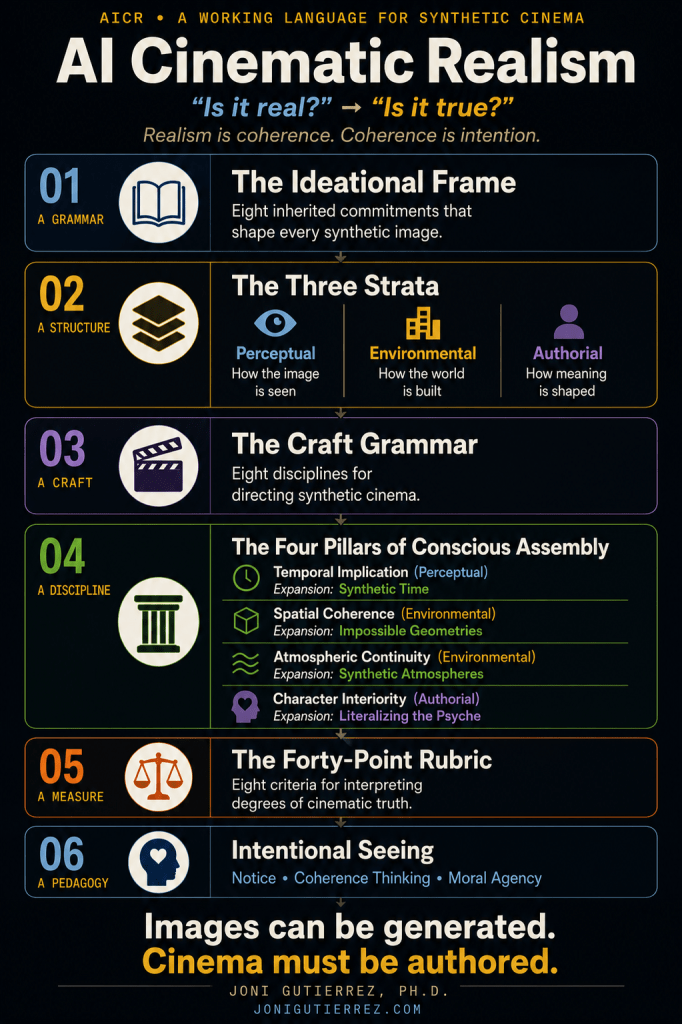
Abstract
AI Cinematic Realism (AICR) argues that realism in synthetic cinema can no longer be measured by photographic indexicality alone. In the post-camera era, an image’s claim to realism rests on felt coherence — perceptual stability, world coherence, emotional plausibility, and accountable authorship working together. AICR treats AI-generated images as constructions rather than captures, and offers a vocabulary for evaluating when synthetic cinema feels true. Realism is coherence; coherence is intention.
I. Introduction
A. The problem of realism after the camera. Generative AI destabilizes the assumption that cinematic realism depends on a camera recording a real event. AICR begins from this rupture and shifts the central question from “Is it real?” to “Is it true?” The shift matters because synthetic images can be convincing without being indexical; their credibility is built, not captured.
B. Research claim. AI cinema requires a new realism framework. Photographic criteria alone cannot account for how audiences perceive credibility, meaning, or affect in synthetic images. AICR integrates aesthetics, phenomenology, and ethics into a single analytic structure, grounded in a century of cinematic meaning-making rather than in novelty.
II. Historical Lineage
A. Realism as redemption and trace. Cinematic realism has historically been theorized through capture. For Siegfried Kracauer, film redeemed physical reality by preserving the contingent flow of the life-world; for André Bazin, the photographic image carried an indexical bond to “what has been.” Both located realism in the image’s physical contact with the world, a logic that shaped realist film theory and remains embedded in common notions of authenticity.
B. Realist interruptions. Successive movements — from Méliès’s constructed illusions to Italian Neorealism, Cinéma Vérité, and Dogme 95 — repeatedly revised what counted as truth on screen without abandoning realism as an aim. AICR situates itself in that revisionist lineage while responding to a rupture none of those movements faced: the arrival of images with no photographic referent at all.
III. Ontological Shift
A. From indexical trace to ideational synthesis. AI-generated images are synthesized from data patterns rather than recorded from events. AICR names this movement from indexical trace to ideational synthesis. Where photography preserved “what was,” generative systems propose “what could be.” Realism therefore becomes a matter of constructed plausibility rather than captured evidence.
B. Why ontology matters. Once the image is no longer guaranteed by physical contact with the world, realism must be judged by how the image organizes perception, meaning, and trust. The question is no longer what was captured, but what has been made legible as true. This is the ontological starting point for the framework.
IV. Philosophical Foundations
A. From the Lebenswelt to emotional plausibility. AICR extends a Kracauerian lineage. Kracauer’s redemption of physical reality drew on Husserl’s Lebenswelt — the pre-reflective life-world of flux and contingency. The seven tropes distilled from that tradition (quotidian, transient, refuse, fortuitous, indeterminate, flow of life, and the spiritual life itself) operate in AICR as a diagnostic grid, now testing whether synthetic images can evoke lived experience without a lens. The redemptive object shifts from physical reality to emotional truth: emotional plausibility.
B. Phenomenology and embodied perception. Realism is experienced in the body before it is theorized by the mind. Drawing on Merleau-Ponty’s account of embodied perception, AICR holds that a synthetic image is cinematically real when it produces a believable embodied response. Viewer presence and felt credibility are central to the framework.
C. Posthuman realism. Through the extended-mind account of distributed cognition, AICR treats AI not as a mere tool but as a cognitive extension, and realism as a distributed accomplishment across human intention, machine generation, and viewer interpretation. Meaning emerges through interaction rather than from a single source.
V. The Ideational Frame: Cinema’s Inherited DNA
A. Why synthetic images read as cinematic. AI images achieve cinematic legibility not by imitating cameras but by activating the perceptual and narrative structures that have organized cinematic meaning for over a century. Generative models are trained on the visual culture cinema shaped, and they inherit its deep commitments. The Ideational Frame names these inherited logics — the cinematic DNA synthetic images already carry, whether or not creators consciously invoke it.
B. The eight components. The Frame isolates eight recurring cinematic inheritances: implied temporality, spatial coherence, character interiority, atmospheric integration, narrative implication, embodied vantage, material plausibility, and expressive world-building. These are not stylistic embellishments but the underlying commitments that make an image readable as cinema.
C. Foundation, not adjacent layer. The Ideational Frame is not one structure among several. It is the conceptual substrate from which the rest of AICR’s architecture derives. The three strata are its structural resolution: the Frame supplies the components; the strata organize them into an analytic architecture grounded in cinematic lineage and viewer cognition.
VI. The Three Strata
A. Resolution of the Frame. The eight components cluster into three kinds of cinematic commitment, yielding the three strata of AICR. They are derivations from the Frame, not categories imposed upon it.
B. Perceptual stratum. Concerns how the image is seen — the immediate, moment-to-moment experience of the frame. Its components include optical coherence, temporal stability, embodied motion, and material behavior. The question is whether the image holds together at the level of direct seeing, before the mind is given a chance to believe the world.
C. Environmental stratum. Concerns how the world is constructed — the spatial, causal, and atmospheric logic that gives images continuity. Its components include spatial logic, environmental causality, diegetic continuity, ecological plausibility, and sociocultural texture. Even stylized or impossible worlds succeed if they remain internally legible.
D. Authorial stratum. Concerns how meaning is shaped — point of view, narrative causality, stylistic identity, ethical awareness, and interpretive depth. It asks whether the work feels meaningfully authored rather than merely produced, even when authorship is distributed across human and machine.
E. Interaction. Realism emerges from the interplay, not from any single stratum. Perceptual and environmental together yield physical believability; environmental and authorial yield narrative worldbuilding; perceptual and authorial yield stylistic intentionality; all three together yield cinematic realism. Realism is coherence. Coherence is intention.
VII. The Craft Grammar
A. The production counterpart to the Frame. The Ideational Frame names what a synthetic image must achieve; the Craft Grammar names how the maker achieves it. Drawing from a century of staging and cinematography, it translates cinema’s inherited methods into a production language for the post-camera era. The physical tools may have dissolved, but the reasoning behind them remains.
B. The eight craft disciplines. The Craft Grammar consists of directorial control, worldbuilding by design, expressive surface, synthetic performance, architecture of attention, latent optics, psychological vantage, and resonant flow. Together, these disciplines address the arrangement of the scene, the construction and illumination of the world, the orchestration of figures, the direction of attention, and the synthetic equivalents of lens, angle, and camera movement.
C. From physical craft to latent-space authorship. Directorial control becomes total because every element is placed rather than discovered. Worldbuilding by design and expressive surface allow setting, lighting, costume, and texture to carry narrative feeling without being limited by physical production. Synthetic performance authors presence through blocking and gesture, while the architecture of attention uses composition to make emotion and subtext visible. Latent optics, psychological vantage, and resonant flow reimagine lens, angle, and movement as expressive structures rather than mechanical camera operations.
D. Relationship to the strata. The Craft Grammar provides the inherited methods by which the maker reaches the three strata on purpose: worldbuilding and surface primarily serve the environmental stratum; performance serves the authorial stratum; and optics, vantage, and movement shape the perceptual stratum. It is the bridge between the commitments of the Ideational Frame and the Four Pillars of Conscious Assembly, where inherited cinematic reasoning begins to expand beyond what a physical camera could achieve.
VIII. The Four Pillars: The Discipline of Conscious Assembly
A. Conscious assembly. Where the strata describe how realism is read and evaluated, the four pillars name the construction problems the maker must consciously solve. In place of the camera’s reactive capture, the maker engineers the emotional and structural logic a lens once supplied. This is Conscious Assembly.
B. Temporal implication. The suggestion of before, during, and after without literal photographic motion. Its expansion is synthetic time — impossible momentums and non-linear markers of age — treating time as a malleable texture rather than a straight line.
C. Spatial coherence. The organization of geometry, scale, and perspective so a world feels inhabitable. Its expansion is impossible geometries: surreal or dream-like spaces that defy physical law yet remain phenomenologically sound — felt as “right” even when known to be impossible.
D. Atmospheric continuity. The persistence of mood, tone, light, and ambient feeling across a scene. Its expansion is synthetic atmospheres — impossible light or texture with no natural equivalent but perfect internal logic — using atmosphere as a narrative agent that binds the frame into a stable experience.
E. Character interiority. The degree to which a synthetic figure appears to possess psychological depth. Beyond rendering “inner weather” in a gaze, its expansion literalizes the psyche: the environment itself shifts to mirror a character’s internal state, turning inner life into visible cinematic reality.
IX. Glitch and Texture
A. Reframing imperfection. AICR does not treat glitches only as defects. Shimmer, drift, and slight inconsistency can function as meaningful signs of machine mediation — texture rather than failure, and honest markers of synthesis.
B. Limits of polish. Excessive smoothing can weaken cinematic truth by erasing the visible signs of synthesis. Over-polish can make an image feel less honest, not more believable. AICR values calibrated imperfection when it supports expressive honesty: imperfection can be proof of conscious assembly.
X. Ethics and Authorship
A. Accountable authorship. The human maker remains morally responsible for prompts, selection, editing, and publication. The machine generates outputs but does not assume ethical responsibility. Authorship is central because realism carries moral force.
B. Consent, likeness, and trust. Synthetic media raises concerns about consent, representation, and the erosion of evidentiary trust. A convincing image can persuade, mislead, or exploit depending on how it is framed. AICR argues that realism is never neutral: it shapes belief and cultural memory. The framework’s commitments — to ontological stakes, accountable authorship, and emotional plausibility — treat ethics as part of the definition of realism, not an addendum to it.
XI. Evaluation Rubric
A. The 40-point rubric. AICR’s primary evaluative instrument is a 40-point rubric built on eight criteria, each scored from 1 to 5. The criteria move evaluation beyond surface polish, treating realism as a multi-layered achievement across perception, environment, time, character, mood, intention, emotion, and responsibility.
| Criterion | Focus |
| 1. Perceptual Realism | Visual fidelity, lighting, texture, sensory impact |
| 2. Environmental Realism | Spatial logic, physics, reflections, stability |
| 3. Temporal Coherence | Motion, pacing, continuity over time |
| 4. Character Realism | Embodiment, facial consistency, expression |
| 5. Atmospheric Continuity | Tone, mood, color grading, weather |
| 6. Authorial Intentionality | Deliberate human choice over machine output |
| 7. Emotional Plausibility | Affective force, resonance, experiential truth |
| 8. Ethical Accountability | Consent, transparency, representation |
B. Scoring and tiers. Each criterion is scored 1 (absent) to 5 (excellent), and the eight scores sum to a total out of 40, interpreted through four tiers:
| Total | Interpretation |
| 32–40 | Highly convincing AI cinematic realism; the technology dissolves completely. |
| 24–31 | Strong realism with noticeable limitations; persuasive in bursts. |
| 16–23 | Developing realism with major weaknesses; structural inconsistencies recur. |
| 8–15 | Not yet cinematically persuasive; a collection of visual fragments. |
The numerical score never stands alone; brief qualitative notes accompany it so the evaluator can capture why a scene succeeded or failed.
C. Pedagogical use. A lighter three-strata checklist — perceptual, environmental, authorial — serves classroom critique and prompt iteration. Together, the instruments let students analyze synthetic images without reducing critique to “looks real” versus “looks fake,” encouraging intentional seeing and more precise discussion of how realism is assembled.
XII. Research Implications
A. For film theory. AICR extends realism theory into the generative era by replacing photographic proof with experiential credibility, inviting scholars to rethink indexicality, authorship, and spectatorship in post-camera media.
B. For practice and production. AICR offers creators a vocabulary for directing synthetic cinema with greater rigor — informing prompting, curation, editing, and visual design. It is useful both analytically and practically.
C. For media ethics. AICR helps distinguish aesthetic persuasion from deceptive simulation — an increasingly urgent distinction as synthetic images circulate across public and cultural institutions. Ethics becomes part of the definition of realism itself.
XIII. From Framework to Practice
A. For AI filmmakers. AI Cinematic Realism for AI Filmmakers: The AICR Framework, Its Ideas, and Its Craft translates AICR from theoretical architecture into the perspective of the working maker. It connects the Ideational Frame, Three Strata, Craft Grammar, Four Pillars, ethics, evaluation, and Intentional Seeing to the practical decisions involved in creating synthetic cinema.
B. From principles to production. The AI Cinematic Realism (AICR) Production Manual operationalizes the framework as a production workflow, carrying AICR into preproduction, generation, evaluation, continuity, postproduction, and final audit. It treats filmmaking as a process of conscious assembly rather than prompt execution.
C. Theory and practice as one system. Together, these resources position AICR as both a framework for understanding synthetic cinema and a discipline for making it. The theory supplies the principles; the craft translates them into creative decisions; the production process puts those decisions into practice.
XIV. Teaching and Pedagogy
A. AICR in the classroom. Teaching AI Cinematic Realism (AICR): An Open Syllabus extends the framework into formal film and media education. The thirteen-week course situates AICR within the historical tradition of cinematic realism before moving through generative media, the framework’s conceptual architecture, ethics, evaluation, and creative practice.
B. From framework to curriculum. Published openly for adoption and adaptation, the syllabus provides a structured pathway for teaching AICR at the upper-division undergraduate or graduate level. It positions the framework not only as a theory to be studied or a practice to be applied, but as a developing body of knowledge that can be taught, tested, critiqued, and extended by others.
XV. Conclusion
AICR is best understood as a theory of cinematic truth under conditions where images are constructed rather than captured. Its contribution is to show that realism in AI cinema depends on perceptual stability, world coherence, authorial responsibility, and emotional plausibility working together — felt coherence rather than photographic trace. Grounded in cinema’s inherited grammar and a Kracauerian lineage, AICR is both a critical framework and a creative ethic for the post-camera era. Realism is coherence; coherence is intention.


Leave a comment