
What survives the crossing from what a filmmaker means to what a model can make?
Study 33, First Lesson, is a 57-second film about Rosa, a woman in her seventies, taking a driving lesson in her late husband’s car. It has eight shots and five lines of dialogue. Nothing dramatic happens. A young instructor asks her to bring the seat forward. She says, “He was taller.” She adjusts the mirror, asks what comes next, and pulls away from a green light. On the corner, her husband watches the car go.
I made it in Google Flow with Omni 1.1 Flash, as practice for a Bellevue College workshop and as the film I would screen in its first minutes. That double purpose shaped the study. I needed a film that worked, and I needed an honest record of what it took to get there.
Study 32 asked whether a synthetic person could have a life. It drew on a distinction the AICR Production Manual calls the translation layer: some constraints survive as prompt language, some survive only through references, and some cannot be transmitted at all. The AI Cinema Lab now treats each Study as a test round for that layer. Study 33 is the first one built for it on purpose.
So this write-up follows the framework the whole way through. It starts with the commitments the film makes before any generation, reads the film through the Ideational Frame and the four pillars, logs every failure by stratum, and ends with a light pass and the question of who answers for the result.
The film
Watch Study 33: First Lesson (2026) on YouTube
| Shot | Framing | What happens |
| 1 | Wide | The green sedan at the curb, a wet street of autumn leaves |
| 2 | Two-shot | She and the young instructor, clipboard in hand. “Let’s bring your seat forward a little.” / “He was taller.” |
| 3 | Insert | Her hand on the seat lever |
| 4 | Close-up | The rearview mirror. “Now the mirrors.” |
| 5 | Medium | “Now what?” / “Now you drive.” |
| 6 | Close-up | Her face. A small nod, and the worry lifts |
| 7 | From behind | The car at a green light |
| 8 | Exterior | Her husband on the corner as the car drives away. He smiles, closes his eyes, and exhales |
The end card reads: Study 33: First Lesson. Made with AI in Google Flow.
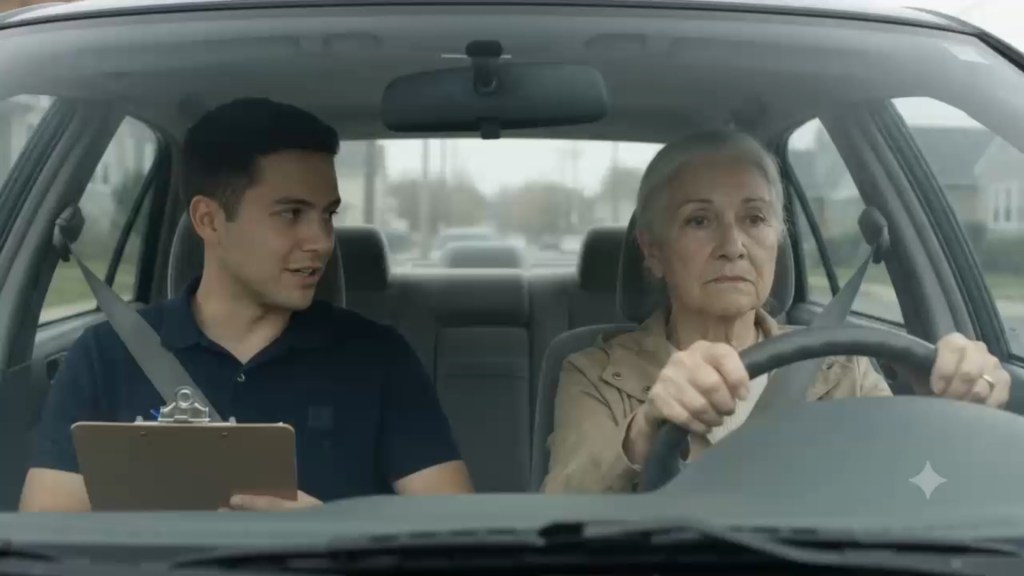
Figure 1. Shot 2. The instructor turns to her before the lesson begins.
Before generation: what the film commits to
The Production Manual asks for three bibles before any generation: an authorial bible, a style bible, and a world bible. It also asks for a test of the authorial stratum that is harder than any prompt: complete the sentence “This exists because ______.”
For First Lesson, the sentence is: this exists because love does not end when someone dies. It stays, and it wants the person left behind to keep living.
Written out the way the Manual asks, the commitments looked like this.
| Bible | Commitment |
| Authorial: thematic spine | Love survives, and it wants us to live. |
| Authorial: narrative commitment | One lesson, one Sunday morning, no backstory spoken beyond three words |
| Authorial: genre grammar | Quiet domestic drama. No music cues, no tears, no speeches |
| Authorial: character logic | Rosa is proud and a little stubborn, hides her nerves with dry humor, and goes still rather than showing feeling on her face. The instructor is patient and professional. Her husband is present but never haunting |
| Style | Eye level, mid-distance, natural color, a camera that observes rather than performs |
| World | A Pacific Northwest neighborhood of craftsman houses in late autumn. Overcast, wet, leaves on the street. No sun |
The concept came from my own life. My father died a few months before I made this film, and that loss shaped its central images. The car crossing the intersection under a green light is permission to go on. The old man on the corner smiles, closes his eyes, and lets out a final breath. He is not watching her leave him. He is sending her on to live the rest of her life, until it is time for them to meet again.
Most of the authorial bible was written by subtraction. Early drafts of the concept included a watch, a photo tucked in the visor, and a mother-and-son dynamic. Each one told the audience what to feel. Each one came out. One early version came too close to the premise of Study 29, so it went too. What remained was a seat set for a taller man.
That seat is the film’s real thesis. The Framework in Full makes the point directly: a thematic spine cannot be prompted, but its recurring objects, palettes, and spaces can. The seat is the spine made into an object.
Building the characters
The characters who recur across shots were built before the film, in Flow’s character builder. Each one got a portrait, a body reference, and a short written profile. The husband was not. He appears in a single shot, so there was no continuity to protect, and he was generated directly in that shot. The car, which does recur, got a reference of its own, so the same dark green sedan could appear in every shot. In Production Manual terms, the profile carried the character logic and the references carried the identity.
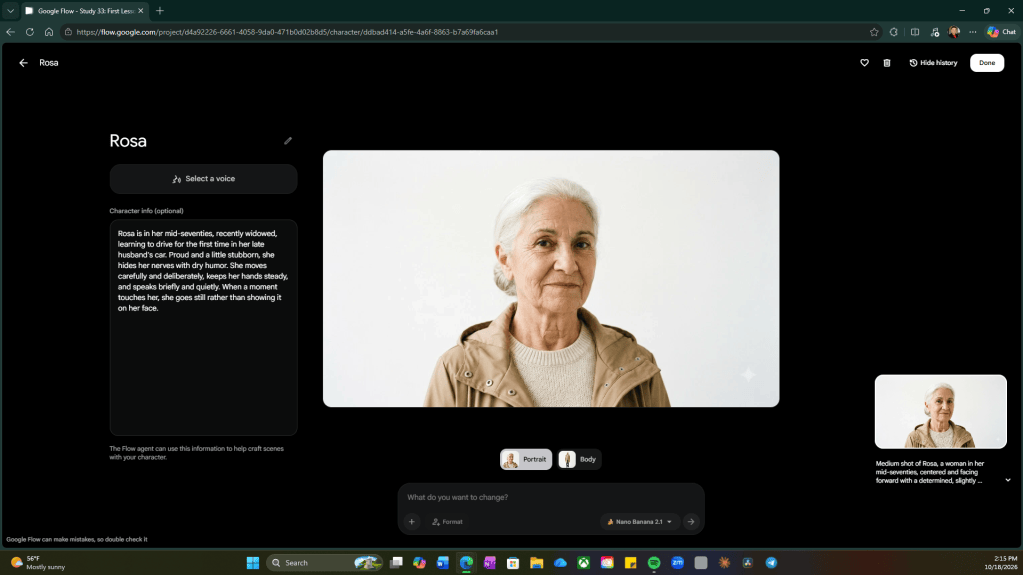
Figure 2. Flow’s character builder, open on Rosa. Identity is carried by the references, and character logic by the written profile.
Three practical lessons came out of this step before a single shot existed.
- An edit is not a recast. Editing a character in Flow keeps the face. A different person needs a new character, built fresh. Identity is reference-legible, and the reference wins over any later instruction.
- References are a budget. Veo 3.1 accepts three reference images, and each character counts as two. Omni 1.1 Flash accepts up to seven and also generates sound. For a scene with two people in a car, that difference chose the model.
- Pick the model out loud. I set the video default to Omni 1.1 Flash, but the Agent session kept reading Veo. Every request to the Agent ended up opening with “Using Omni 1.1 Flash,” ahead of the scene description itself.
The character logic for the husband needed the most care. He is dead, and he is on screen. The Manual’s emotional grammar asks for an emotional range and a gesture vocabulary for every figure. His range was narrow on purpose: happy, unhurried, at peace. Not a ghost, not a memory effect, not a sad man watching from the past. If he looked grieving, the film would be about his loss. Because he looks at peace, it is about her life going on.
Voice was the one place the builder fell short. Flow’s voice library has few voices that sound like people in their seventies. Rosa’s character page still reads “Select a voice” (Figure 2). Voice identity is reference-legible, but only if the reference exists.
The Ideational Frame, shot by shot
The Ideational Frame names the eight commitments a synthetic image carries whenever it reads as cinema. An image breaks when it violates one of them, not when it stops matching reality. Going through First Lesson commitment by commitment shows where the film earns its belief, and where it nearly lost it.
| Commitment | Stratum | Where it lives in the film |
| Implied temporality | Perceptual | “He was taller.” Three words imply decades of a seat set for someone else |
| Embodied vantage | Perceptual | The windshield view in shots 2 and 5 holds a steady, grounded vantage, like a camera mounted on the hood. Shot 7 watches from behind as she leaves |
| Material plausibility | Perceptual | Wet asphalt, sodden leaves, her hand on the lever. Weakest where the seat had to move |
| Spatial coherence | Environmental | One street, one intersection, one corner. Threatened by the car’s habit of drifting to the center of the road |
| Atmospheric integration | Environmental | Overcast light binds all eight shots into one morning |
| Expressive world-building | Environmental | Late autumn, an ordinary neighborhood, a car older than the instructor. A season of endings that is still a place people live |
| Narrative implication | Authorial | The seat, the mirror, the green light. Each frame is a consequence of a death the film never shows |
| Character interiority | Authorial | Her nod in shot 6. His smile in shot 8 |
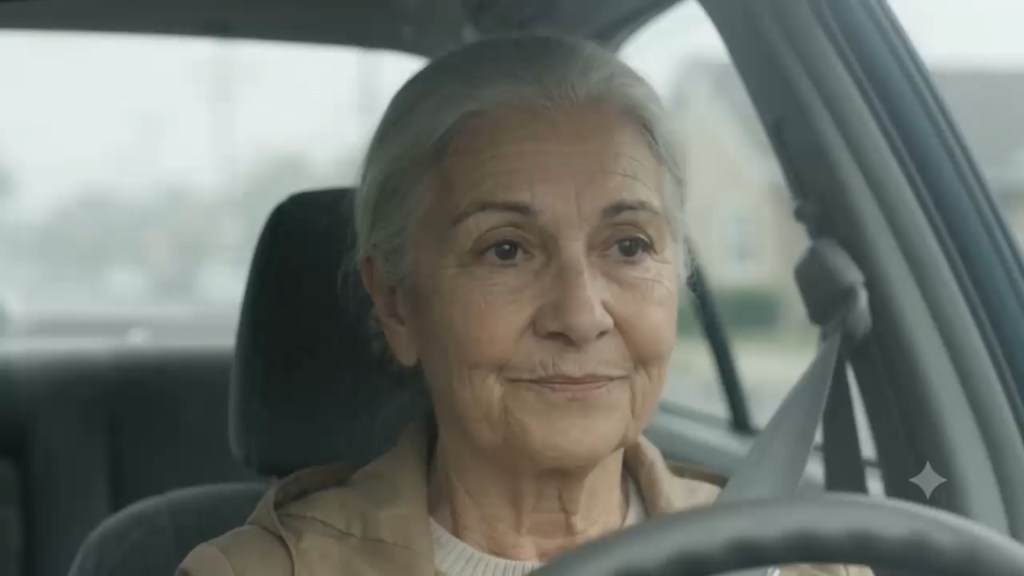
Figure 3. Shot 6. A small nod, and the worry lifts.
The commitment that carries the film is implied temporality, and it is carried almost entirely by dialogue. “He was taller” does the work of a flashback without one. A model can render a seat. It cannot render the years someone spent sitting in it. Three words can.
Conscious assembly: the four pillars
A camera inherits coherence from a world that was already coherent. A synthetic film has no such world behind it. Conscious assembly is the name for building that coherence on purpose, and the four pillars mark where the building is heaviest. In First Lesson, each pillar asked for a different kind of decision.
Temporal implication: a death that happened before the film
Temporal implication is the suggestion of a before, a during, and an after. The film’s “before” is a marriage and a death, and neither appears. The film implies them through the seat, through one line, and through a car that is clearly not hers.
Its expansion, synthetic time, arrives in the last shot. A man who is gone stands on the same wet corner, in the same light, on the same morning. The film does not mark him as a flashback or a vision. He simply shares her present tense.
Spatial coherence: the road that would not move
Spatial coherence asks that geometry, scale, and perspective hold together as a space a body could step into. This was the pillar the model fought hardest. The car kept settling into the middle of a two-way street. That is not an impossible geometry. It is an inconsistent one, and the viewer’s body notices.
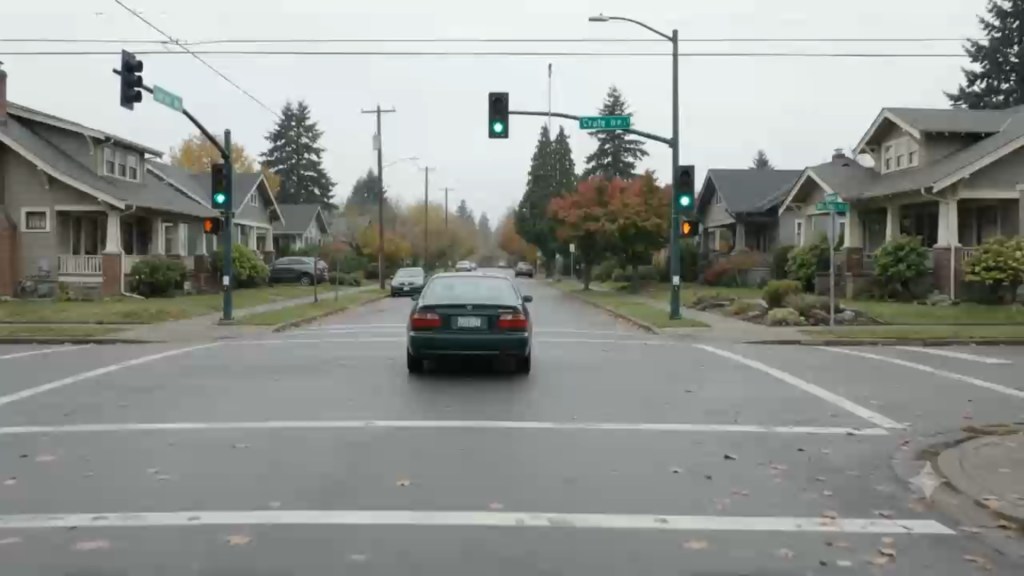
Figure 4. A rejected take. The car drives down the center of a two-way road, a failure of spatial coherence. It is also a different sedan, despite the car’s reference: the plate sits higher and the taillights are a different shape. The plate is not blurred, and the street sign is garbled.
Atmospheric continuity: refusing the sunlight
Atmospheric continuity is the persistence of mood, tone, and light across a scene. At one point a shot of sunlight breaking through the clouds looked tempting. It would have been the most beautiful frame in the film, and it would have told the audience exactly what to feel. It also would have broken the gray that ties eight separate generations into one morning. The weather stayed gray. The light had to come from her face, not from the sky.
Character interiority: two faces, one turn
Character interiority is the sense that a figure has an inside. The film gives it to two people, in two close shots that answer each other. In shot 6, she nods, and the worry lifts. In shot 8, he watches the car leave, smiles, closes his eyes, and lets out a final breath.
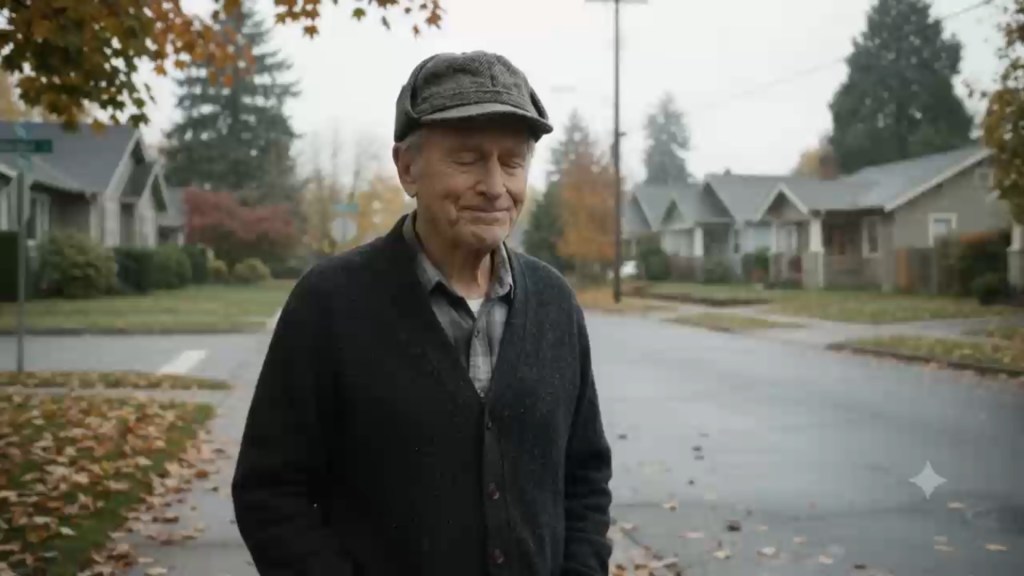
Figure 5. Shot 8. Her husband on the corner, smiling, eyes closed.
Here is the prompt that made shot 8, as I wrote it:
A quiet residential street on an overcast morning, clear and gray with no fog or mist, the same even gray light as the rest of the street, wet autumn leaves at the curbs. In the foreground, a tall older man in his late seventies stands alone on the sidewalk, half a block back from the intersection, wearing a worn gray wool cap and a dark cardigan, hands in his pockets. He is seen in three-quarter profile, looking down the street ahead of him. Far down the street, already past the intersection, the dark green sedan drives away from him in the right-hand lane, small and growing smaller; it never comes near him. As he watches it go, his whole face softens into a deep, peaceful smile, his eyes bright and glistening. He lets out a slow breath and briefly closes his eyes, at ease, as if something long held has finally been let go. He doesn’t wave or move. Static medium shot, his face in focus, the street and the car softly in the distance. Sound: the faint engine fading away, his slow breath, then stillness. No dialogue. No music.
Read against the translation layer, the prompt does three kinds of work at once. Most of it is text-legible: the light, the weather, the lens, the blocking, and the silence policy written out in full. Some of it is legislation against known failures: “the same even gray light as the rest of the street” protects atmospheric continuity, and “in the right-hand lane” fights the center-of-the-road drift. And one phrase reaches for what cannot be prompted: “as if something long held has finally been let go.” That is where the prompt comes closest to the thematic spine: his peace is what love looks like when it wants someone to live. The model can render a smile, a breath, and closed eyes. Whether they add up to that is decided afterward, in the choosing and the cutting.
This is the pillar’s expansion, literalizing the psyche, used quietly. The film never says whether he is there, whether she imagines him, or whether he is simply what her going on looks like from the outside. Because the maker authors the whole world, an inner state can stand on a street corner. Here it stands still and wants her to live.
The generative loop: locate it, do not reroll it
The Manual’s generative loop has four steps: generate, evaluate, correct, regenerate. The step that matters most is the third, and the Manual is blunt about it: correction is not fixing prompts. It means naming the failure, locating it in a stratum, and restoring the discipline it broke. Often the fix is authorial, not a change of wording.
Here is the rejects log for First Lesson, one line per failure.
| Failure | Stratum | What broke | Correction | Kind of fix |
| The seat would not slide forward | Perceptual | Material plausibility | Rerolled closer, on her hand and the lever; the cut implies the motion | Tightened constraint |
| Rosa reached for the passenger seat, an open door appeared, and the instructor vanished | Environmental | Spatial coherence | Rerolled closer, so only her hand and the driver’s seat remain in frame | Tightened constraint |
| The key would not turn | Perceptual | Material plausibility | The key turn never appears on screen | Authorial |
| The car settled into the center of a two-way road | Environmental | Spatial coherence | Regenerate; edits could not move it | Regeneration |
| Edits changed framing but not the street behind | Environmental | Spatial coherence | Treat background layout as fixed once generated | Workflow |
| Music and invented dialogue appeared unprompted | Sonic | Silence policy | “No music. No dialogue.” in every prompt that needed silence | Text |
| A Toyota emblem appeared despite “no logos” | Environmental | Cultural semiotics | Kept, as a named fracture | Accepted |
| Colors drifted between generations | Perceptual | Style continuity | Carry color through references, not words | Reference |
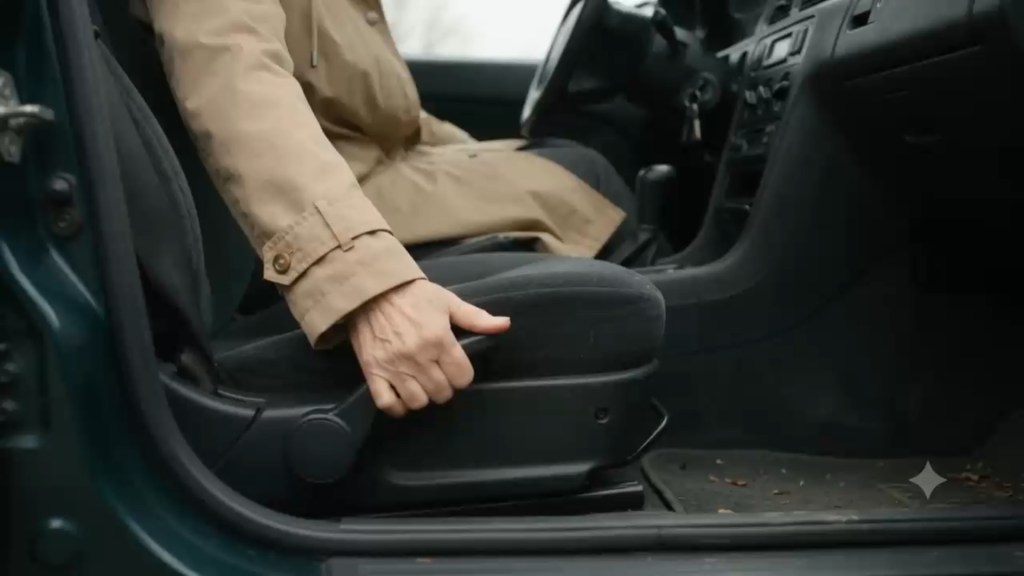
Figure 6. A rejected take. Rosa adjusts the passenger seat instead of her own, a door that should be closed stands open, and the instructor has vanished.
Figure 6 is a spatial failure hiding inside a mechanical one. Asked for her hand on the seat lever, the model moved her to the wrong seat, opened a door, and erased the instructor. Every detail in the frame is plausible on its own. Together, they describe a different car.
The mechanical failures are the instructive ones. Sliding a seat forward and turning a key are small, ordinary motions. Both failed again and again. The model could show a hand near a lever and a seat in a new position, but not the motion that connects them. It knows what things look like better than it knows how things work.
The fix was a reroll, but not a blind one. I asked for the shot closer, on her hand and the lever, so the car around her had no room to go wrong. That is what the Manual calls constraint tightening: regenerate with a refined constraint, not the same one again. The tighter insert, followed by a cut, lets the audience assemble the motion the model could not. The oldest tools in cinema, framing and editing, solving the newest problem in it.
The emblem: a fracture, named
The AICR framework separates authored imperfection, which reads as texture, from accidental imperfection, which reads as defect. It is strict about the middle case: an artifact the maker notices and leaves in is a continuity fracture, not texture. Noticing does not make it intentional.
The Toyota emblem on the trunk in shot 7 is that middle case. The prompt said “no logos” and asked for the license plate to be blurred. In the same shot, the model blurred the plate and kept the emblem. One instruction held and its neighbor did not, which says something about how unevenly text-legible constraints are honored. The take was good, so I kept it. It does not break a pillar. A brand mark on an ordinary sedan is a real-world detail, not a lie about the world. But it is not a choice I made, and calling it texture would be dishonest. It is a fracture, accepted and named here.
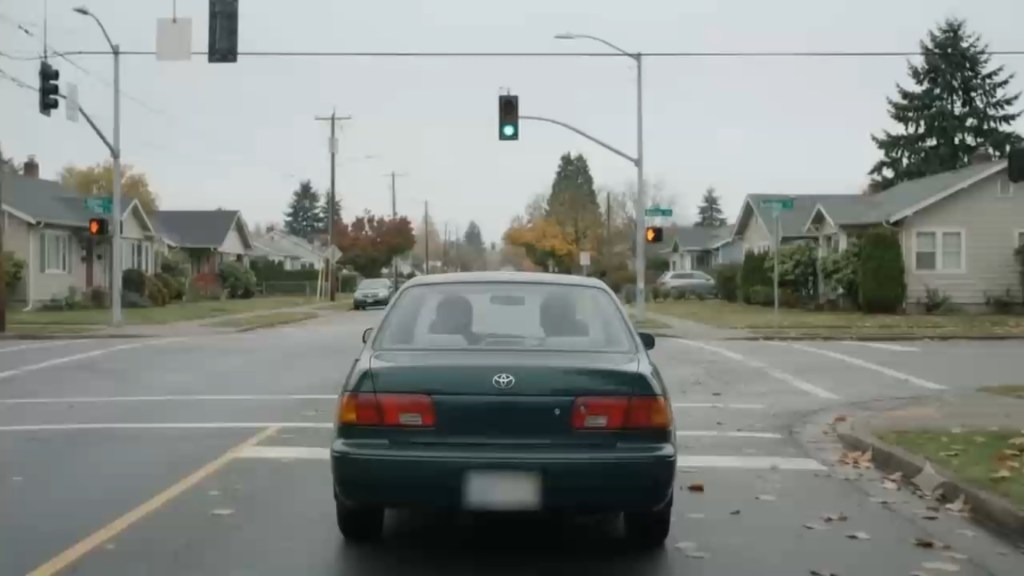
Figure 7. Shot 7. The license plate is blurred, as requested. The emblem, which the prompt also asked the model to leave out, stayed.
The translation layer: what survived the crossing
The bibles are written for people. The model reads something else, and the crossing is lossy. The Manual sorts every constraint into one of three translation modes:
- Text-legible: survives as prompt language and mostly holds.
- Reference-legible: cannot survive as words alone; it transfers through reference images, first frames, seeds, or voice samples.
- Enforcement-only: cannot be transmitted at all; it is enforced in evaluation and postproduction.
Study 33 was built to test that sorting. Here is how each constraint was classified, and what it turned out to be.
| Constraint | Classified as | Behaved as |
| Eye-level, mid-distance framing | Text-legible | Text-legible. Held, and responded to conversational edits |
| Overcast weather, wet leaves | Text-legible | Text-legible. Held across all eight shots |
| Silence policy | Text-legible | Text-legible, but only when restated in every prompt |
| “No logos,” blurred license plate | Text-legible | Uneven. The plate blur held in shot 7; the emblem stayed |
| Colors described in words | Text-legible | Reference-legible. Drifted in words, held in references |
| Faces, bodies, mixed-race features | Reference-legible | Reference-legible. Held when built fresh as characters |
| Voices in their seventies | Reference-legible | Limited by the library. No suitable reference to give |
| The seat sliding, the key turning | Text-legible | Untranslatable. Framed out and carried by the edit |
| Thematic spine, emotional rhythm, the husband’s peace | Enforcement-only | Enforcement-only. Carried by selection and cutting |
Two patterns stand out.
First, text is good at instructions and weak at identity. Every constraint about how the world behaves, its light, its weather, its framing, survived as words. Every constraint about what a specific thing is, its color, its face, needed a reference.
Second, the costliest mistake was a misclassification. The Framework in Full warns that misclassifying an enforcement-only constraint as text-legible “wastes more generation than anything else.” The seat proved it at a smaller scale. I treated a simple physical action as text-legible and spent generation after generation on it. The Manual’s prompt architecture already has a place for this, untranslatable constraints, and its answer is the one the film used: stop prompting for the motion, frame it out, and let the edit carry it.
The sonic layer: a defined silence
The Manual’s sonic layer asks one governing question: does the world sound like itself? It begins with two decisions, a sonic spine and a silence policy.
The sonic spine for First Lesson: a quiet street on a wet Sunday morning, so that five spoken lines can carry the whole film.
The silence policy followed from it. No music, anywhere. No dialogue beyond the five lines. Ambient sound fills the frame whenever no one speaks. The last shot, her husband on the corner, plays under almost nothing, and the end card is silent.
This was the layer where the model pushed hardest in the wrong direction. Omni 1.1 Flash generates sound with the image, and left alone it added music and invented dialogue. Both are the model’s default idea of what a tender scene sounds like. Both would have turned the film into the sentimental version I had already cut from the authorial bible.
So the silence policy had to be written down, every time: “No music. No dialogue.” The Framework in Full asks for “a silence policy that is defined rather than accidental.” In a model that scores its own scenes, an undefined silence does not stay silent. It gets filled.
A light pass across the strata
The forty-point rubric is the full instrument, meant for close study and juries. For a maker’s own iteration, the framework offers a lighter pass with the same logic: does the surface hold, does the world hold, does it sound like itself, does it feel authored?
Does the surface hold? Mostly. Faces stay themselves across shots, and the wet street behaves like a wet street. The perceptual stratum is weakest exactly where the film avoids showing motion: the seat and the key. Those were framed out and cut around rather than solved, and the cuts hold.
Does the world hold? Yes, because it was protected. One overcast morning, one neighborhood, one season. The center-of-the-road drift was the one real threat, and it was regenerated out rather than accepted. Together with the surface, this is what the framework calls physical believability: a world that looks seen.
Does it sound like itself? Yes, once the model’s defaults were overruled. Without the silence policy, it would have sounded like a different and worse film.
Does it feel authored? This is the row no model update fixes, and the one the film was built to pass. The authorial stratum lives in what was left out: the watch, the photo, the sunlight, the music, the backstory. Where the environmental and authorial strata meet, the framework names narrative worldbuilding, a place that means. A gray street in late autumn means something here because nothing in it is decorative.
The pass locates the film’s weak point clearly. It is not the world or the meaning. It is the perceptual stratum at the scale of small mechanical action, the hand and the lever, which is where this generation of models still breaks.
Accountable authorship
AICR holds that the maker is not a prompt typist but a moral agent. I prompted these images, chose among them, cut them together, and published them. The model did not decide that a dead man should smile. I did, and I answer for it.
The framework’s three commitments put that responsibility into questions.
Ontological stakes: what must this fabricated image mean, and for whom? First Lesson borrows no one’s face, home, or likeness. But it is not without a referent. My father died a few months before I made it, and the film is where that loss went. Its claim is not “this happened” but “this is how it can feel,” and I know how it feels. Kracauer saw film’s greatness in the redemption of physical reality. A generated image has no physical reality to redeem. What it can carry is an experience the maker brings to it. The film’s honesty depends on that experience being real, even when every pixel is not.
Accountable authorship: what does each choice cost? The Manual places ethical framing inside postproduction, treating representation as a continuity question. Two choices carried that weight here. The first was how to show a woman in her seventies learning something new: competent, unhurried, not frail, not a joke. The second was the husband. A dead figure can easily become an effect, a glow or a fade or a ghost. Giving him a flat cap, a wet corner, and an ordinary smile was a decision about his dignity as a synthetic figure.
The limits matter too. A voice library with few older voices is a representation problem, not only a casting one. When a tool has fewer ways to sound seventy than to sound thirty, the films it makes will skew young unless someone notices.
Emotional plausibility: does the moment persuade? The test is the moment, not the pixels. The film works if the nod in shot 6 lands as a decision. It fails if it lands as a model performing relief.
Disclosure closes the loop. The end card reads Made with AI in Google Flow, and Flow’s visible mark stays in the corner of every shot. Neither apologizes for the film. Both tell the viewer what kind of truth to look for.
In the classroom
First Lesson opened “AI Filmmaking and Creative Video Generation,” a Continuing Education workshop at Bellevue College on October 17, 2026. The film ran first. Then the Flow project opened on screen, so participants could see the characters, the prompts, and the failed takes behind the 57 seconds they had just watched.
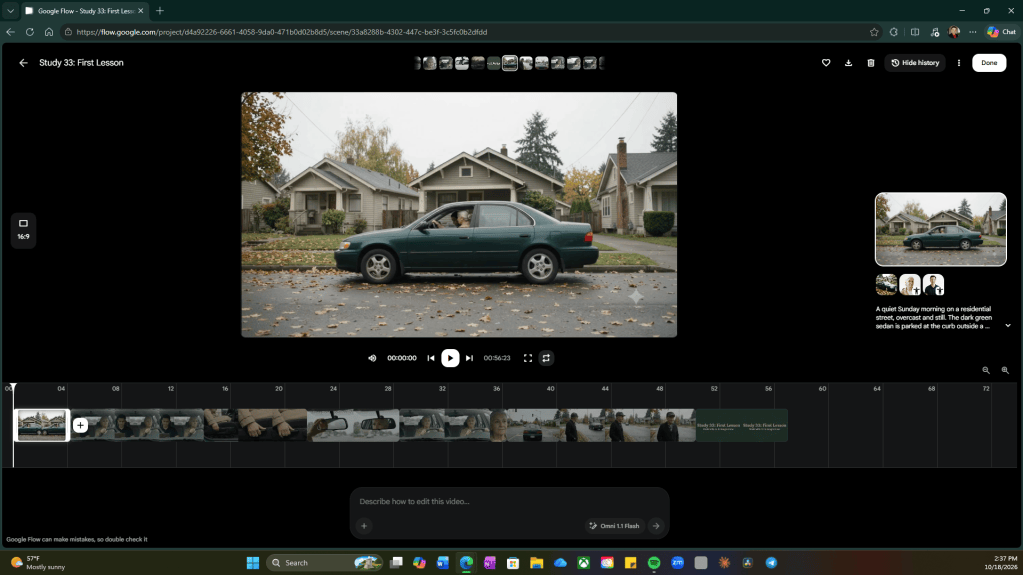
Figure 8. The finished scene in Flow: every shot and the end card on one timeline, with references for the car, Rosa, and the instructor.
That order mattered. A finished film invites the question “how did the AI do that?” The project answers a better one: what did the filmmaker decide, and where did the model push back? The framework’s pedagogy names this shift. It treats the strata as faculties of attention: noticing at the perceptual surface, coherence thinking about the world, and moral agency about what the work means. A rejects log is a good place to start practicing all three.
A lesson in two directions
The title was meant for her. It turned out to describe the production too.
She learns where the seat goes, where the mirror points, and when to go. I learned where the model’s hands stop: at the lever, at the key, at the edge of its own lane. Both lessons are about working inside a machine someone else designed, and finding the part of it that is still yours to steer.
Study 32 argued that a reference preserves appearance, while authorship must preserve who a character seems to be. Study 33 adds a corollary from the translation layer. Words preserve how a world behaves. References preserve what things are. Neither preserves why the film exists. That part never crosses into the model. It stays with the maker, in the choosing and the cutting.
In First Lesson, that part came from my father. The model could make an old man on a corner. It could not know why he should smile, close his eyes, and breathe out. That was mine to bring, and it is the one part of the film no prompt could carry.
The film does not work because the model did everything asked of it. It works because every refusal forced a decision: the insert instead of the slide, the silence instead of the score, the gray instead of the sun, the emblem left in and named. Each is a choice someone has to answer for.
Realism is coherence. Coherence is intention. Intention is answerable.
Related AICR resources
- AI Cinematic Realism (AICR) Production Manual
- AI Cinematic Realism for AI Filmmakers: The AICR Framework, Its Ideas, and Its Craft
- AI Cinematic Realism (AICR): The Framework in Full


Leave a Reply