“Is it real?” is the wrong question for AI cinema.
AI Cinematic Realism, or AICR, is the framework I built to ask a different question instead: “Is it true?” I develop the framework at length in my book, AI Cinematic Realism, now in its second edition. This article brings the complete architecture together in one place: the philosophy it rests on, the Ideational Frame and the three strata at its center, the craft grammar and the four pillars of conscious assembly, the production workflow from the bibles through the generative loop to postproduction weaving, the forty-point rubric that judges the result, and the pedagogy that follows from all of it.
This article presents the complete architecture in one place, laid out slide by slide so you can read at your own pace, argue with it, or teach from it.
If you would rather watch than read, the video version of this article is at the end of the article.
Tip: Click any image below to enlarge it for a closer look.
AI images are made without a camera. No lens, no sensor, no light bouncing off a world. And yet some of those images feel true, and some do not. This is a working language for telling the difference.
What follows is the whole framework, in one sitting. The philosophy it rests on, the architecture at its center, the craft that builds it, the workflow that produces it, and the instrument that judges it.
Two camps, one shared mistake
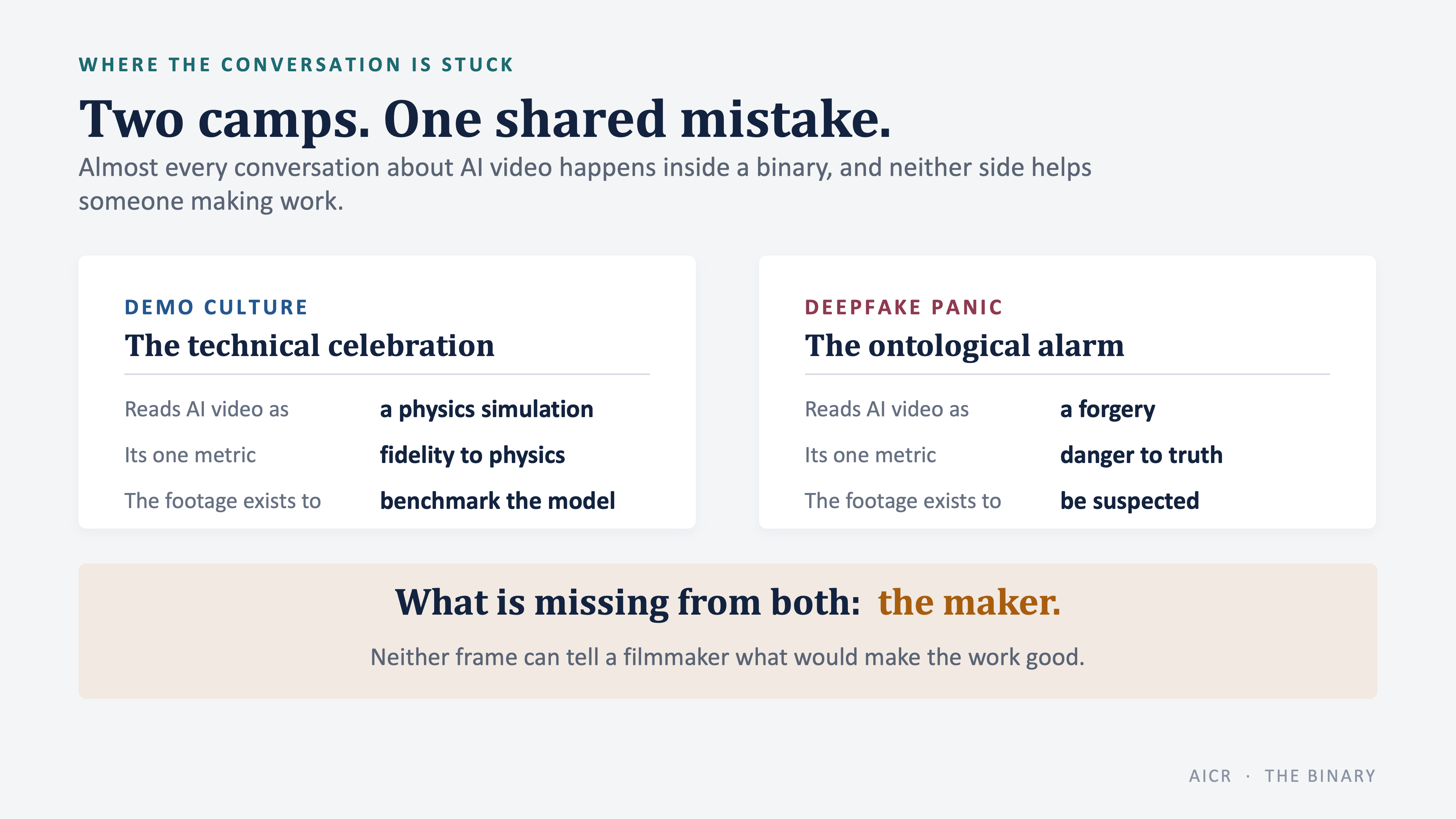
Almost every conversation about AI video happens inside a binary, and neither side helps anyone who is actually making work.
The first camp is demo culture. It reads AI video as a physics simulation, its only metric is fidelity to physics, and the footage exists to benchmark the model. Does the water splash correctly. Do the fingers obey anatomy.
The second camp is deepfake panic. It reads AI video as a forgery, its only metric is danger to truth, and the footage exists to be suspected.
The shared error is the interesting part. Both treat the AI as a device whose output should be measured against captured reality. Neither can describe what happens when someone works with a latent space for a hundred hours on a single piece. One reduces a new art form to a benchmark. The other reduces it to a crime. What is missing from both is the maker.
Two questions
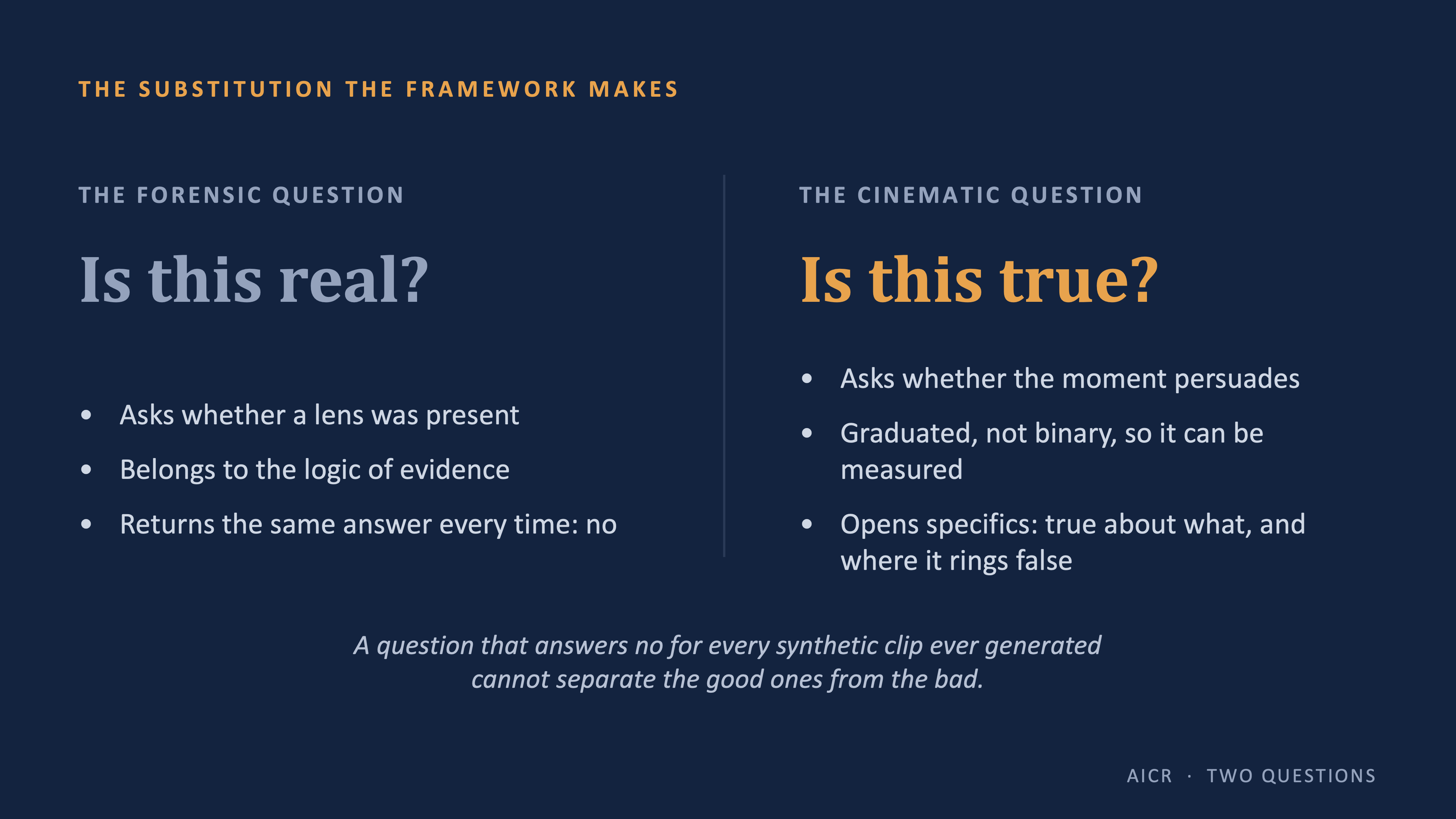
So the framework starts by changing the question.
Is this real? That was the right question when every image had a camera behind it. It is a forensic question and it belongs to the era of evidence. It asks whether a lens was present. Point it at fully synthetic work and it returns the same answer every time, for every clip ever generated: no. A question that answers no to everything cannot separate the good work from the bad.
Is this true? That is the cinematic question. It asks whether the moment persuades. It is graduated rather than binary, which means it can actually be measured. And it opens specifics immediately. True about what. True for whom. And where, exactly, does it ring false.
Everything after this follows from that substitution.
Six movements
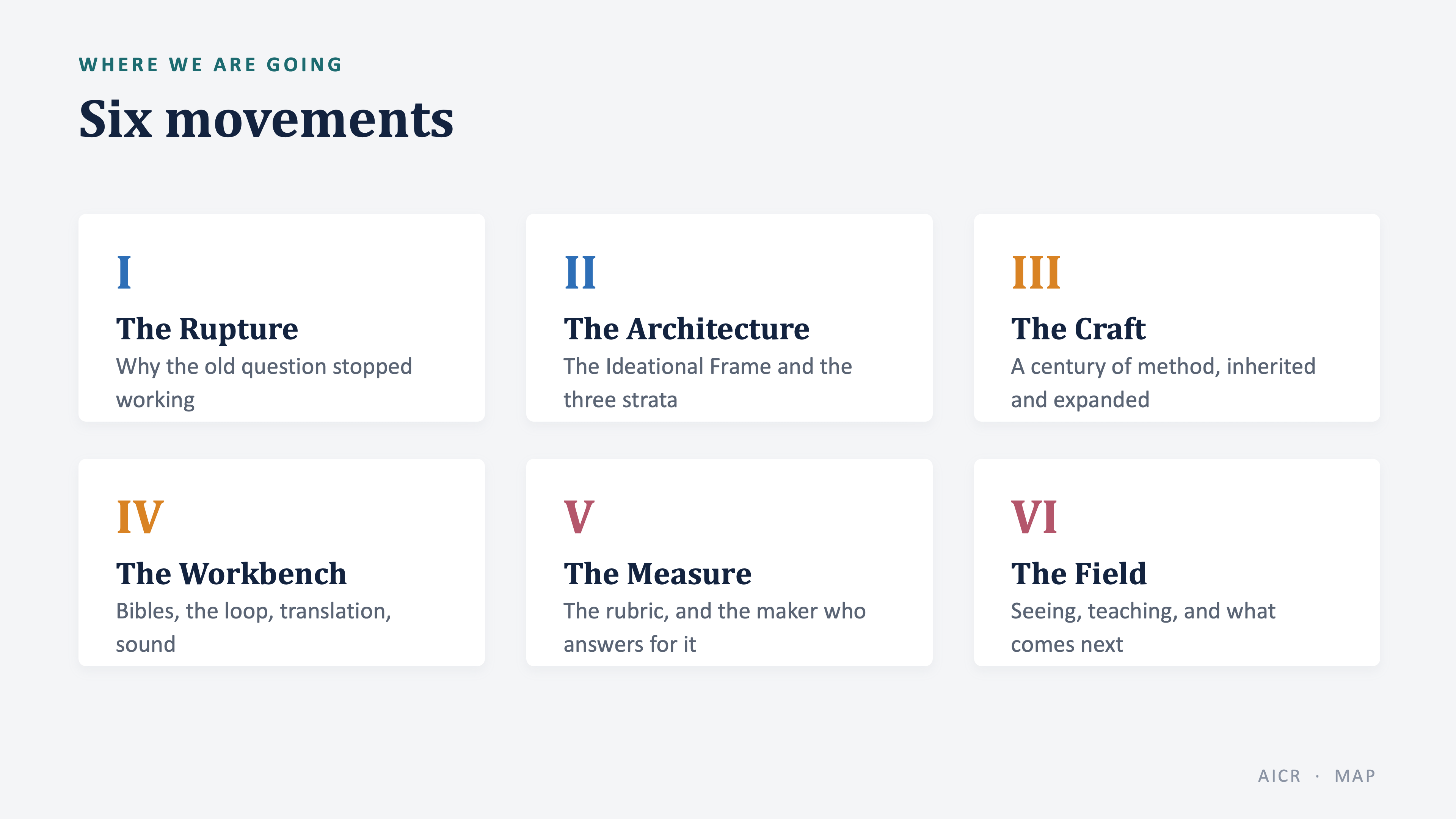
Six movements. The rupture, and why the old question stopped working. The architecture, which is the heart of the framework. The craft, which turns out to be a century old. The workbench, which is what you actually do at the keyboard. The measure, which is how any of this gets judged. And the field, which is where it goes next.
Realism leaned on one thing for a century. Generative media took it away.
The bond that held
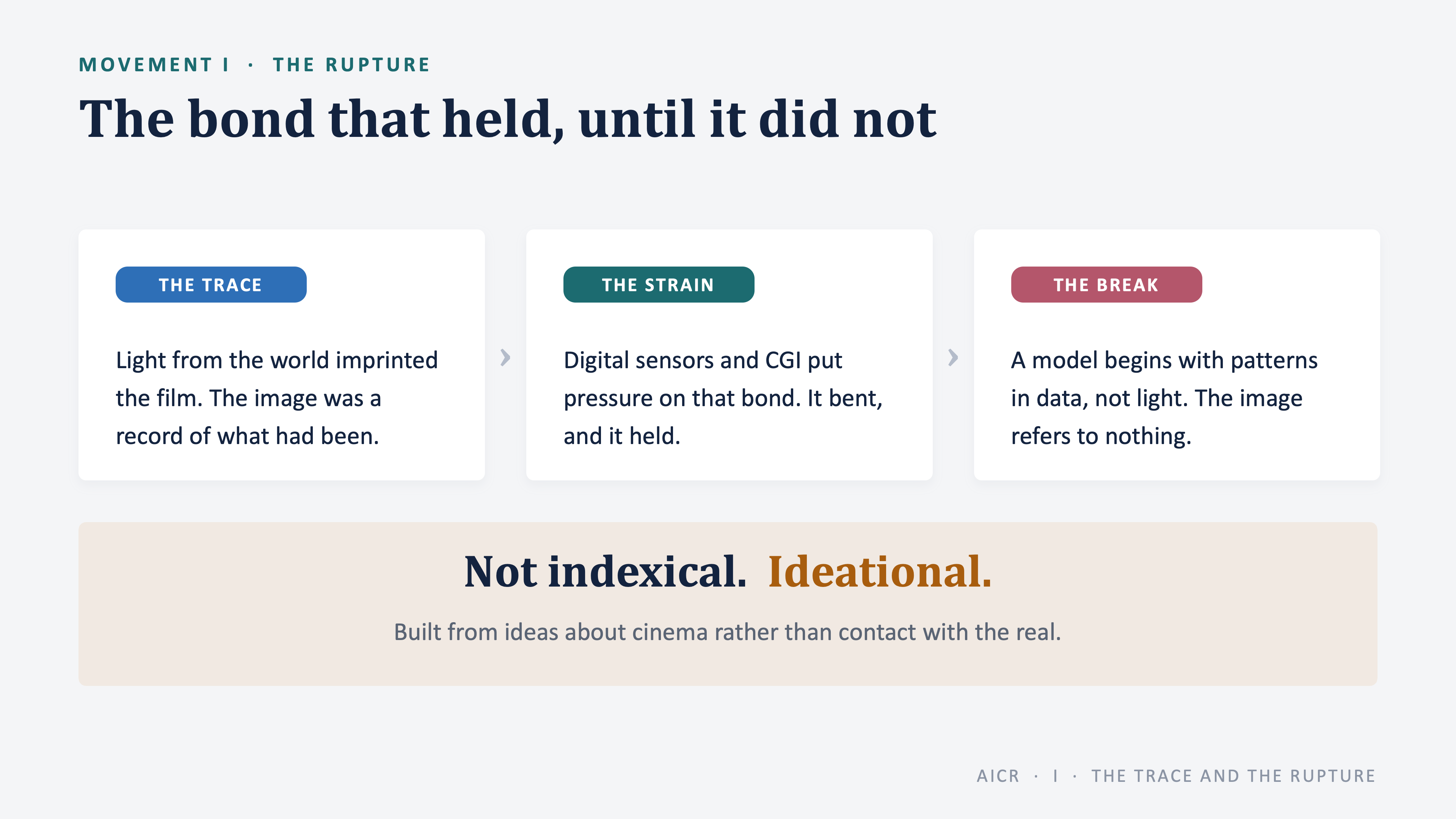
Bazin argued that photography gave cinema a privileged bond with truth. The image was not just a picture of reality, it was a trace of it, a record of what had been. Kracauer called film the redemption of physical reality.
That foundation took a great deal of punishment and it held. When cinema went digital, theorists worried, but a digital sensor still recorded light from the world. Computer graphics expanded spectacle, but they stayed folded into photographed footage, tethered to captured textures and captured motion.
Generative AI breaks it. When a model assembles a frame it never begins with light bouncing off anything. It produces images out of patterns in data. The result is not a record of what has been. It is a synthesis of what could be made to appear.
So the image is no longer indexical. It is ideational. Built from ideas about cinema rather than contact with the real. And judging it by how closely it resembles photography is like judging a painting by how well it behaves as a sculpture. The rubric is simply wrong for the medium.
What happens to the realist mission
Which leaves a genuine problem, and I want to state it as a problem rather than pretend I have closed it.
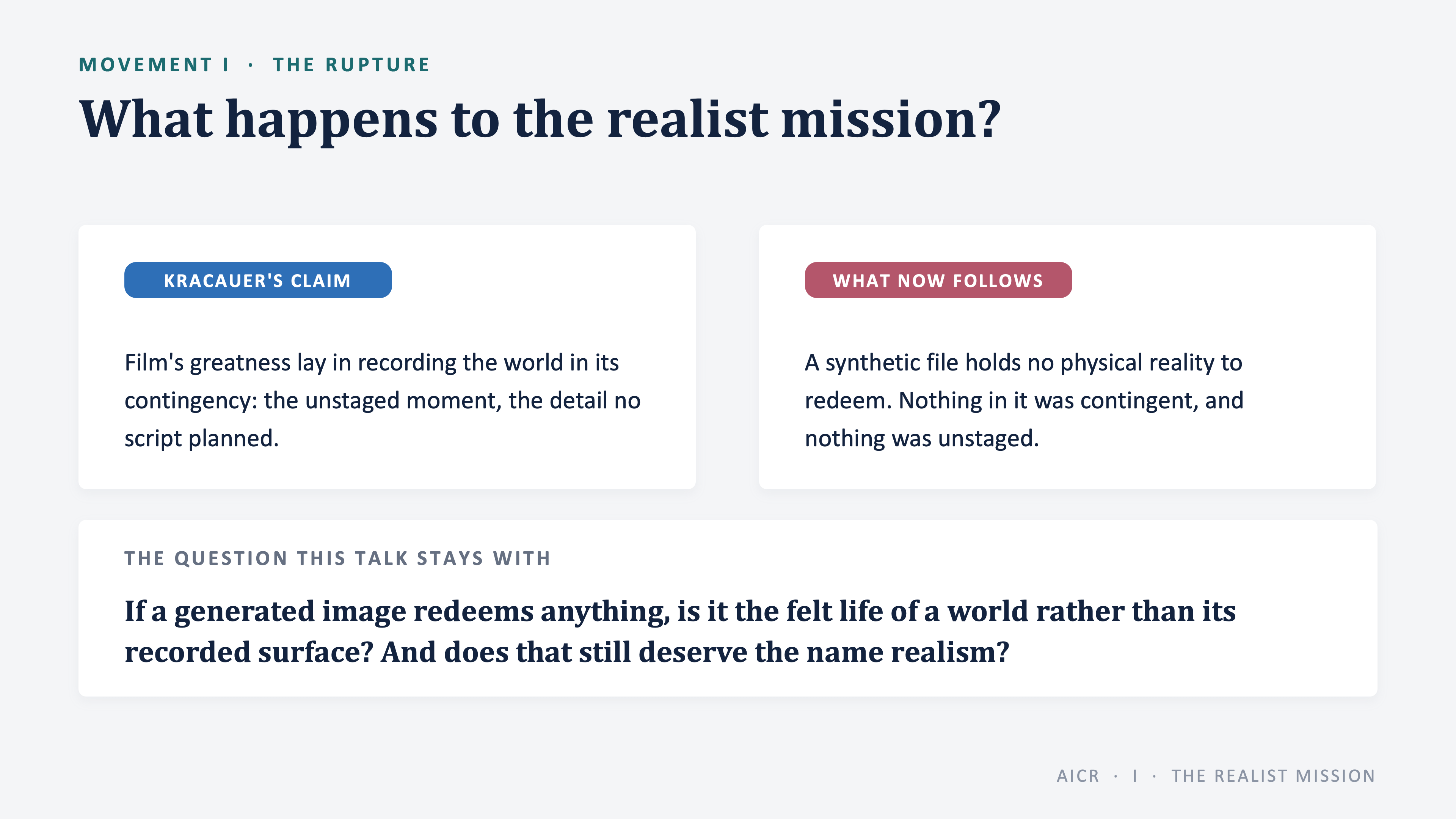
Kracauer’s claim was that film’s greatness lay in recording the world in its contingency. The unstaged moment. The detail no script planned. The thing the camera caught because it happened to be there.
A synthetic file holds no physical reality to redeem. Nothing in it was contingent. Nothing in it was unstaged. Everything was produced rather than encountered.
So here is the question this talk stays with. If a generated image redeems anything, is it the felt life of a world rather than its recorded surface? And does that still deserve the name realism? I think it does. The rest of this is the argument.
What a synthetic image inherits, and the three layers where it holds or fails.
The Ideational Frame
Start with something that gets missed. The AI image is not a blank slate.
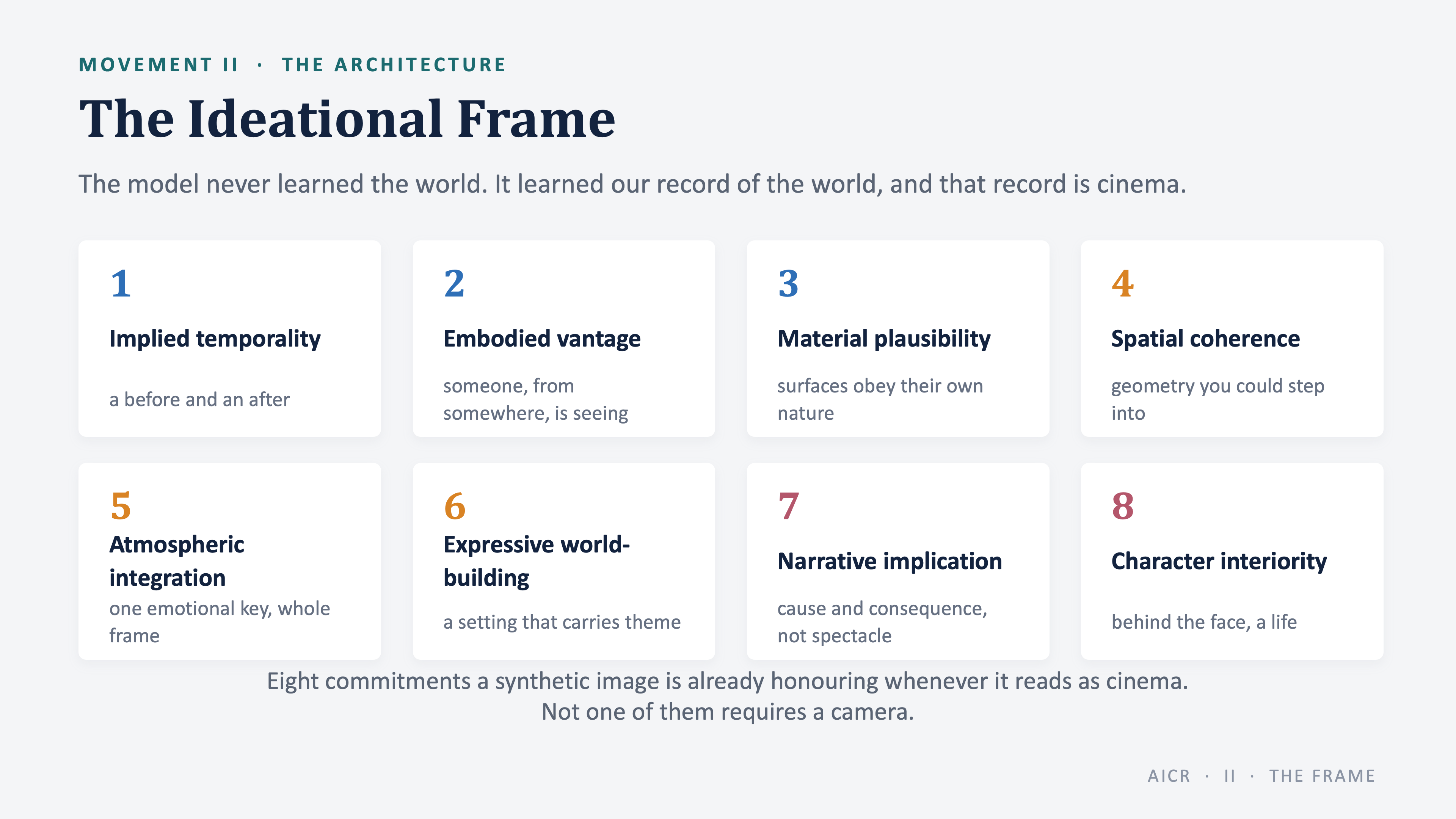
A generative model does not learn the world. It learns the record we made of the world, and an enormous portion of that record is cinematic. So the synthetic image arrives already saturated with cinematic assumption. It carries forward not the pixels of past films but their commitments. That light has mood. That space has logic. That a face implies a mind.
I call these eight commitments the Ideational Frame. Implied temporality, the sense that this moment has a before and an after. Embodied vantage, the feeling that someone, from somewhere, is seeing this. Material plausibility, surfaces obeying their own nature. Spatial coherence, geometry you could step into. Atmospheric integration, one emotional key across the whole frame. Expressive world-building, a setting that carries theme. Narrative implication, cause and consequence rather than spectacle. And character interiority, the sense that behind the face there is a life.
Not one of them requires a camera. That is why this is not a lesser cinema.
Where an image actually breaks
And here is what makes that list useful rather than decorative.
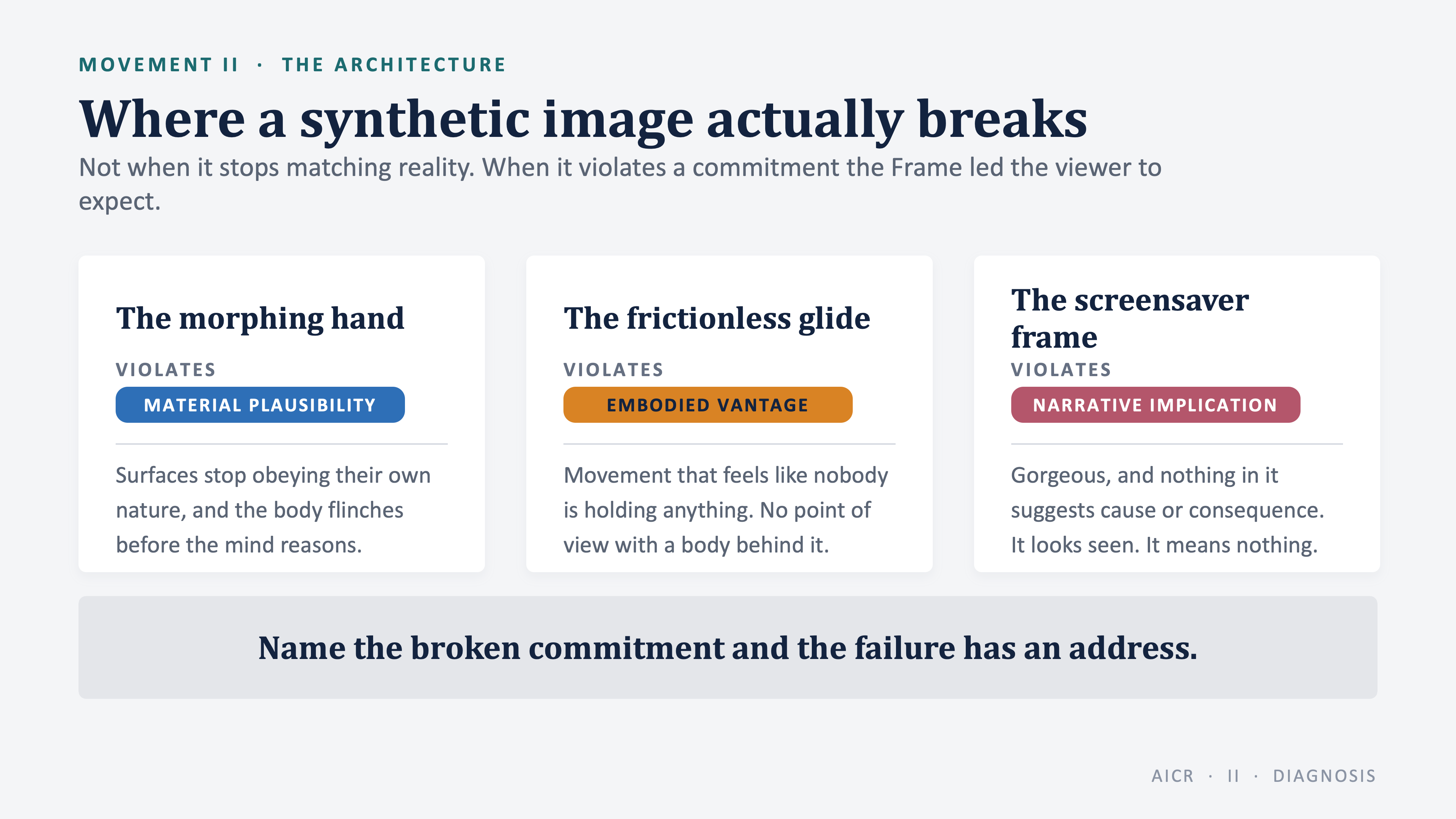
A synthetic image does not break when it stops matching reality. It breaks when it violates a commitment the Frame led the viewer to expect.
The morphing hand violates material plausibility. Surfaces stop obeying their own nature, and the body flinches before the mind has reasoned about anything.
The frictionless glide violates embodied vantage. The movement feels like nobody is holding anything. There is no point of view with a body behind it.
And the gorgeous frame that lands like a screensaver violates narrative implication. Nothing in it suggests cause or consequence. It looks seen. It does not mean anything.
Name the broken commitment and the failure has an address. That changes what you do next.
The three strata
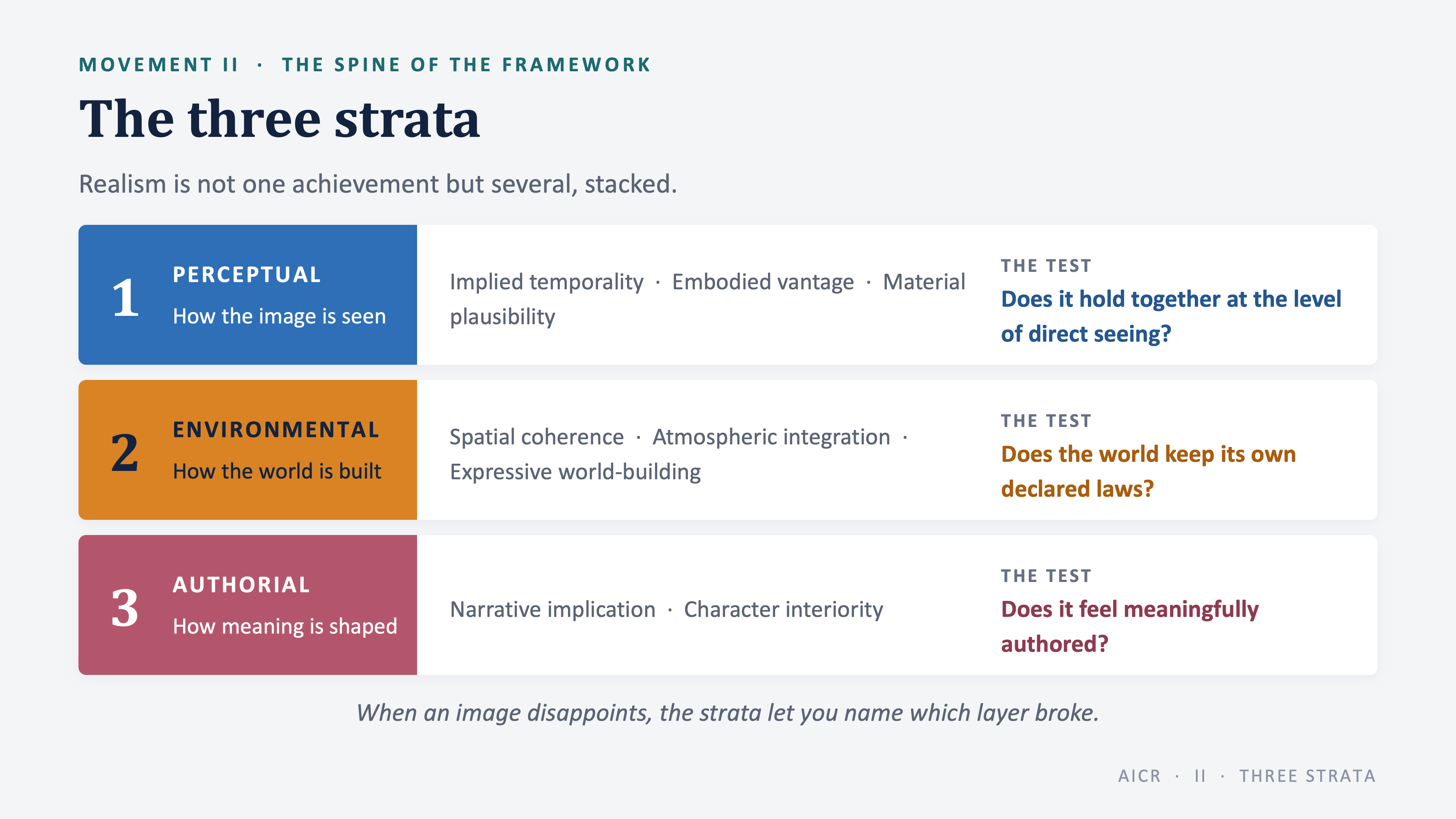
Those eight commitments resolve into three layers, and this is the spine of the whole framework.
The perceptual stratum is how the image is seen. Implied temporality, embodied vantage, material plausibility. It is the half second in which the body decides whether to believe. And note the thing demo culture misses: perceptual success is not polish. A grainy, unstable image can be perceptually coherent if its instability is consistent, and a flawless render can fail if its light implies no source.
The environmental stratum is how the world is built. Spatial coherence, atmospheric integration, expressive world-building. This is the world’s internal law. The impossible can still be coherent if it obeys its own rules. German Expressionism proved that a century ago with painted sets. What breaks this layer is never impossibility. It is inconsistency.
The authorial stratum is how meaning is shaped. Narrative implication and character interiority. This is the one no render supplies. It is implied, or it is absent.
Realism is not one achievement. It is several, stacked. An image can be flawless in one register and bankrupt in another.
Realism lives between the layers
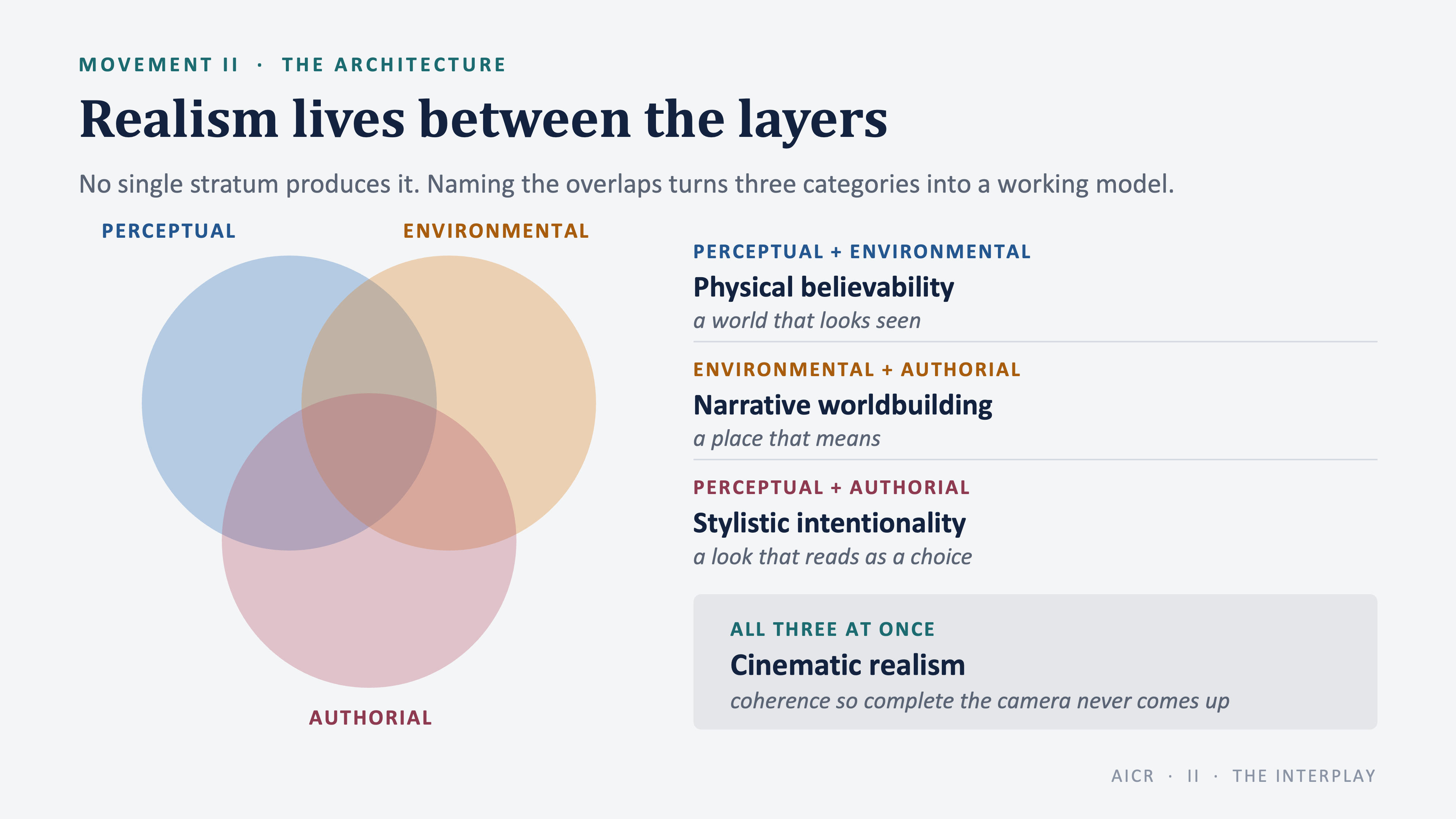
The strata are not a checklist you tick independently. Realism emerges from their combinations.
Perceptual and environmental together give you physical believability, a world that looks seen. That is as far as demo culture ever gets. Valuable, and not the whole game.
Environmental and authorial together give you narrative worldbuilding, a place that means something. That is the house in Parasite, a social order rendered as architecture.
Perceptual and authorial together give you stylistic intentionality, a look that reads as a choice rather than a default.
And all three at once give you cinematic realism. Coherence so complete that the camera never comes up. That is the actual goal. Not to make viewers believe a lens was present, but to make the question never occur to them.
Locate it, do not reroll it
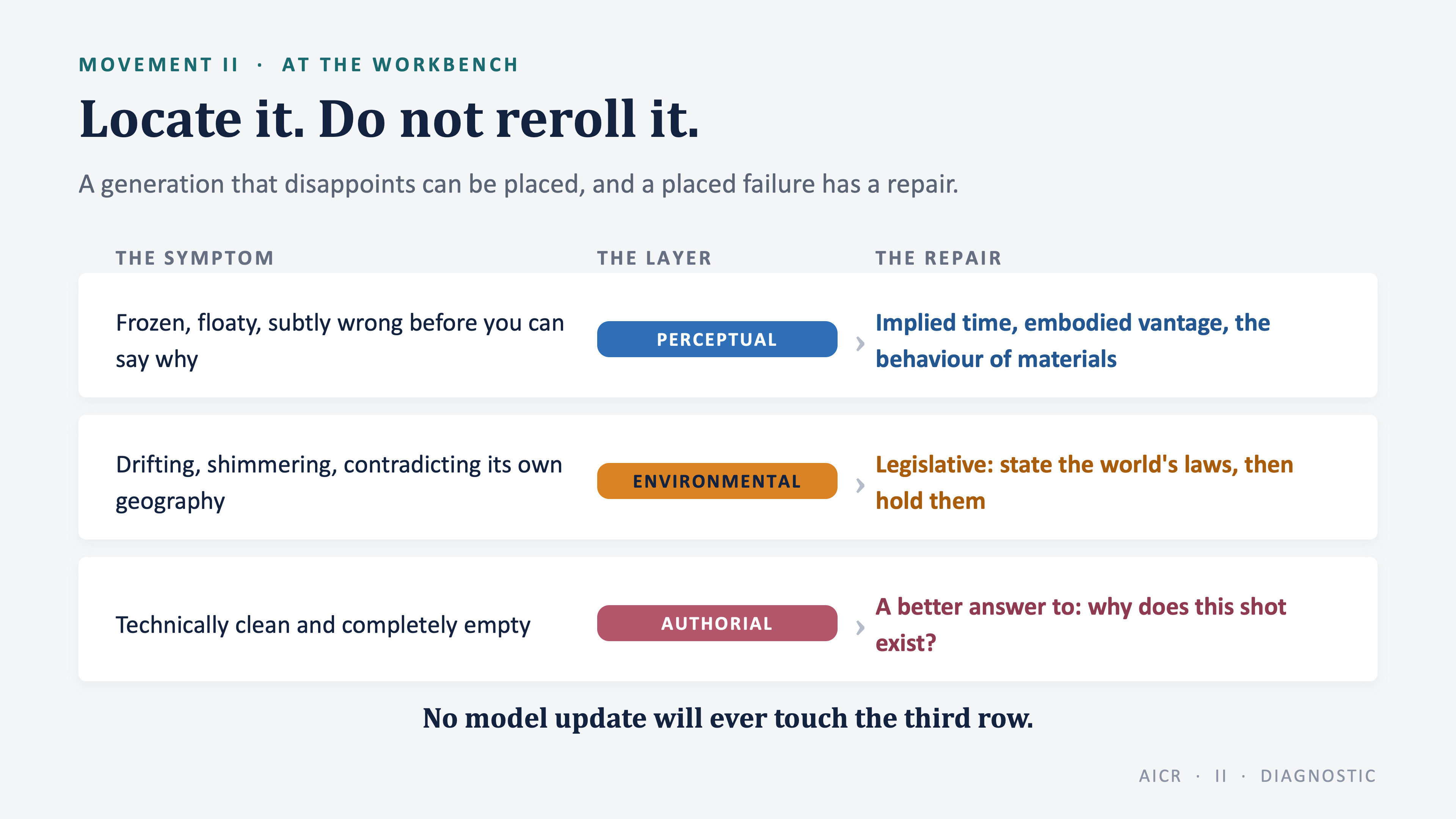
Here is the most immediately useful thing the strata do.
If a shot feels frozen or floaty, subtly wrong before you can say why, that is perceptual. Go work on implied time, embodied vantage, the behavior of materials.
If it drifts and shimmers and contradicts its own geography, that is environmental. Get legislative. State the world’s laws and then hold them.
If it is technically clean and completely empty, that is authorial. You need a better answer to why this shot exists at all.
A maker who knows which stratum failed knows what to repair. A maker who can only say it looks off is stuck pulling a slot machine handle. And notice the third row. No model update will ever touch it.
A commitment is not a method. The method is already a century old.
Eight disciplines
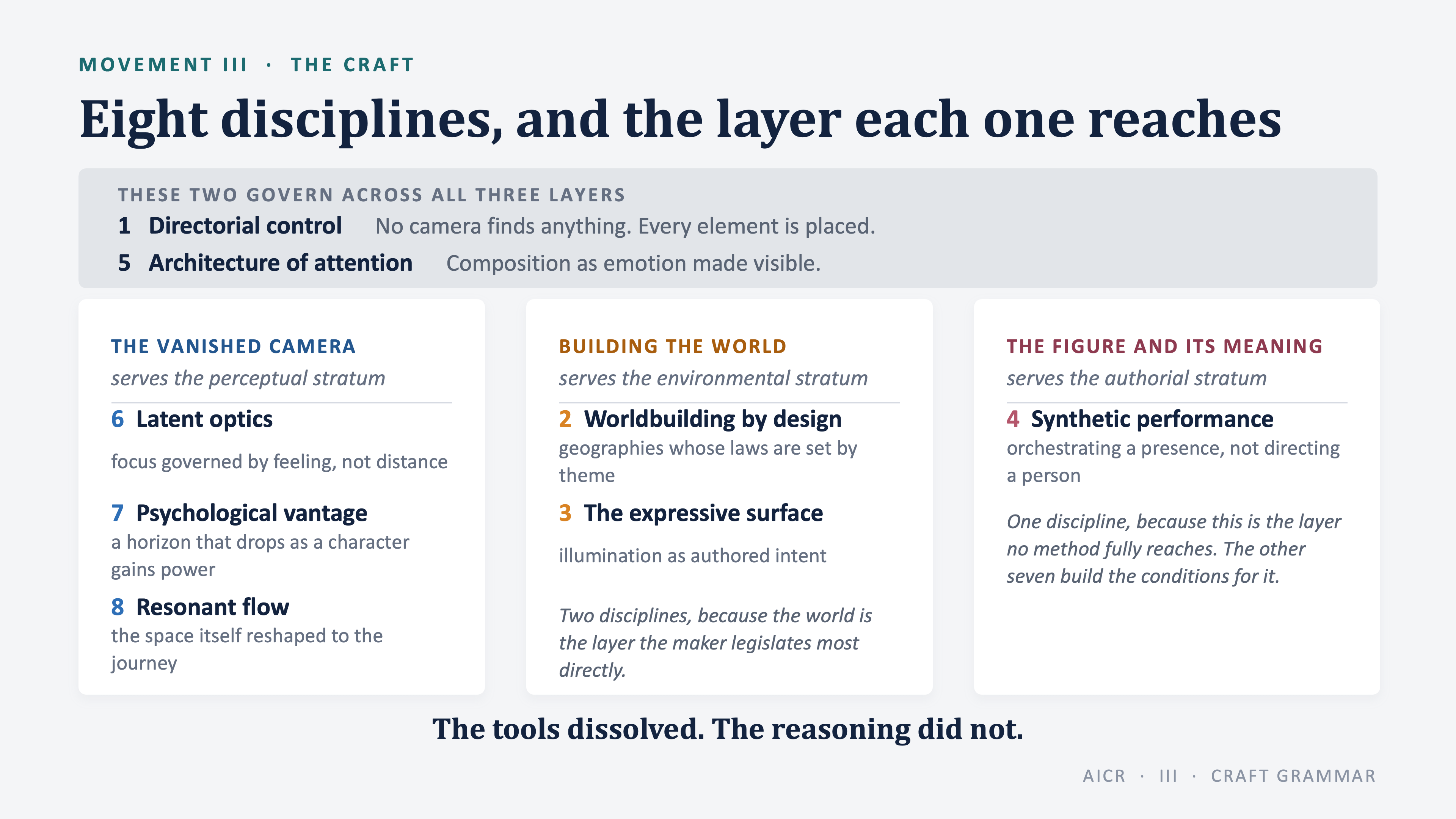
This is the best news in the framework. Everything the Frame asks for, cinema has spent a hundred years learning how to build.
Two disciplines govern across all three layers. Directorial control, because in the latent space there is no camera to find anything, so every element is placed. And the architecture of attention, composition as emotion made visible.
Three serve the perceptual stratum. Latent optics, where focus is governed by feeling rather than distance. Psychological vantage, where a horizon can drop as a character gains power. And resonant flow, where the space itself reshapes to the journey. No physical lens will honor those requests. This one will.
Two serve the environmental stratum. Worldbuilding by design, geographies whose laws are set by theme. And the expressive surface, illumination as authored intent.
One serves the authorial stratum. Synthetic performance, which means orchestrating a presence rather than directing a person.
The tools dissolved. The reasoning did not. And the real difference between filmmaking and prompt-rolling is not better keywords. It is knowing which discipline reaches which layer, so that when the world is not holding you go to worldbuilding, not to another lens keyword.
A camera inherits its coherence
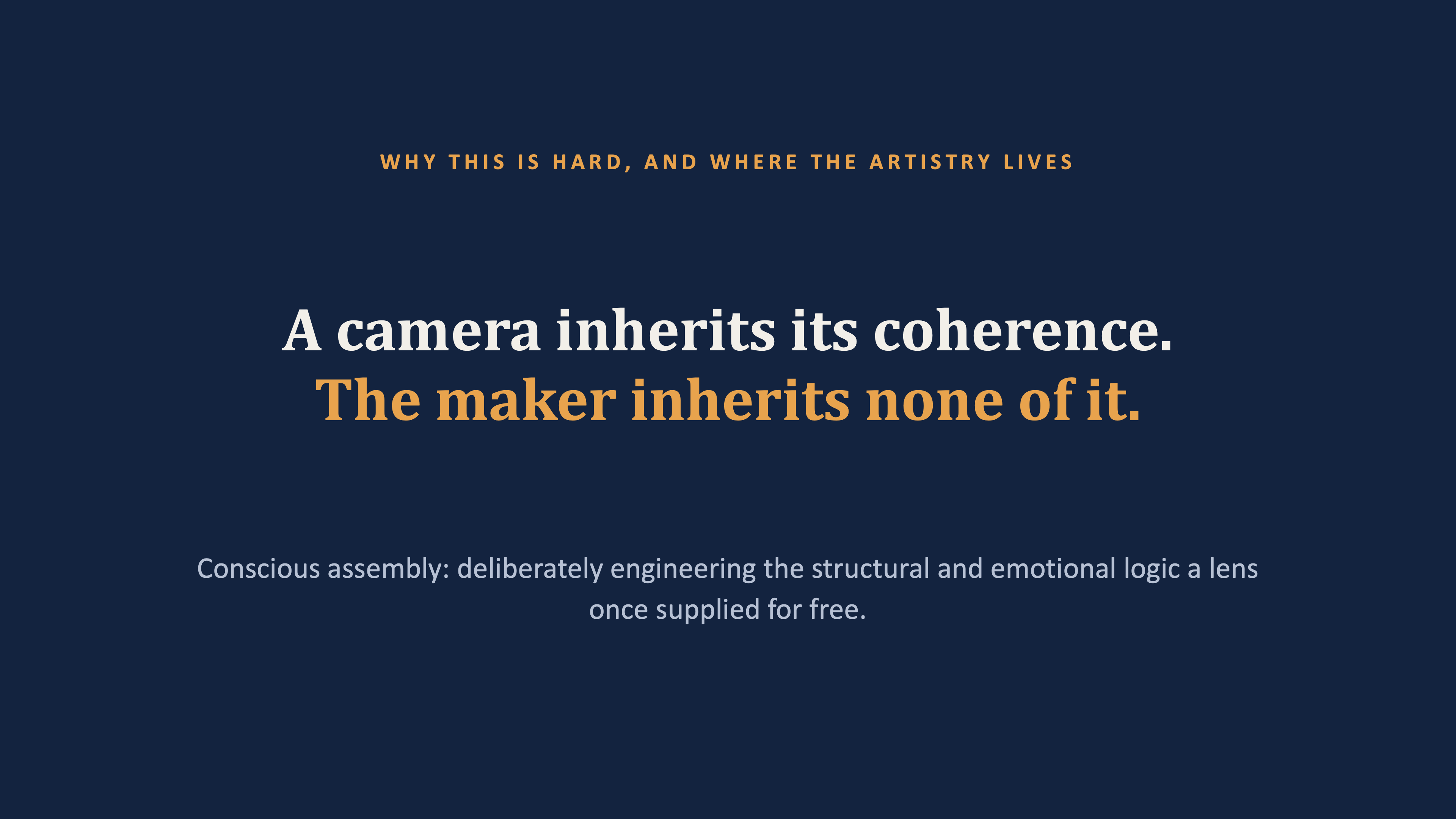
One idea explains, at the deepest level, why this is hard.
A camera is reactive. Light arrives, the sensor records, and a great deal of what makes the image cohere comes for free, supplied by a physical world that was already coherent before the lens showed up. The fall of a shadow. The depth of a room. The continuity of a moment. The camera never authored any of it. It inherited it.
The AI filmmaker inherits none of it. Whatever coherence the work needs has to be assembled, or accepted, on purpose. I call that conscious assembly.
Read as a burden, that sounds like an endless chase. Read accurately, it is the job description.
The four pillars
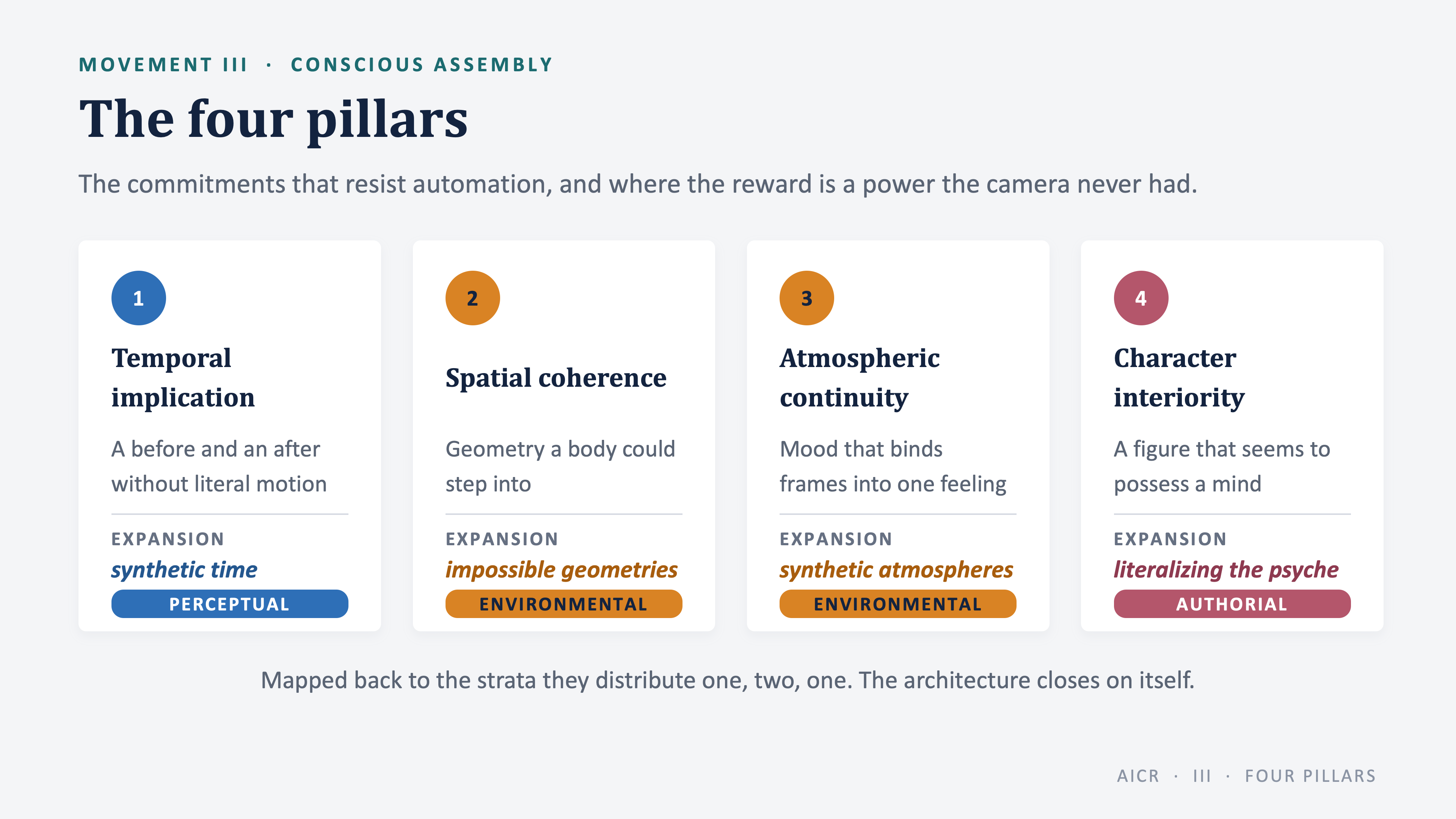
Four of those eight commitments resist automation hardest, and each one comes with a power the camera never had. I call them the four pillars.
Temporal implication. A before and an after without literal motion. The expansion is synthetic time.
Spatial coherence. Geometry a body could step into. The expansion is impossible geometries that still obey their own law.
Atmospheric continuity. Mood that binds separate frames into one feeling. The expansion is synthetic atmospheres.
And character interiority. A figure that seems to possess a mind. The expansion is the remarkable one. Because you author the entire world, a character’s interior can be turned outward. Inner weather becomes visible weather.
Map them back to the strata and they distribute one, two, one. The architecture closes on itself.
Prompts are constraints
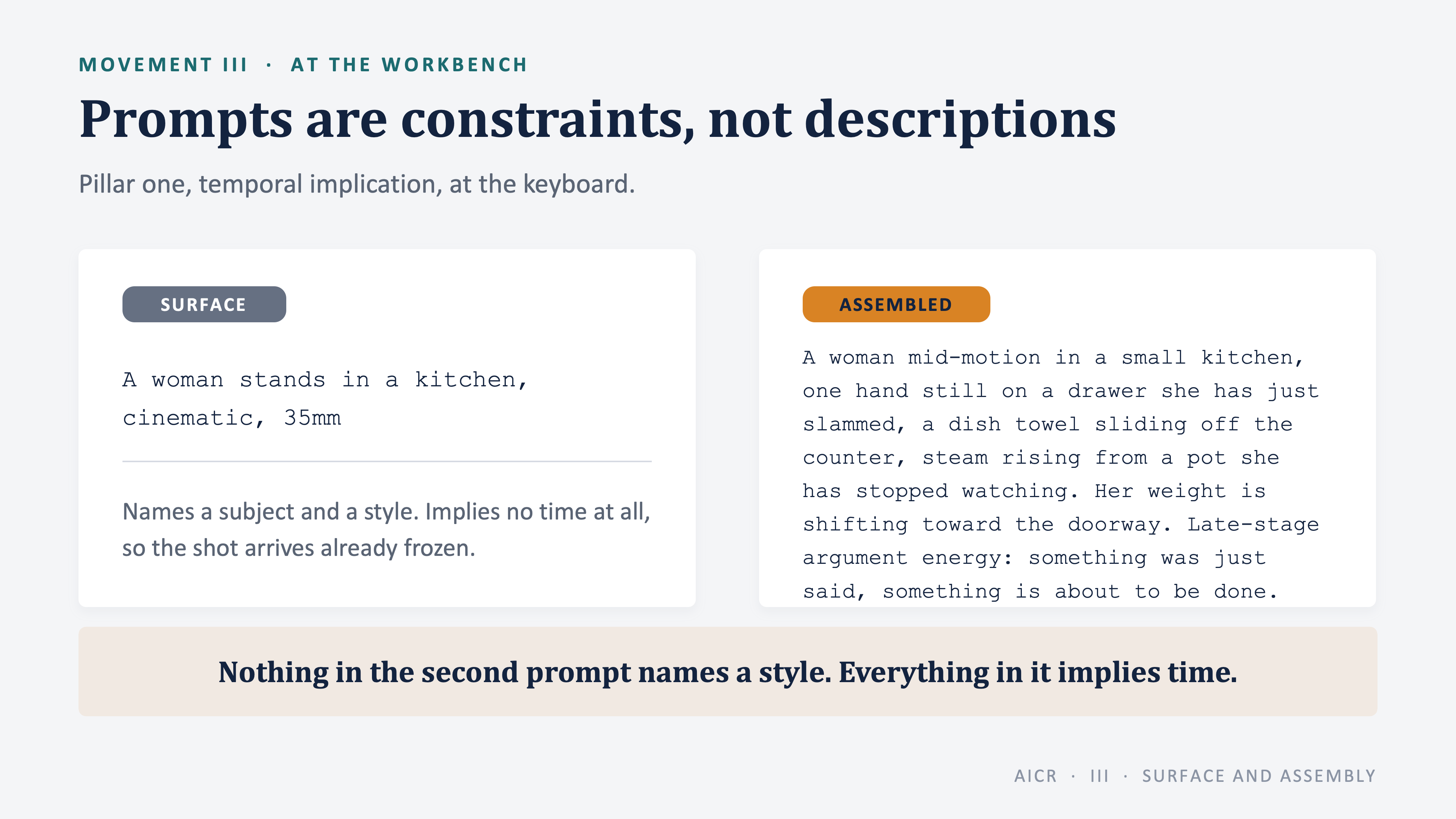
Let me show you the first pillar at the keyboard.
A surface prompt says: a woman stands in a kitchen, cinematic, thirty-five millimeter. It names a subject and a style. It implies no time at all, which is why the shot arrives already frozen.
An assembled prompt says something closer to this. A woman mid-motion in a small kitchen, one hand still on a drawer she has just slammed, a dish towel sliding off the counter, steam rising from a pot she has stopped watching. Her weight is shifting toward the doorway. Late-stage argument energy. Something was just said, and something is about to be done.
Listen to what is not in there. No style vocabulary whatsoever. No lens, no film stock, no lighting reference. What it has instead is momentum, consequence, and a moment that arrives already underway. That is temporal implication built rather than requested.
The general lesson: frozen-feeling AI shots are shots with no implied history.
Legislate the world, turn the psyche outward
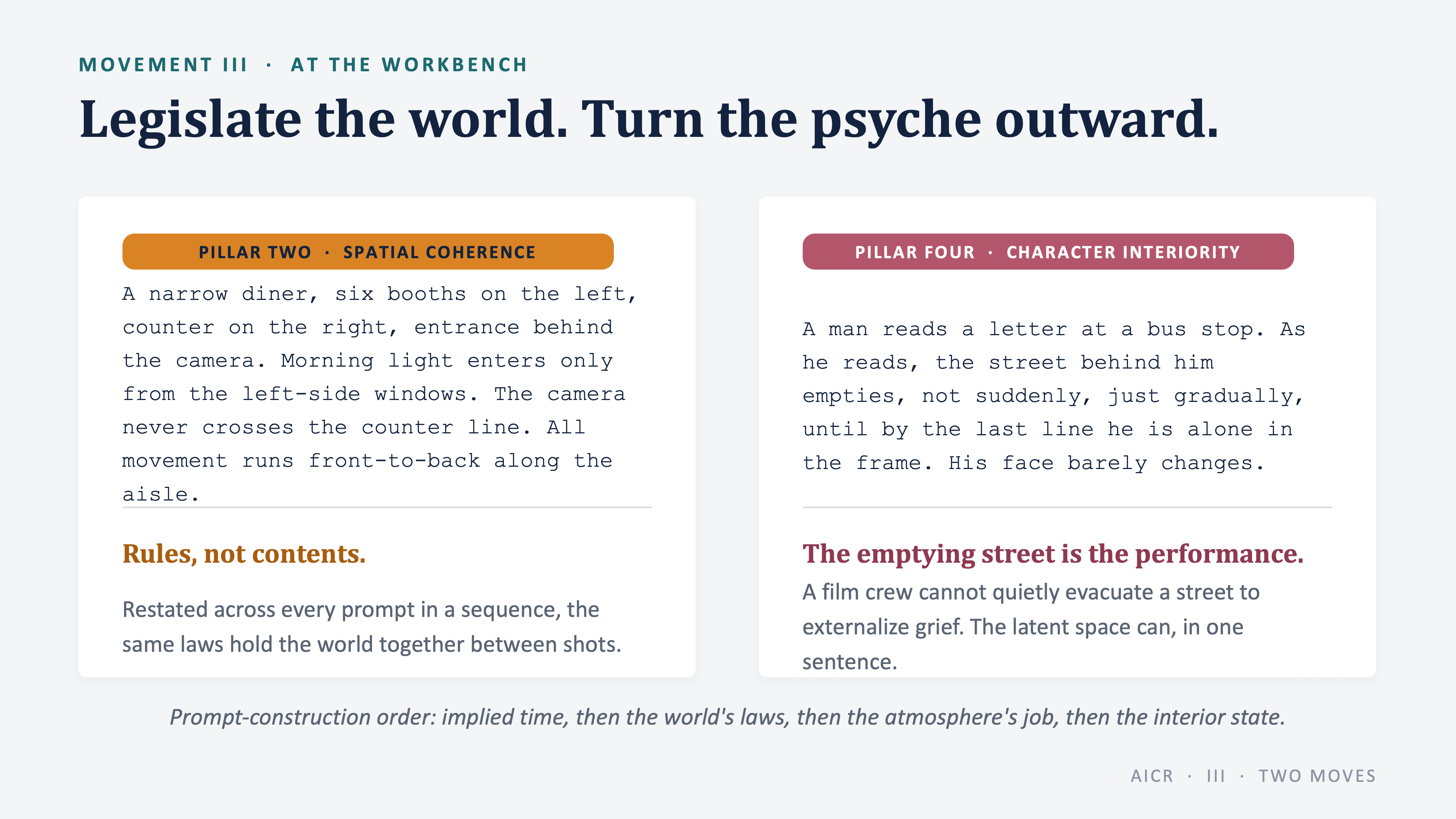
Two more moves, quickly.
For spatial coherence, legislate. A narrow diner, six booths on the left, counter on the right, entrance behind the camera. Morning light enters only from the left-side windows. The camera never crosses the counter line. All movement runs front to back along the aisle. Those are rules, not contents. Restate them across every prompt in a sequence and the same laws hold the world together between shots. That is the practical answer to the consistency problem.
For character interiority, turn the psyche outward. A man reads a letter at a bus stop. As he reads, the street behind him empties, not suddenly, just gradually, until by the last line he is alone in the frame. His face barely changes. The emptying street is the performance. A film crew cannot quietly evacuate a street to externalize grief. The latent space can, in one sentence.
Same pixels, opposite meanings
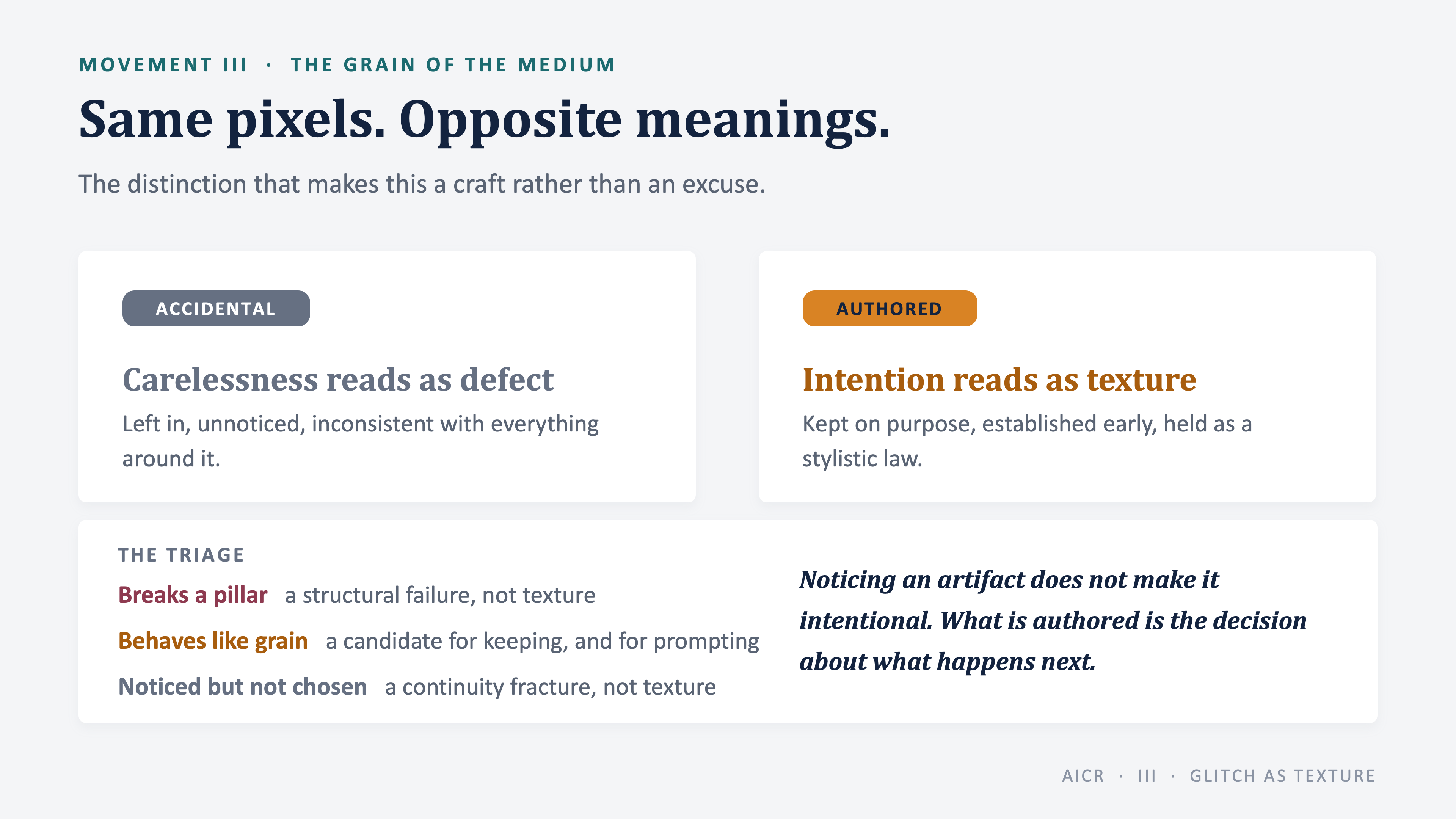
Now the most counterintuitive move in the framework.
Twentieth-century filmmakers embraced grain, lens flare and optical aberration as expressive tools, reminders that the audience was watching cinema. The shimmer of latent space is the equivalent. An honest signal that this is a synthesis and not a recording.
But there is a distinction that makes this a craft rather than an excuse. Accidental imperfection reads as defect. Left in, unnoticed, inconsistent with everything around it. Authored imperfection reads as texture. Kept on purpose, established early, held as a stylistic law. Same pixels, opposite meanings.
So triage. If it breaks a pillar, it is a structural failure, not texture. If it behaves like grain, it is a candidate for keeping, and for prompting deliberately. And there is a third case worth naming, because it is the honest one. If you noticed it and simply let it stand, that is a continuity fracture, not texture. Noticing an artifact does not make it intentional. What is authored is the decision about what happens next.
Truth over resolution
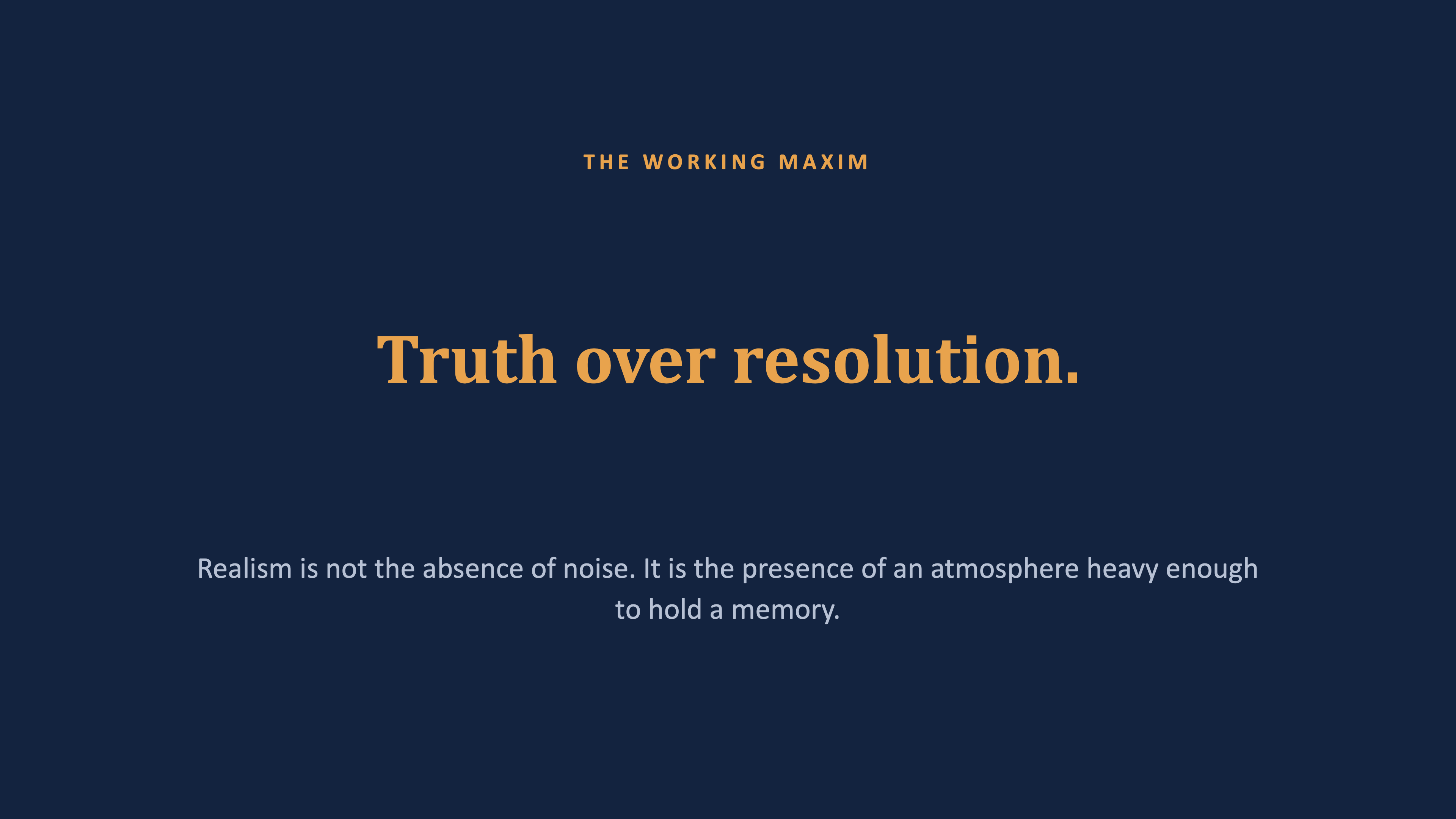
Which gives the working maxim of the whole framework. Truth over resolution.
The pursuit of resolution for its own sake, clearing the image and polishing away every artifact, tends to destroy the very atmospheric continuity that carries feeling. Realism is not the absence of noise. It is the presence of an atmosphere heavy enough to hold a memory.
The framework explains why. This movement is what you actually do at the keyboard.
Three documents that come first
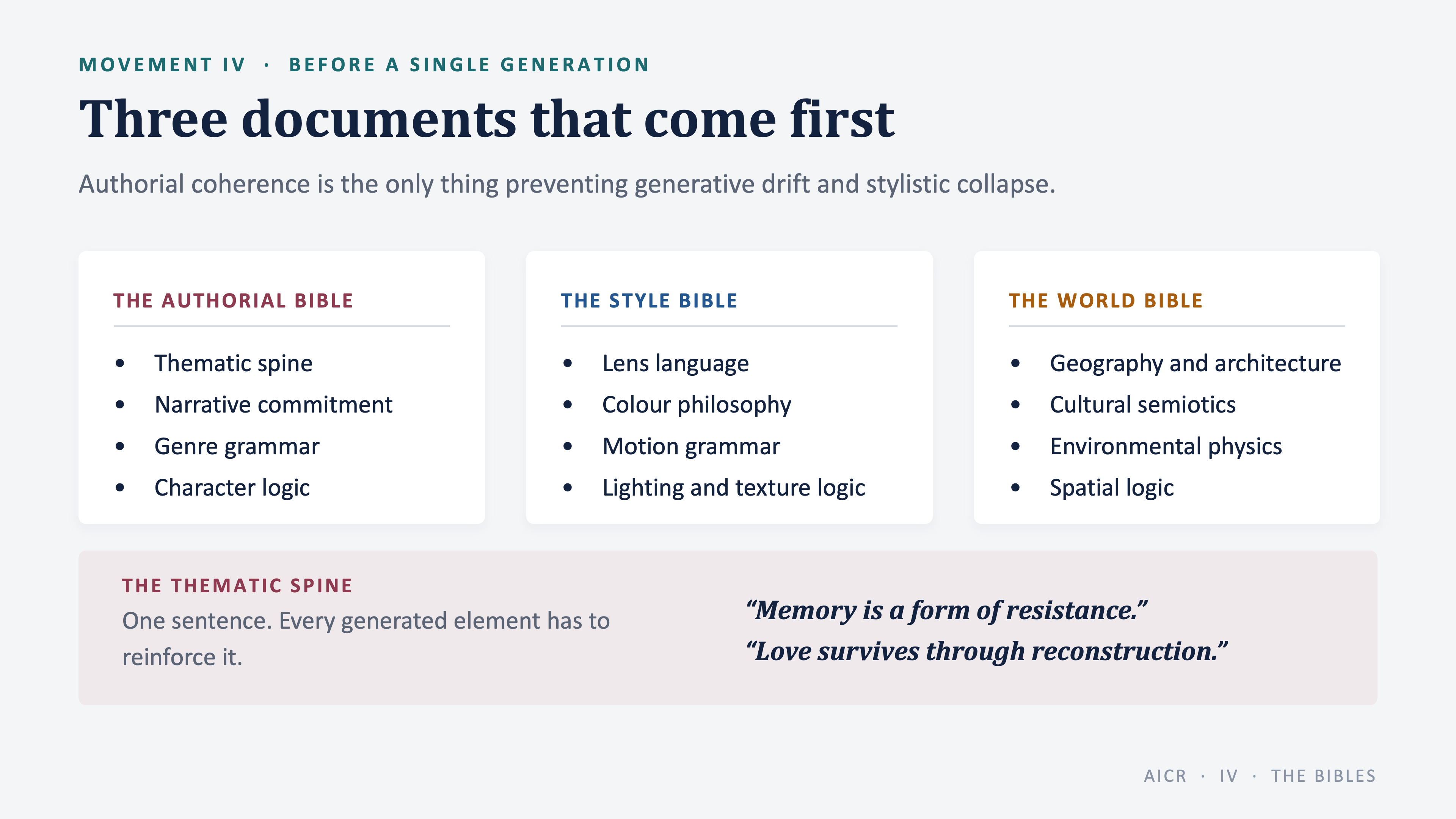
Before a single generation, three documents.
The authorial bible holds the thematic spine, the narrative commitment, the genre grammar and the character logic. The style bible holds lens language, color philosophy, motion grammar, lighting and texture logic. The world bible holds geography and architecture, cultural semiotics, environmental physics and spatial logic.
Do not skip the thematic spine. It is one sentence expressing the film’s reason for existing. Memory is a form of resistance. Love survives through reconstruction. That sentence becomes the realism anchor for everything downstream, and if it is missing, realism collapses on about day three of the project.
The generative loop
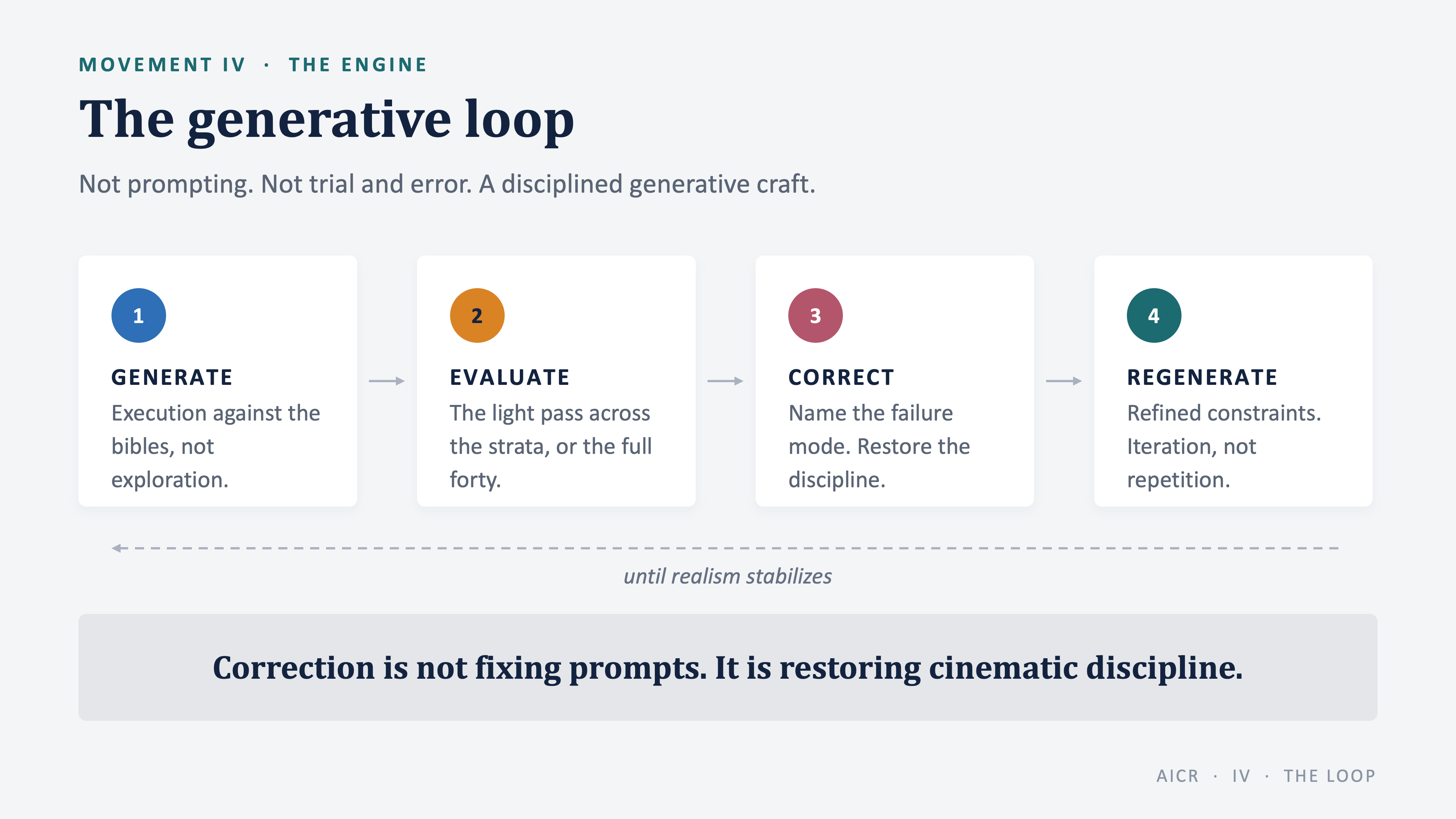
Then a loop, and the discipline is in what each step refuses.
Generate. This is execution against the bibles, not exploration. Exploration is a separate and earlier mode, and it is research, not production.
Evaluate. Two resolutions here. For iteration, a light pass across the strata. Does the surface hold. Does the world hold. Does it sound like itself. Does it feel authored. For close judgment, the full forty-point rubric.
Correct. This is the line that matters. People hear correction and reach for the prompt. But correction means naming the failure mode and restoring the discipline, and that is very often an authorial fix rather than a wording fix.
Regenerate. Refined constraints. Iteration, not repetition. And you run that loop until realism stabilizes.
What survives the crossing
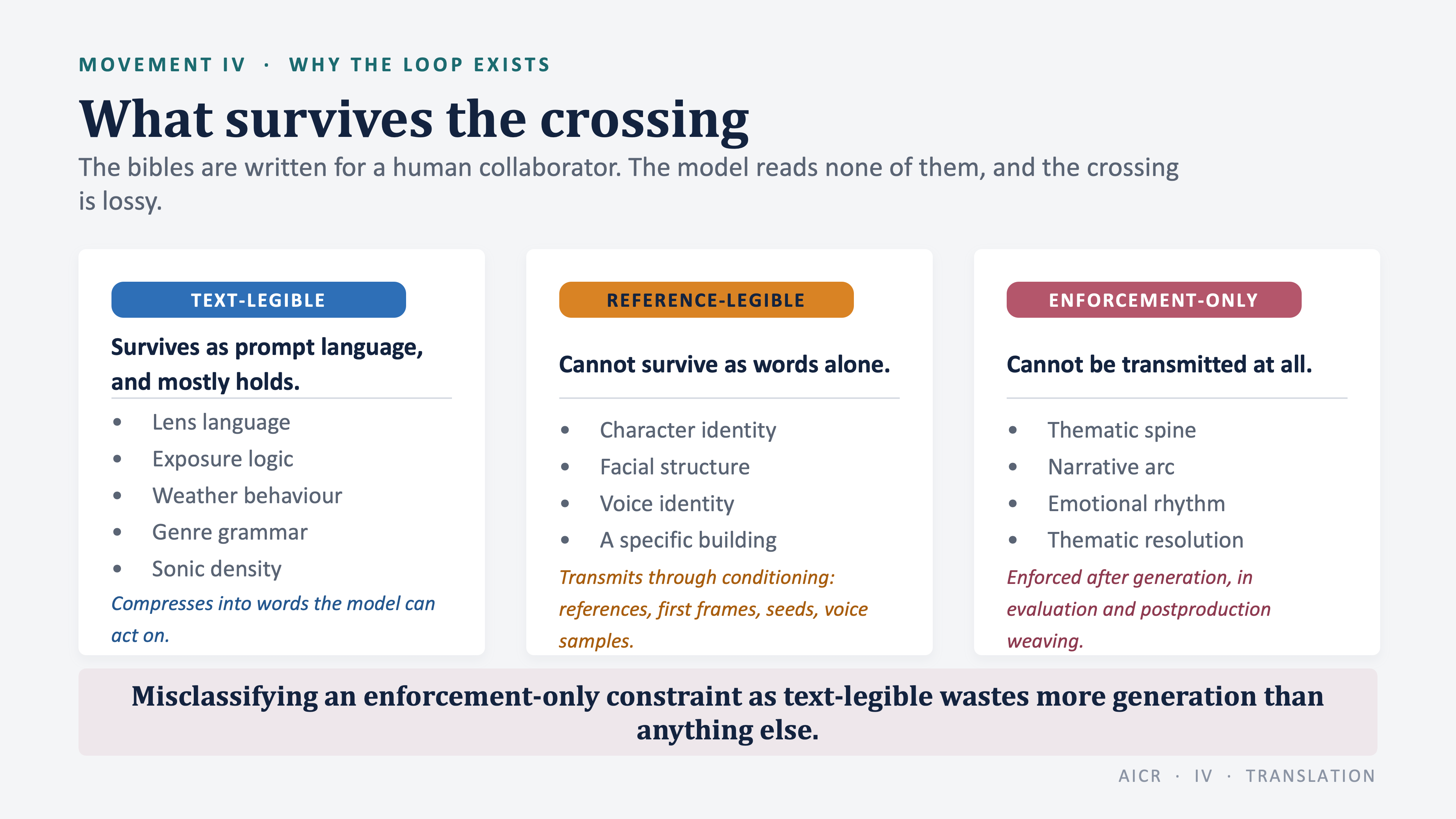
Which raises the obvious question. Why does the loop need to exist at all?
Because the bibles are written for a human collaborator, and the model reads none of them. Every constraint has to cross from a document written for a person into a form a model can register, and that crossing is lossy. There are three modes.
Text-legible constraints survive as prompt language and mostly hold. Lens language, exposure logic, weather behavior, genre grammar, sonic density. They compress into words the model can act on.
Reference-legible constraints cannot survive as words alone. Character identity, facial structure, voice identity, a specific building. These transmit through conditioning. References, first frames, seeds, voice samples.
Enforcement-only constraints cannot be transmitted at all. The thematic spine. The narrative arc. Emotional rhythm. Thematic resolution. These are enforced after generation, in evaluation and in postproduction.
Misclassifying an enforcement-only constraint as text-legible wastes more generation than anything else. If the failure is enforcement-only, stop rewriting the prompt. Your wording was never the problem. Move the constraint downstream, translate its symptoms rather than the constraint itself, and budget regeneration for it. A thematic spine cannot be prompted, but its recurring objects, palettes and spaces can.
And that is why the loop exists. If translation were lossless you would generate once and be done.
The sonic layer
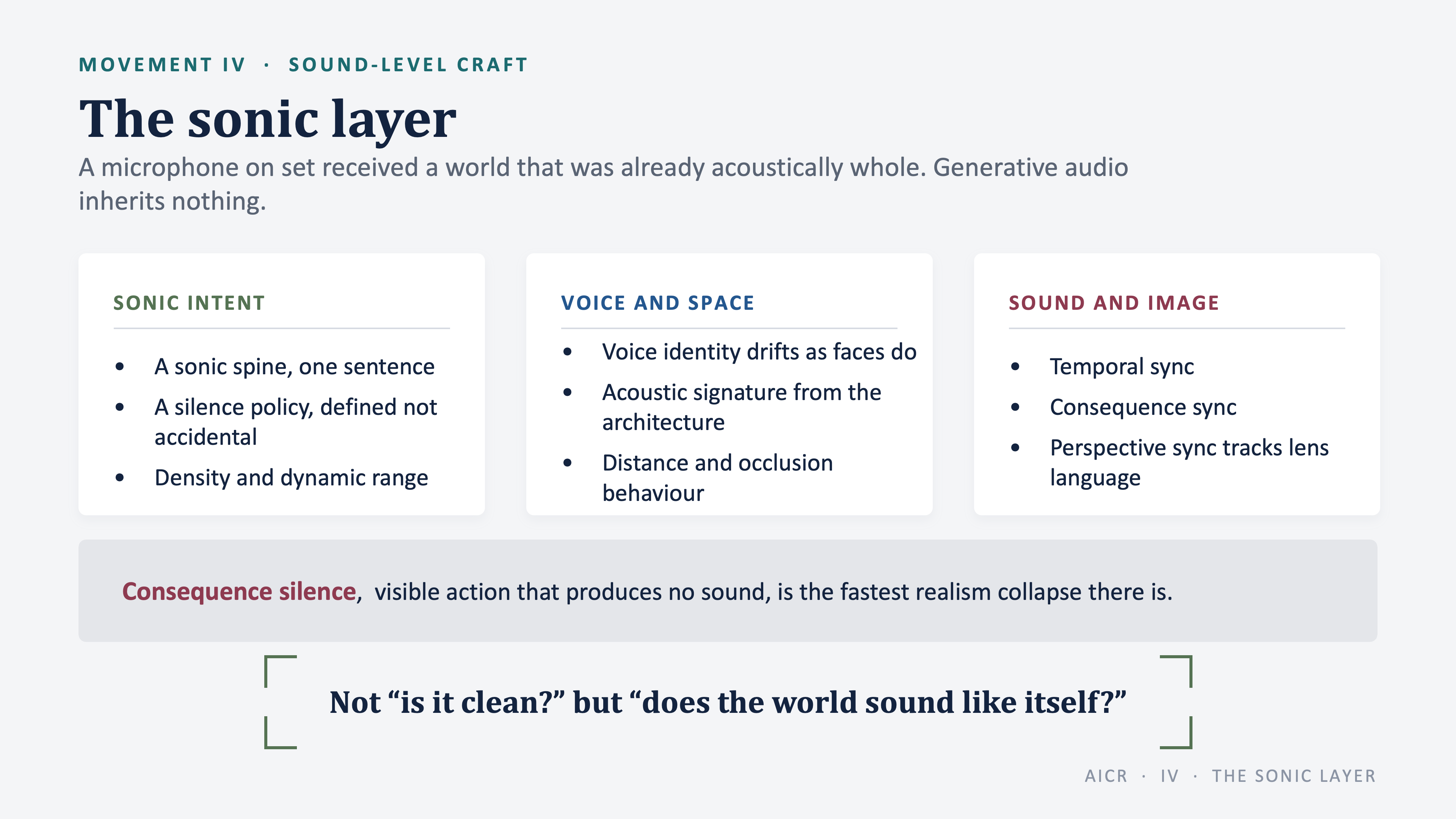
Sound is the part of this architecture still actively building, so take this section as working doctrine rather than settled.
In physical cinema, sound was coherence the filmmaker inherited. The voice matched the body. The room matched the architecture. The footstep matched the floor. Generative audio inherits none of that. It produces material by statistical pattern, without physics, memory or intent.
So sonic intent needs a spine of its own, one sentence, plus a silence policy that is defined rather than accidental, plus a decision about density and dynamic range. Voice and space need attention because voice identity drifts the way faces do, and because a room’s acoustic signature should follow from its architecture. And sound and image need to stay locked, through temporal sync, consequence sync, and perspective sync that tracks your lens language.
The stakes are higher than they look, because audiences rarely audit sound consciously. A viewer forgives a mildly uncanny face. A viewer does not forgive a voice that changes timbre between shots. Consequence silence, visible action that produces no sound, is the fastest realism collapse there is.
The question is not is it clean. The question is does the world sound like itself.
Postproduction weaving
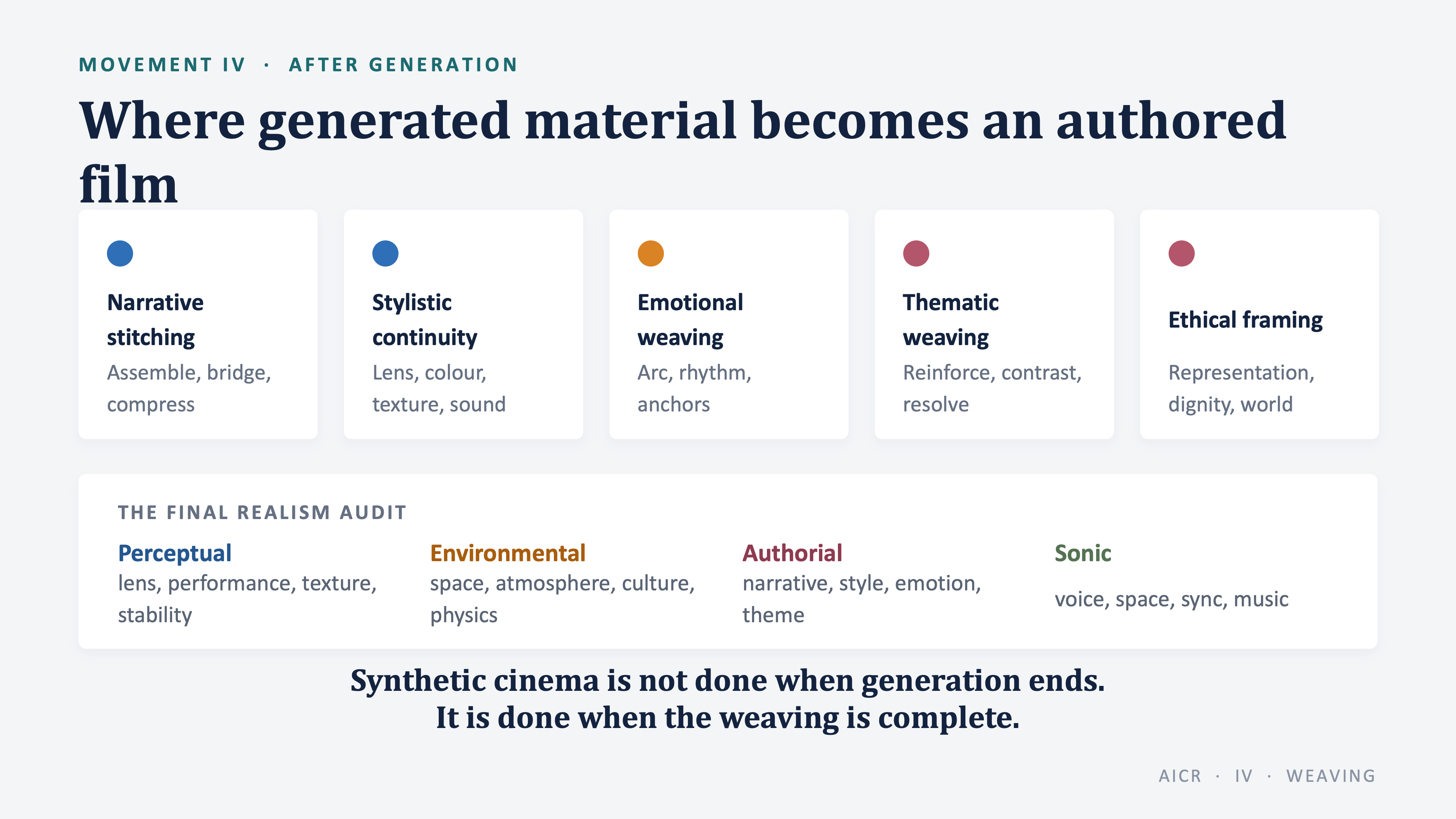
If the generative loop is where synthetic cinema is made, postproduction is where it becomes authored.
Narrative stitching. Stylistic continuity. Emotional weaving. Thematic weaving. And ethical framing, which sits inside the weave rather than bolted on at the end, because representation and the dignity of the synthetic figure are continuity questions, not compliance questions.
This is also where every enforcement-only constraint lands. The thematic spine no prompt could carry gets enforced here.
Then a final audit across all four layers, and if anything fails you go back to the loop. Synthetic cinema is not done when generation ends. It is done when the weaving is complete.
A vocabulary can be admired. An instrument can be used, argued over and taught.
The forty-point rubric
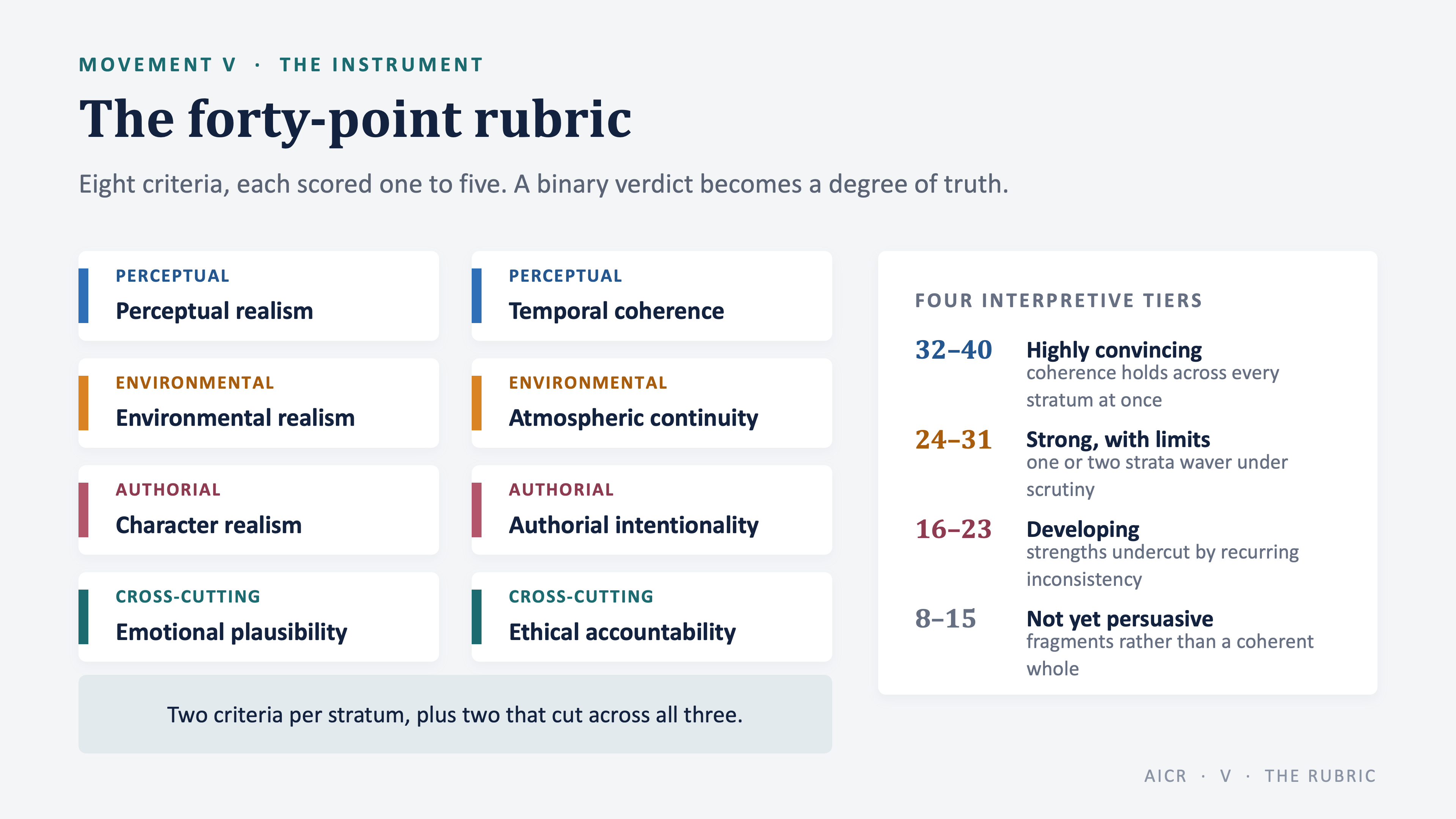
Eight criteria, each scored one to five, for forty points total.
Two read the perceptual surface: perceptual realism and temporal coherence. Two read the world: environmental realism and atmospheric continuity. Two read the authored layer: character realism and authorial intentionality. And two cut across all three, because they are properties of the whole image: emotional plausibility and ethical accountability.
Four interpretive tiers. Thirty-two to forty is highly convincing, where coherence holds across every stratum at once. Twenty-four to thirty-one is strong with noticeable limits. Sixteen to twenty-three is developing. Eight to fifteen is not yet persuasive.
These are descriptions of how completely coherence holds, not grades.
Three conditions
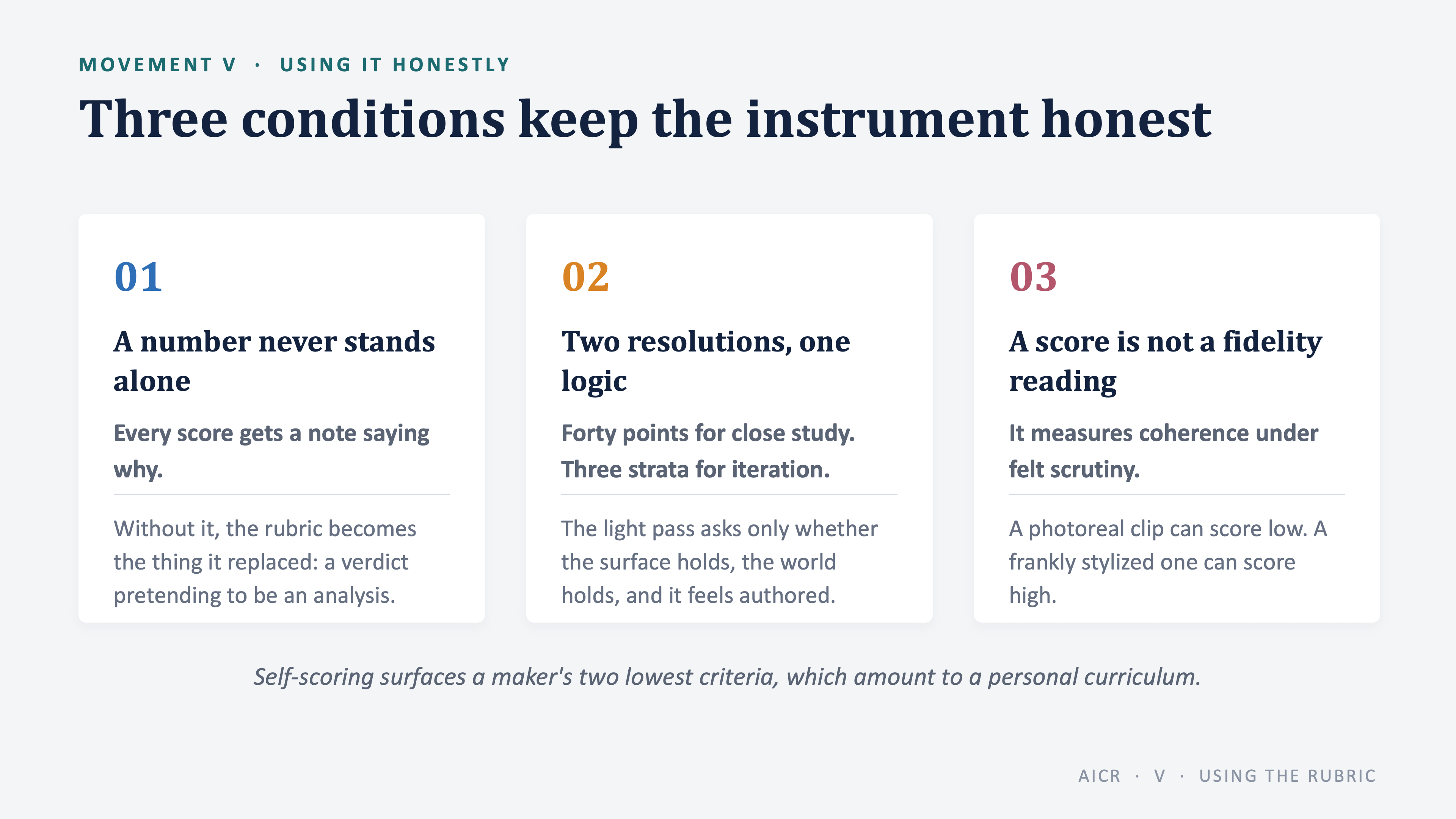
Three conditions keep the instrument honest.
First, a number never stands alone. Every score gets a brief note saying why. Without the note, the rubric becomes the thing it replaced, a verdict pretending to be an analysis. The score is where the conversation starts, not where it ends.
Second, two resolutions, one logic. Forty points is the wrong speed for iteration, so the three-stratum light pass is the working instrument and the full rubric is for close study, comparison and jury work.
Third, and this one changes what people expect from the tool: a score is not a fidelity reading. A photoreal clip can score low. A frankly stylized one can score high. Read as a fidelity meter it measures entirely the wrong thing.
One last observation. Score your own work and your two lowest criteria amount to a personal curriculum. Among experienced makers, the most commonly low score is authorial intentionality, which is exactly the criterion this whole framework exists to raise.
Not a prompt typist
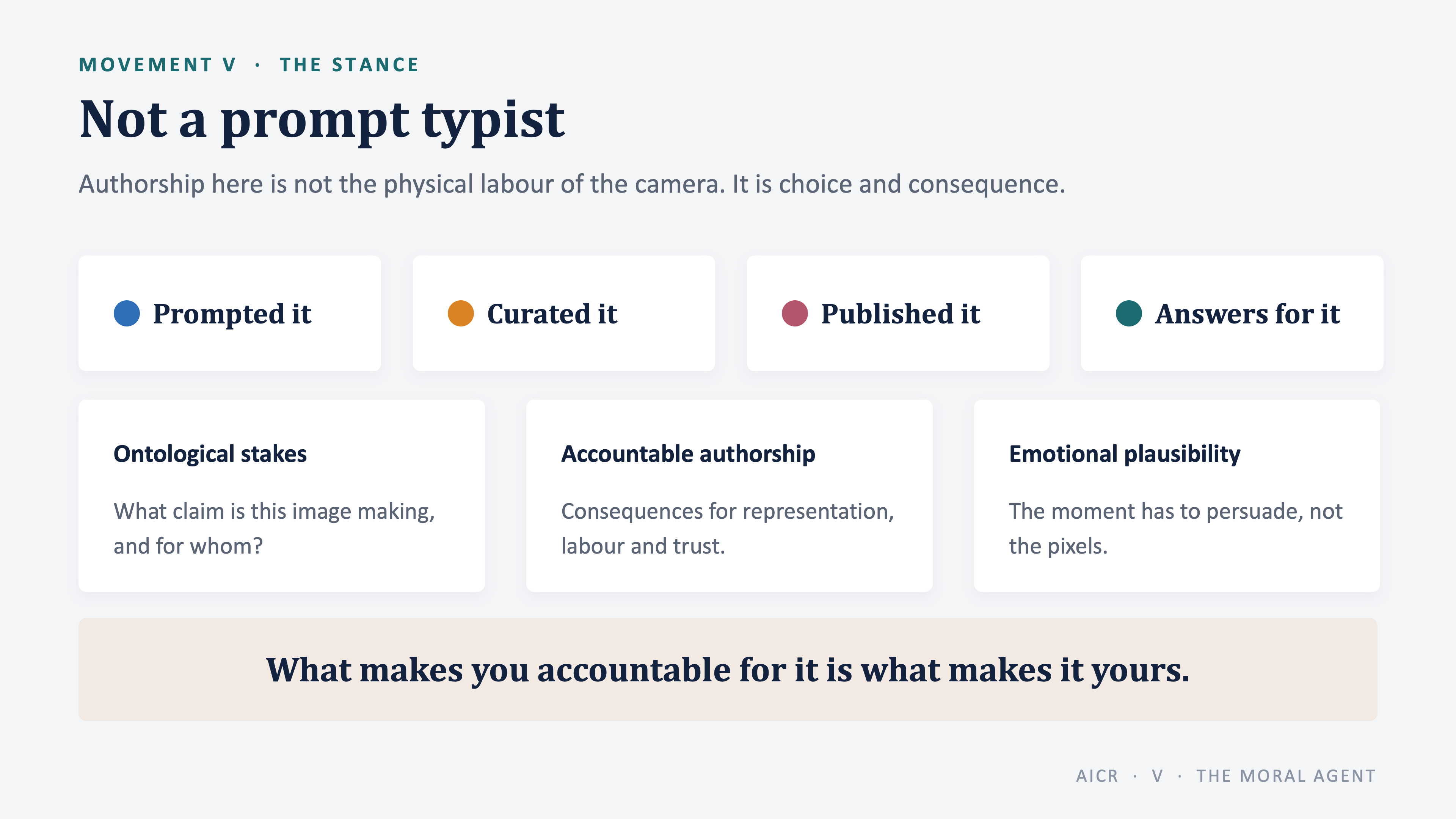
Which brings me to the accusation that shadows the entire medium. That the AI creator is passive. Feeding words into a black box and waiting for a payout.
Everything in the framework so far refutes it structurally. Total directorial control. Legislated worlds. Consciously assembled coherence. A psyche literalized in weather. None of that is typing and waiting.
You prompted it. You curated it. You published it. And you answer for it. Which means three commitments come with the work. Ontological stakes, asking what claim this image makes and for whom. Accountable authorship, with real consequences for representation, labor and trust. And emotional plausibility, because the moment has to persuade, not the pixels.
Here is the symmetry, and it is the point. What makes you accountable for it is what makes it yours. Anyone who wants credit for the good frame has already conceded responsibility for the bad one. Most filmmakers, on reflection, want exactly that trade.
The governing thesis
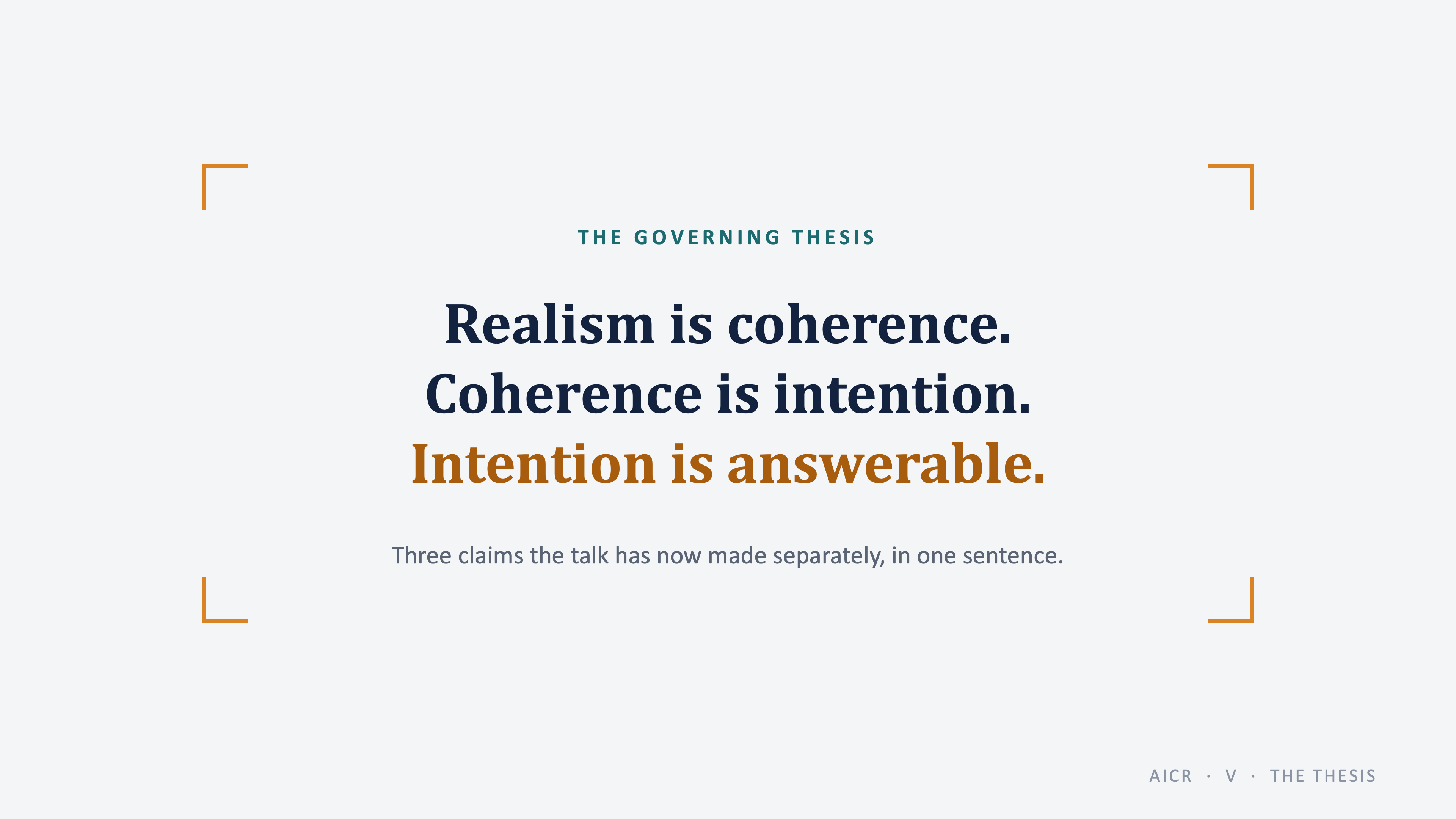
So I can finally say the thing in one sentence, now that all three parts of it have been earned.
Realism is coherence. That was the three strata.
Coherence is intention. That was conscious assembly and the four pillars.
And intention is answerable. That was the slide you just watched.
Realist movements arise in defiance of spectacle
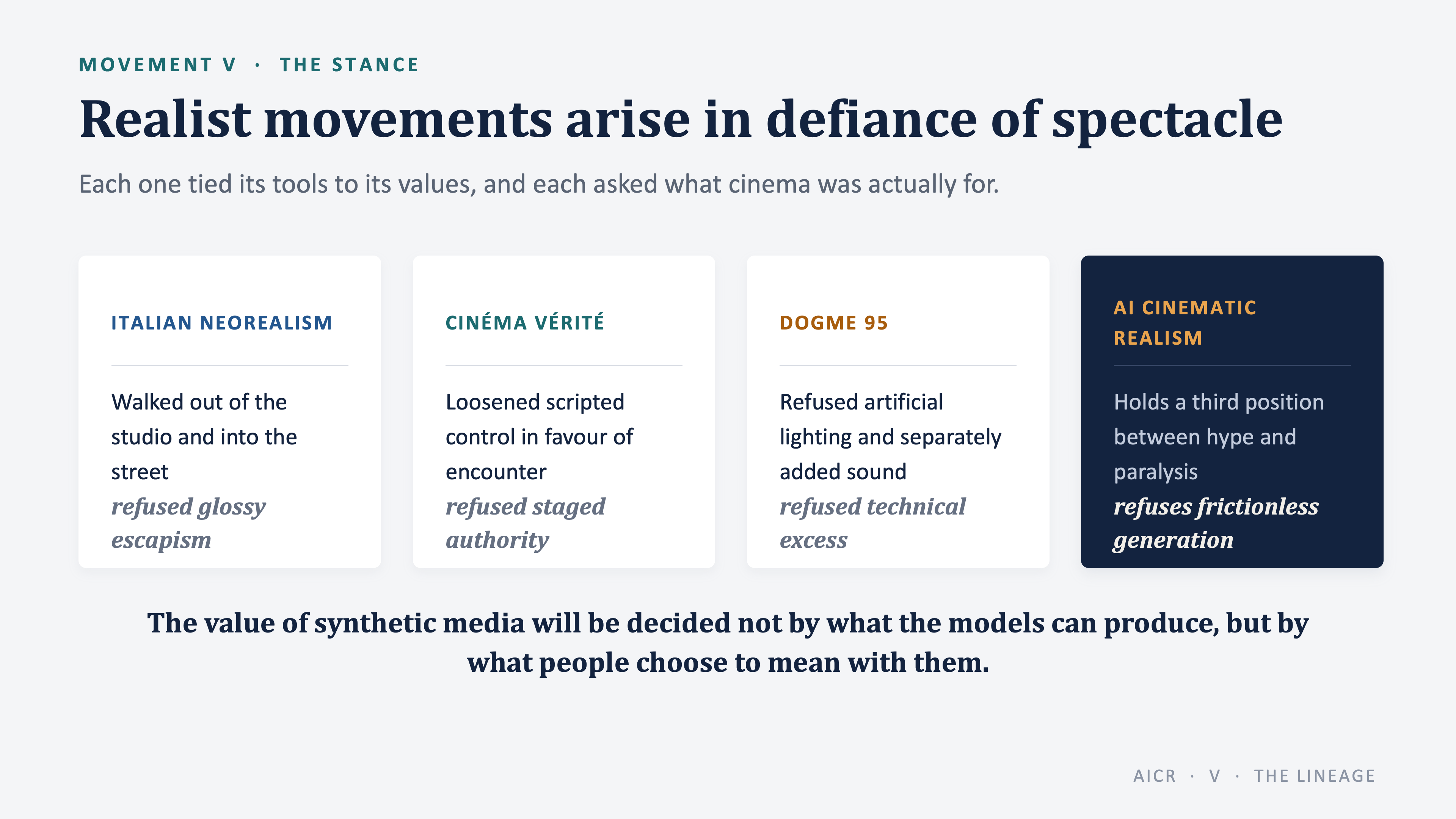
It is worth knowing where this sits in film history.
Every realist movement arose in defiance of a spectacle its era had accepted. Italian Neorealism walked out of the studio and into the street, refusing glossy escapism. Cinéma vérité loosened scripted control in favor of encounter, refusing staged authority. Dogme 95 refused artificial lighting and separately added sound, refusing technical excess.
AI Cinematic Realism belongs to that lineage, and the spectacle it refuses is frictionless generation itself. The endless, effortless production of images that are impressive on contact and empty on reflection. It refuses demo culture’s hype and deepfake panic’s paralysis alike, and holds a third position between them.
The value of synthetic media will be decided not by what the models can produce, but by what people choose to mean with them.
We stop being forgers
And that is the ethical core.
The deepfake exists because bad actors force AI video into the domain of captured reality. They want it to pass as evidence. They want deception.
A genre that privileges emotional resonance over photorealistic mimicry refuses that premise by design. The kept glitch, the impossible geometry, the world that obeys theme instead of physics. The genre’s openness about being synthetic works as a safety layer of style.
When the goal is to move the heart rather than trick the eye, the work no longer has to win by hiding its artificiality. We stop being forgers and start being filmmakers.
A framework becomes a field when it becomes teachable.
Point the strata at your own attention
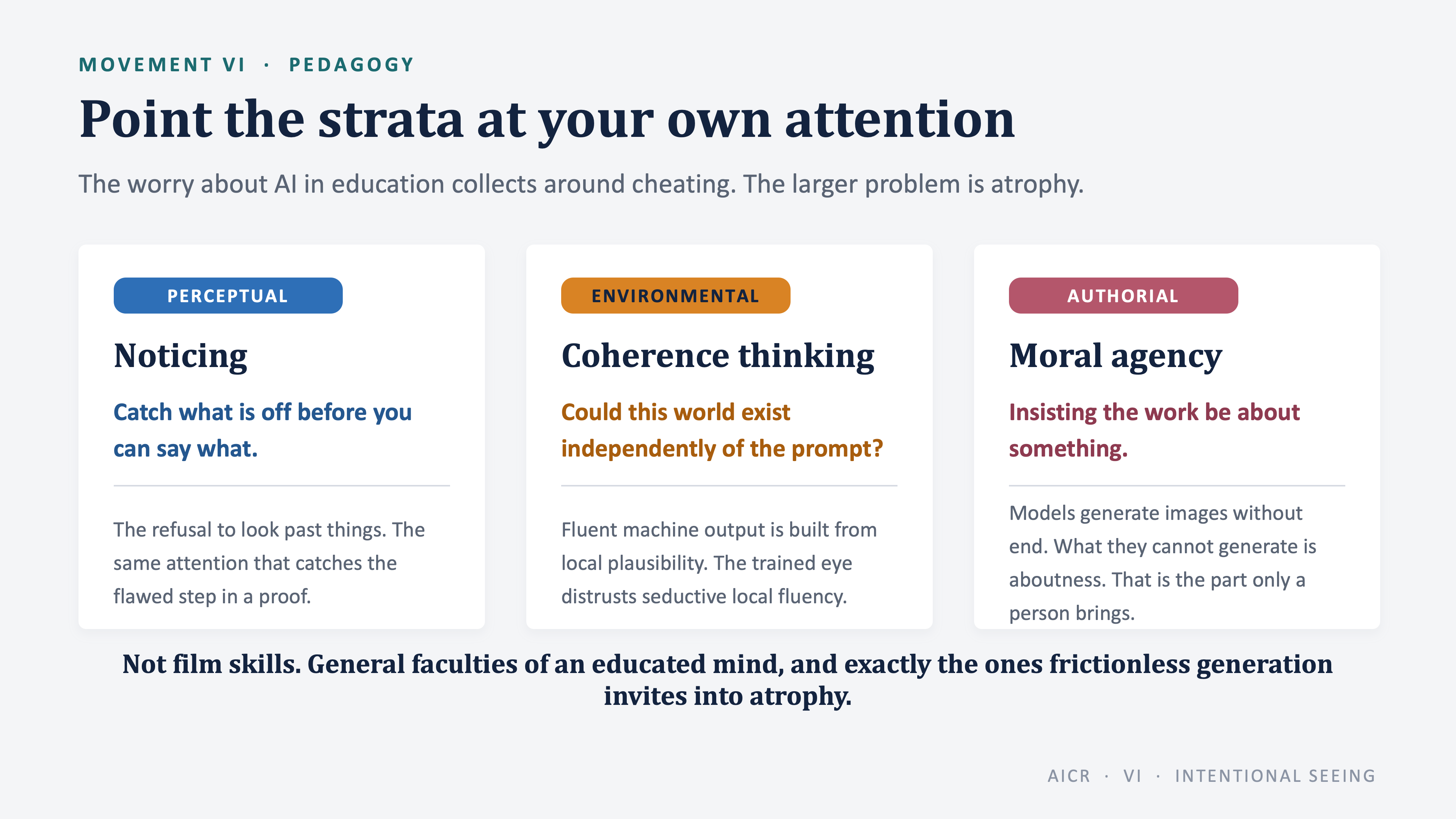
Pointed at a machine’s output, the strata are an evaluation method. Pointed at your own attention, they describe what a trained eye does in any medium.
Perceptual becomes noticing. Catching what is off before you can say what. The refusal to look past things. It is the same attention that catches the flawed step in a proof.
Environmental becomes coherence thinking. Could this world exist independently of the prompt? Fluent machine output is built from local plausibility, each region convincing given its neighbors, and the whole thing incoherent. A trained eye distrusts seductive local fluency. That is among the most transferable faculties in education.
Authorial becomes moral agency. Insisting the work be about something. Models generate images without end. What they cannot generate is aboutness. That is the part only a person brings.
These are not film skills. They are general faculties of an educated mind, and they are exactly the ones frictionless generation invites into atrophy. The worry about AI in education collects around cheating. The larger problem is atrophy.
The open syllabus
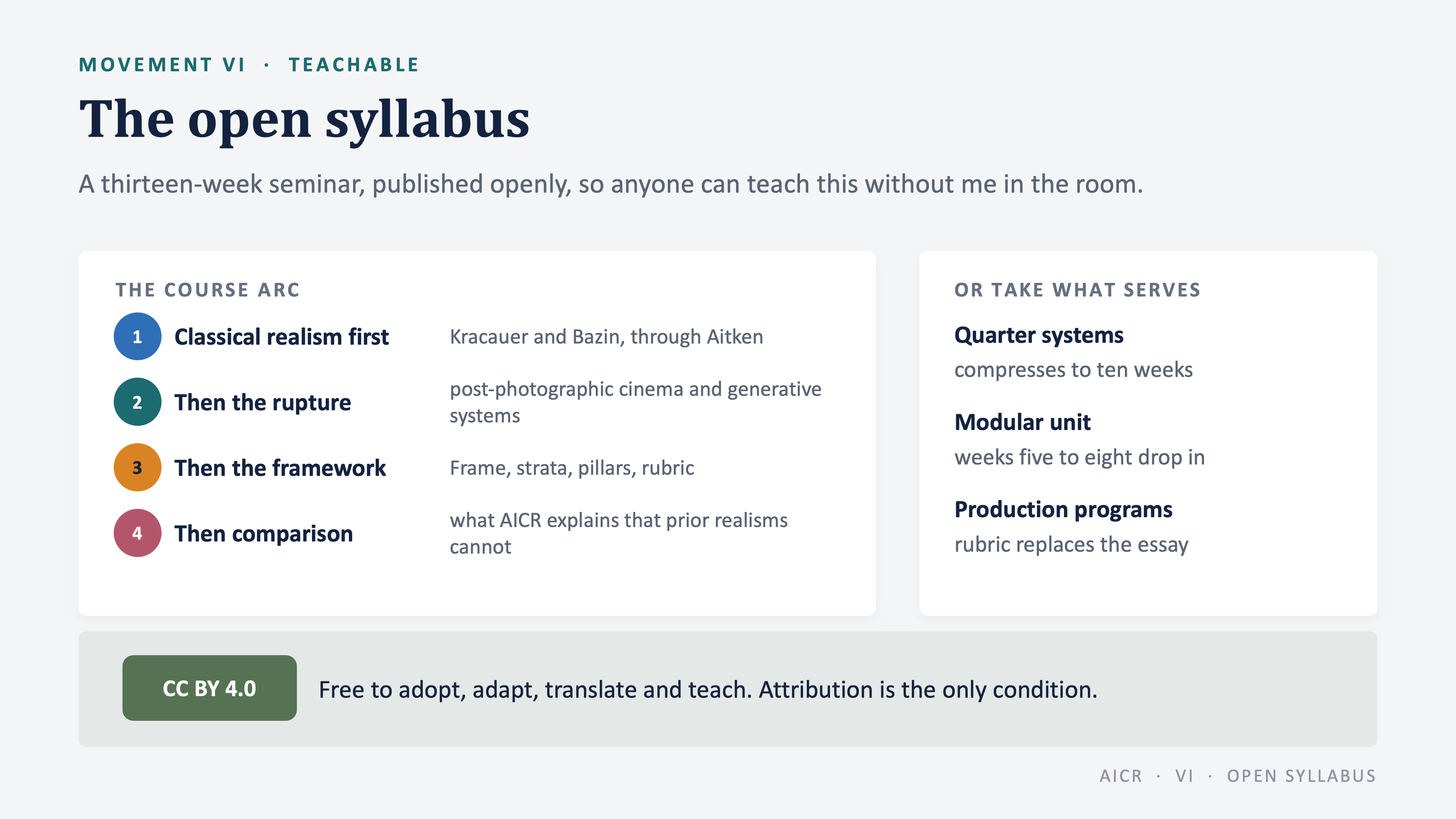
So I published a syllabus. Thirteen weeks, openly licensed, so that anyone can teach this without me in the room.
The order matters. Students meet the classical realist tradition first, Kracauer and Bazin through Aitken. Then the rupture, post-photographic cinema and generative systems. Then the framework itself. Then a comparative evaluation asking what AICR explains that prior realisms cannot.
That order is a deliberate refusal of novelty framing. It gives students the historical grounding to treat synthetic cinema with rigor rather than reflex.
Adopt it whole, compress it to ten weeks for a quarter system, drop weeks five through eight into an existing course as a module, or let the rubric replace the midterm essay in a production program. It is Creative Commons. Attribution is the only condition.
What exists, and what it is for
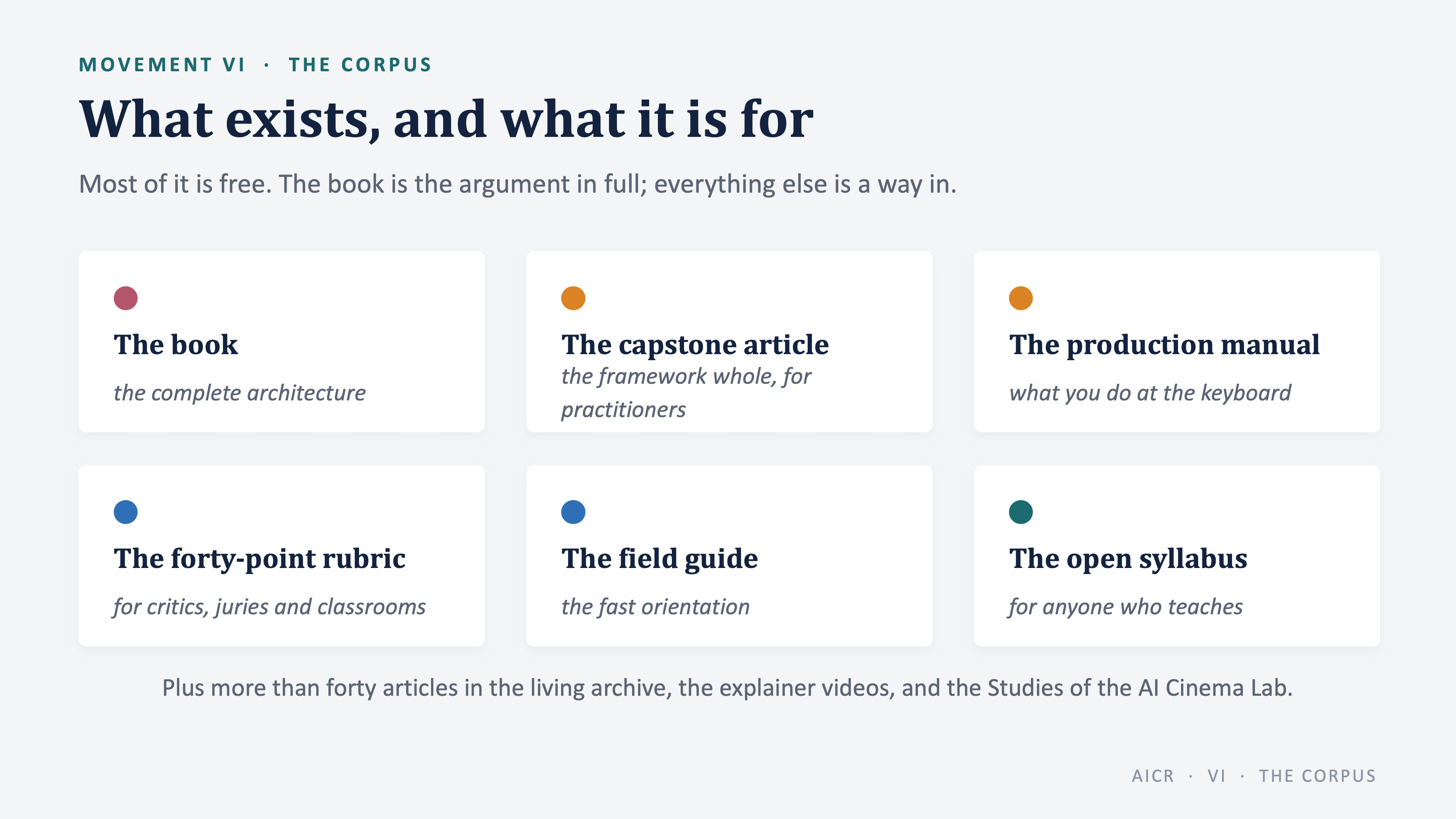
Most of this is free. The book is the argument in full, and everything else is a way in, depending on who you are.
A practitioner should start with the capstone article and the production manual. A critic or a juror should start with the forty-point rubric. An educator should start with the syllabus. A reader who wants the fast orientation should start with the field guide.
Plus more than forty articles in the living archive, the explainer videos, and the numbered studies of the AI Cinema Lab. And one thing worth saying about a corpus that size: it gets revised in place as the framework grows, which means the archive always runs slightly ahead of whatever edition of the book is current.
Coherent, authored, answerable, felt
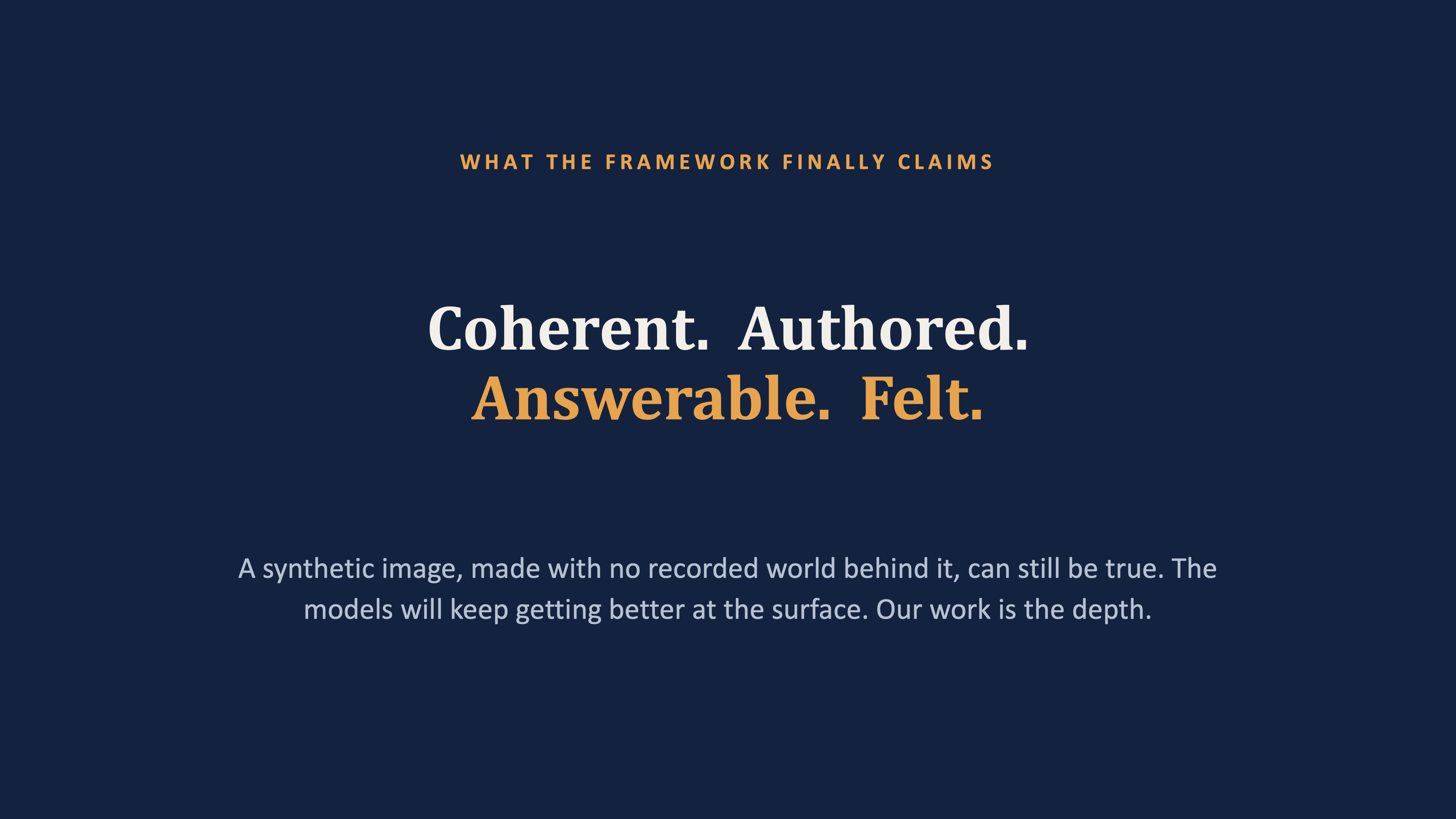
So here is what the framework finally claims.
A synthetic image, made with no recorded world behind it, can still be true. Coherent. Authored. Answerable. Felt.
A model can inherit cinema’s commitments. It can even enforce them against your instruction. But it cannot mean anything by them. Meaning is the part that does not transfer to the tool. It has to be brought, every time, by someone willing to stand behind the image and answer for it.
The models will keep getting better at the surface. Our work is the depth.
Everything in this talk is at jonigutierrez.com, filed under AI Cinematic Realism. The rubric, the field guide, the production manual and the syllabus are all free. The book is called AI Cinematic Realism, and the archive will always point you to the current edition.
If you make something with this framework, I would like to see it. And if you think I have got something wrong, I would like to hear that even more. This is a field being built in public, which means it is being built by more people than me.
Images can be generated. Cinema must be authored.
The framework on one sheet
Everything above, laid out as a single reference poster. The six parts, the eight commitments, the three strata, the four pillars, the production workflow and the forty-point rubric, arranged so the shape of the argument is visible at once. It is licensed CC BY 4.0 along with the rest of this article, so it is free to download, print, put on a wall, drop into a slide deck, or hand to a class.
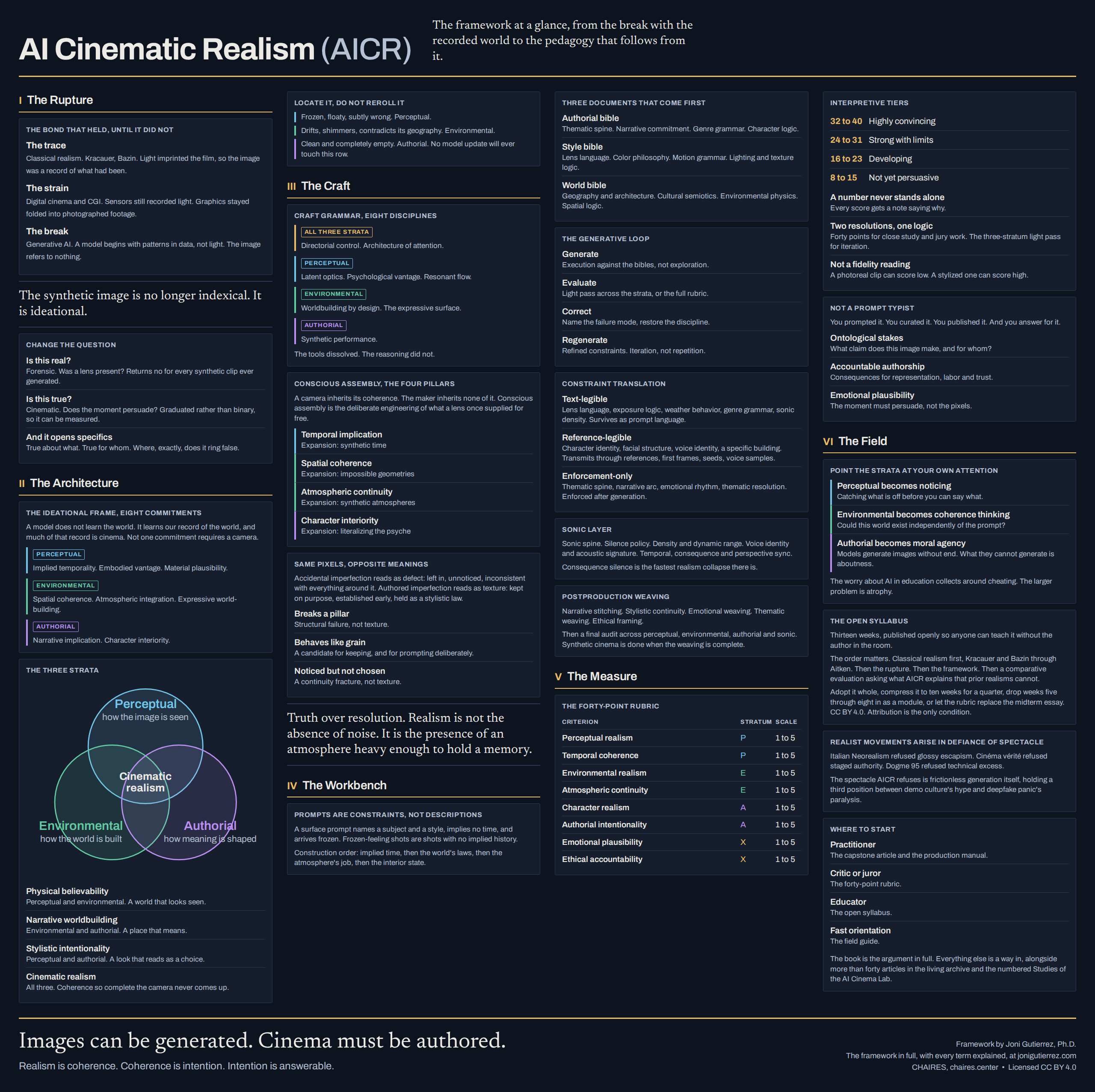
The original text, framework diagrams, and presentation materials in this article are licensed under a Creative Commons Attribution 4.0 International License (CC BY 4.0). You are welcome to share, adapt, translate, and build upon this work with appropriate attribution to Joni Gutierrez, Ph.D., and AI Cinematic Realism (AICR).
AICR resources
- Gutierrez, J. (2026, August 23). AI Cinematic Realism (AICR): The framework in full.
- Gutierrez, J. (2026, July 22). AI Cinematic Realism (AICR) production manual.
- Gutierrez, J. (2026, July 19). AI Cinematic Realism for AI filmmakers: The AICR framework, its ideas, and its craft.
- Gutierrez, J. (2026, July 10). Teaching AI Cinematic Realism (AICR): An open syllabus.
- Gutierrez, J. (2026, July 7). AI Cinematic Realism (Second Edition): A reader’s map to the book.
- Gutierrez, J. (2026, July 1). AI Cinematic Realism (Second Edition) — The framework in brief [Video and article].
- Gutierrez, J. (2026, June 25). AI Cinematic Realism (AICR): Framework, tools, and structural overview.
- Gutierrez, J. (2026, June 20). A 40-point rubric for evaluating AI Cinematic Realism: A practical instrument for critics, scholars, filmmakers, and educators in the post-camera era.
- Gutierrez, J. (2026, June 5). Intentional seeing: AI Cinematic Realism as a pedagogy for the post-camera era.
- Gutierrez, J. (2026, June 1). AI Cinematic Realism (AICR): A new language for cinema [Video guide and slide deck].
- Gutierrez, J. (2026, May 25). AI Cinematic Realism (AICR): Field guide.
- Gutierrez, J. (2026, May 23). AI Cinematic Realism (AICR) – Explained [Explainer video with transcript].
- Gutierrez, J. (2026, April 1). The Ideational Frame as the foundation of the three-strata model of AI Cinematic Realism.
- Gutierrez, J. (2026, February 28). From Lebenswelt to emotional plausibility: A research arc toward AI Cinematic Realism.
- Gutierrez, J. (2026, February 15). The four pillars of AI Cinematic Realism: A framework for conscious assembly.
- Gutierrez, J. (2026, February 13). AI Cinematic Realism: From “Is it real?” to “Is it true?”
- Gutierrez, J. (2025, September 15). Beyond the frame: AI Cinematic Realism as ethical genre.
- Gutierrez, J. (2025, September 13). AI Cinematic Realism: Establishing a new field for film, philosophy, and media.
- Gutierrez, J. (2025, August 2). AI Cinematic Realism: On the aesthetics of an AI-generated world.
Watch — AICR: The Framework in Full
Everything above, delivered as a single talk. The video follows the same six movements in the same order, so you can use it as a first pass before reading or as a way back into any section afterwards.


Leave a Reply