
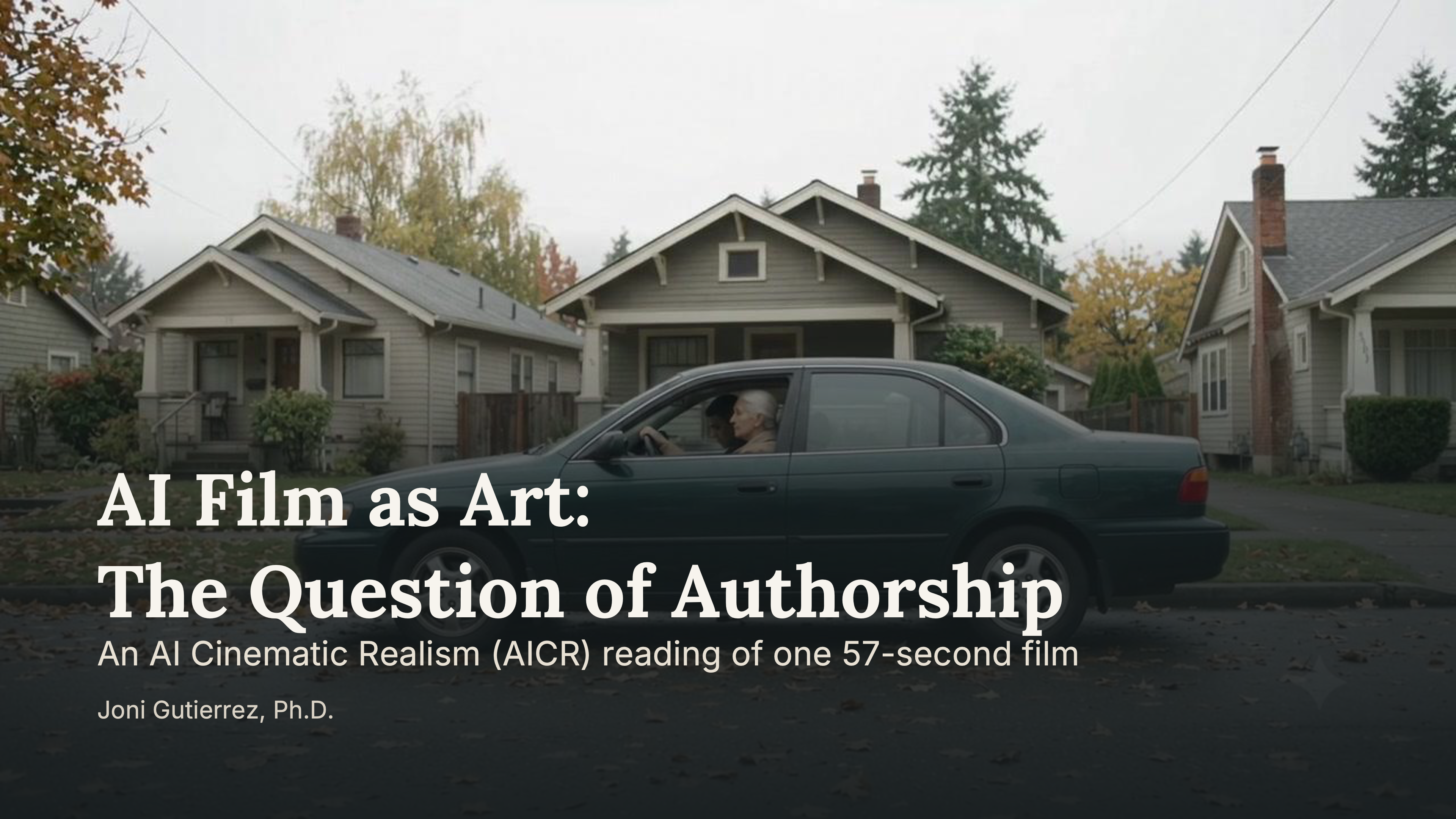
I want to explore authorship through one small film: a 57-second work I made called First Lesson.
I’ll use AI Cinematic Realism, or AICR, to examine the decisions behind it: what I wanted the film to carry, what happened during generation, and how I decided what belonged in the finished work.
But first, I’d like you to watch it. We’ll begin with what you notice.
This is Study 33: First Lesson, made with AI in Google Flow.
What stayed with you? A line, an image, a gesture?
To explain how I approached those decisions, I want to begin with the film questions that shaped my work before I started using AI.
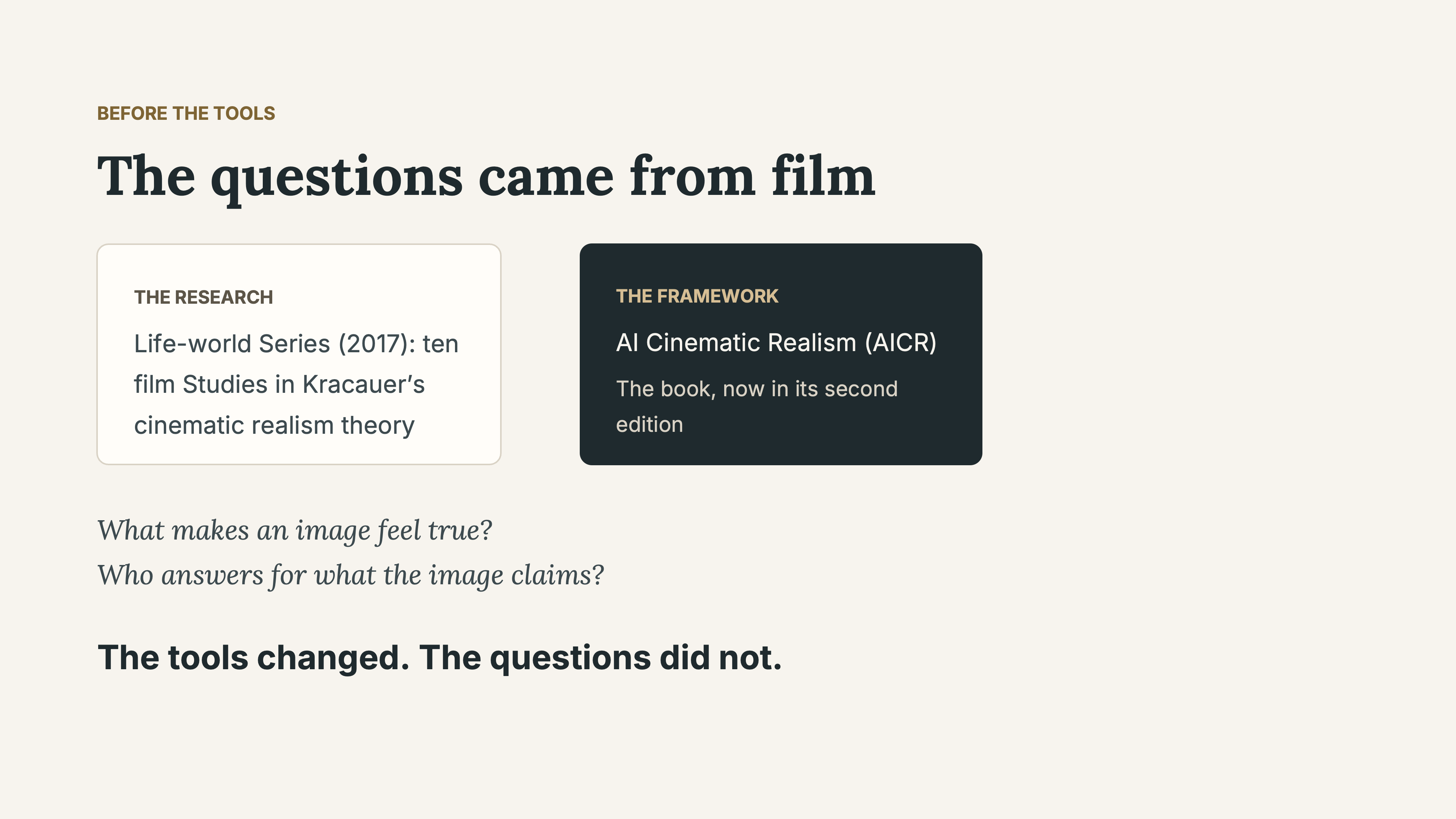
My doctoral research explored Siegfried Kracauer’s cinematic realism through film practice and criticism.
As part of that research, I made Life-world Series: ten film studies exploring our experience of the everyday world.
That work continues to shape how I approach AI cinema. What makes an image feel true? And who answers for what the image claims?
AI Cinematic Realism, now developed in the second edition of my book, grows out of those questions.
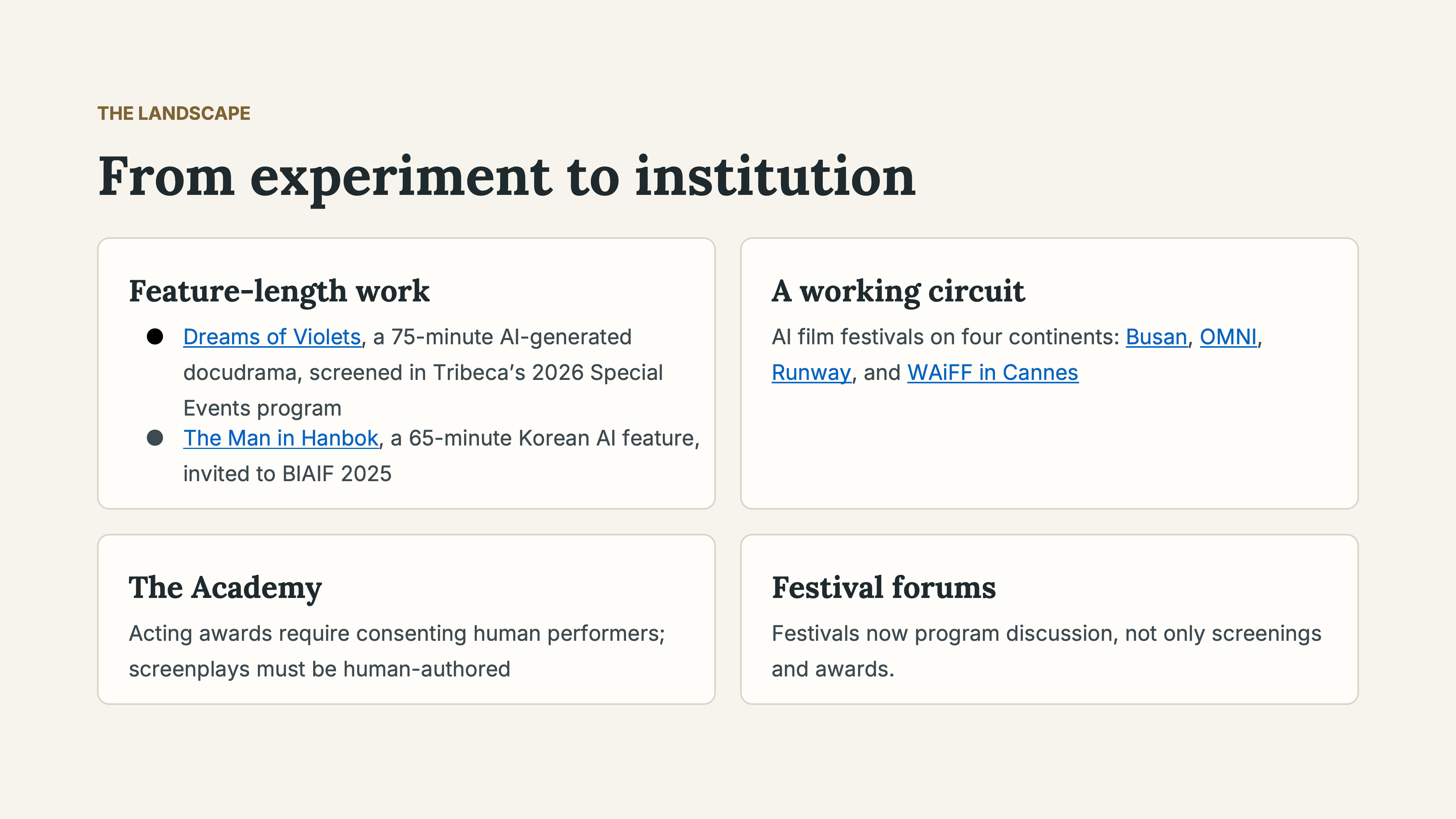
These questions now have institutional consequences.
Dreams of Violets appeared in Tribeca’s 2026 Special Events program. BIAIF 2025 included the Korean AI feature Man in Hanbok.
A festival circuit now extends across several continents. The Academy has also made human authorship explicit in its screenplay eligibility rules and requires eligible acting performances to come from consenting humans.
Festivals, filmmakers, and institutions are deciding how to recognize this work.
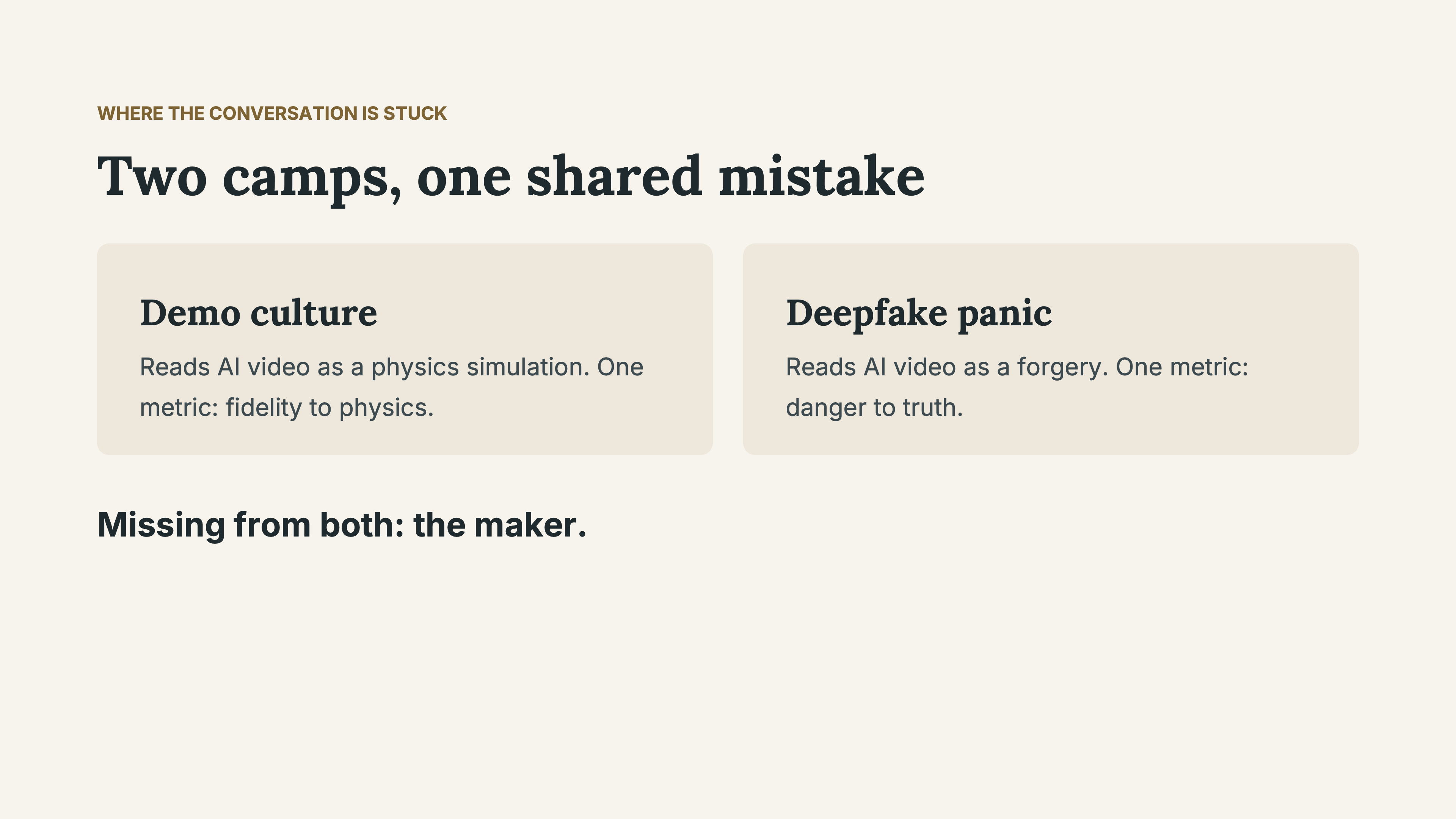
I see two recurring tendencies in discussions of AI video.
One judges the image as a technical demonstration. Does the water move correctly? Do the hands work? Does the scene obey physics?
Another begins with deception. Could someone mistake this image for evidence of something that happened?
Both concerns matter. But when either becomes our entire way of looking, the particular film can disappear from view.
I want to bring the maker’s decisions into that discussion. What experience is being constructed, and what responsibility accompanies it?
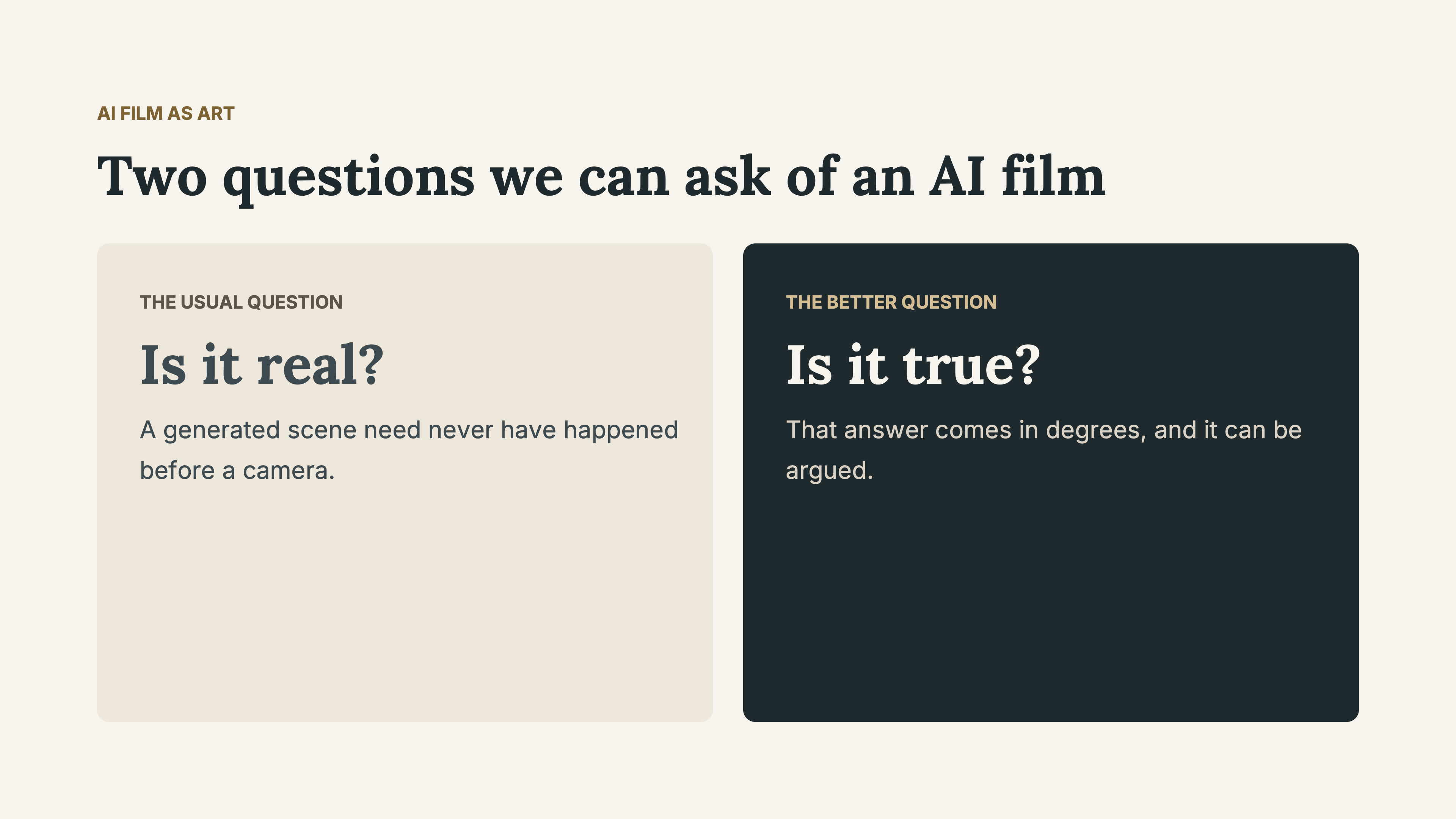
When we ask whether an AI image is real, we may mean: did this scene happen before a camera?
For a generated scene, it need never have happened.
But that leaves another question: can the film convey something true about human experience?
First Lesson asks us to recognize an experience of grief and continuing to live. We can discuss whether its images, gestures, and silences make that experience persuasive.
That is the question AICR helps me investigate.
Kracauer gives us a useful starting point.
In Theory of Film, published in 1960, he describes cinema’s capacity to record and reveal physical reality, including ordinary things we might otherwise overlook.
A camera encounters a world that exists beyond the filmmaker’s intentions. Something can enter the image that the filmmaker did not anticipate.
A fully generated scene changes that relationship. It need not begin with an event before a camera.
That raises a question for my work: what becomes of cinematic realism when that encounter is no longer the basis of the image?
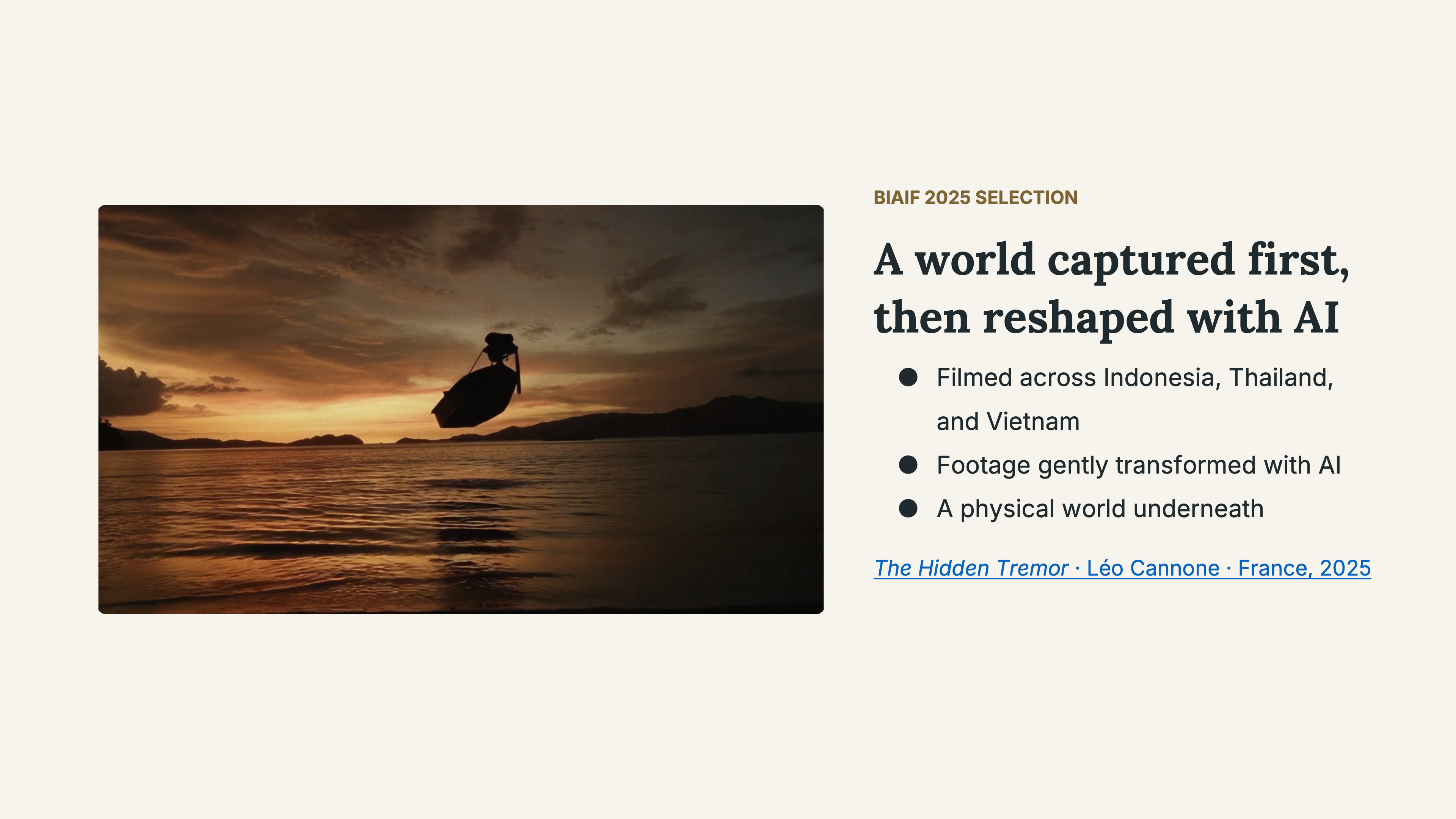
Léo Cannone’s The Hidden Tremor makes this boundary more interesting.
Cannone filmed environments in Indonesia, Thailand, and Vietnam, then gently transformed the footage with AI.
In his account to NOWNESS, he describes wanting to bring out shapes, movements, and energies he sensed while filming.
I read this as a useful conversation with Kracauer. There is a physical world encountered by the filmmaker, followed by an intervention that makes something newly perceptible.
The question becomes how that transformation directs our attention to the world.
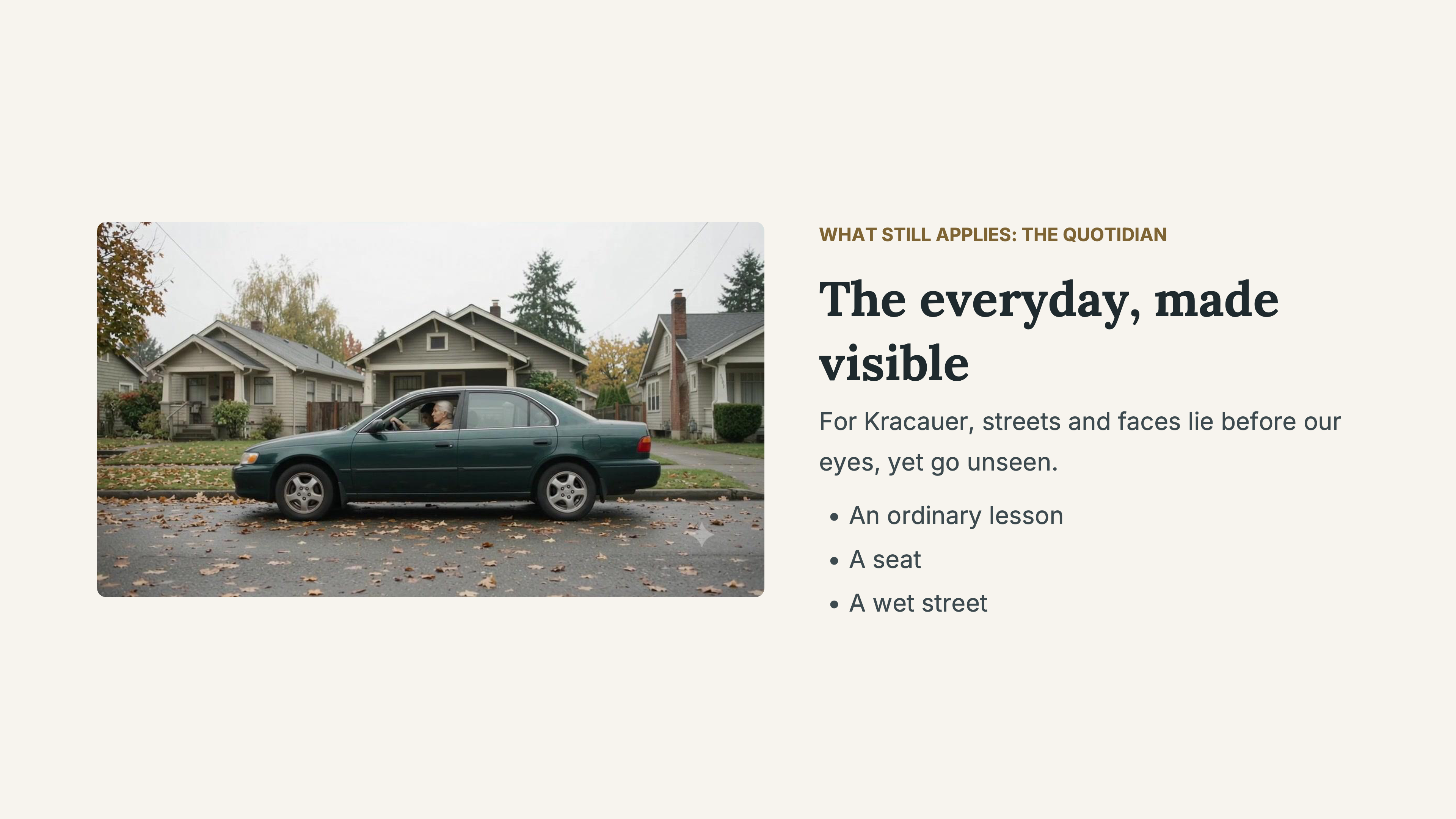
One connection I want to preserve is the quotidian: ordinary, everyday life.
A driving lesson. A seat adjusted for someone else. A wet street.
These details give First Lesson its material. Their significance emerges through the relationships the film builds around them.
The seat is an ordinary object, but “He was taller” makes us encounter it differently. It begins to suggest another person and a shared past.
That attention to the everyday carries forward into my work with generated images.
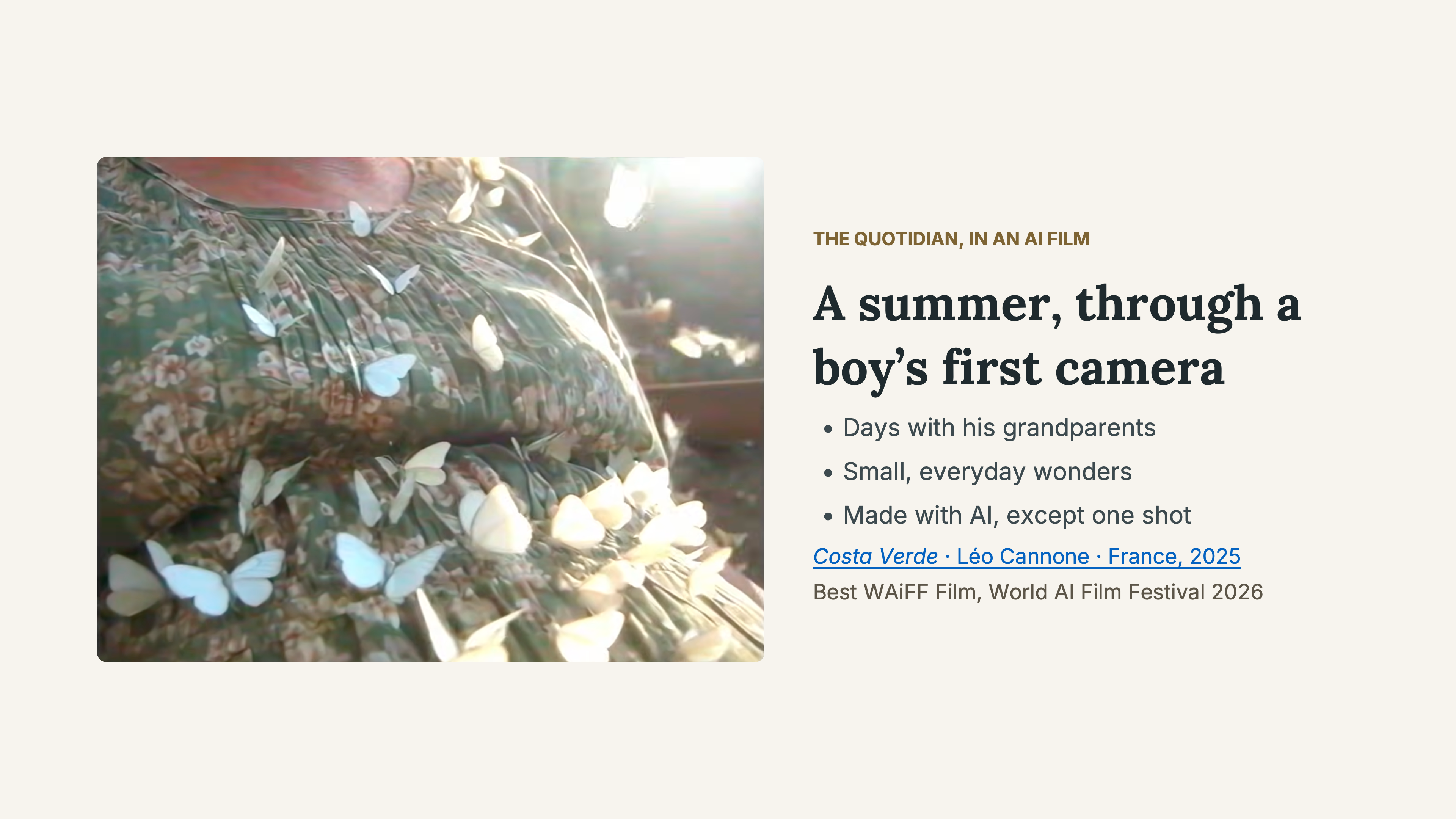
Léo Cannone’s Costa Verde follows a boy discovering the world through his first camera during a summer with his grandparents in Corsica.
Ordinary family life shares the frame with magical beings. The film captures a child’s way of seeing, where the familiar and the extraordinary belong together.
It was made entirely with AI, except for the final shot.
What interests me here is its attention to the everyday. That connection to cinematic realism survives even when the images are generated. It gives us a reason to look beyond photorealism when we ask what makes an AI film feel true.
That brings me to AI Cinematic Realism.
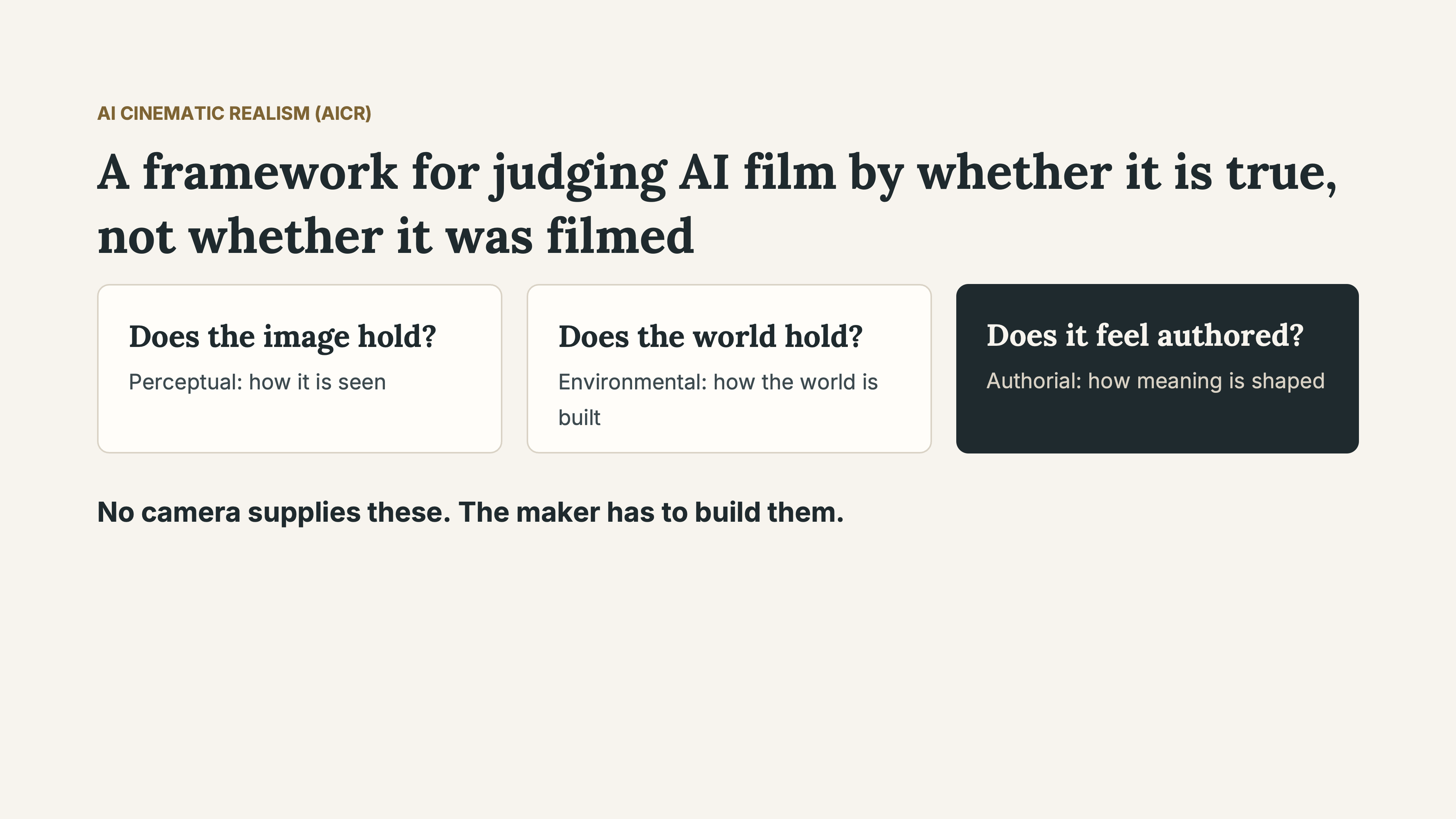
AI Cinematic Realism organizes this inquiry through three strata.
The perceptual stratum asks whether the image holds: its surfaces, light, materials, and sense of physical presence.
The environmental stratum asks whether the world holds: whether space and atmosphere sustain the experience across shots.
The authorial stratum asks how meaning takes shape through the work’s expressive choices.
These are related questions. A convincing surface can belong to an inconsistent world. A consistent world can still leave us wondering why we are watching.
We can now return to First Lesson and examine those relationships decision by decision.
So where does the art go? Let’s look at what I asked for, what I received, and how the film took shape through the decisions between them.
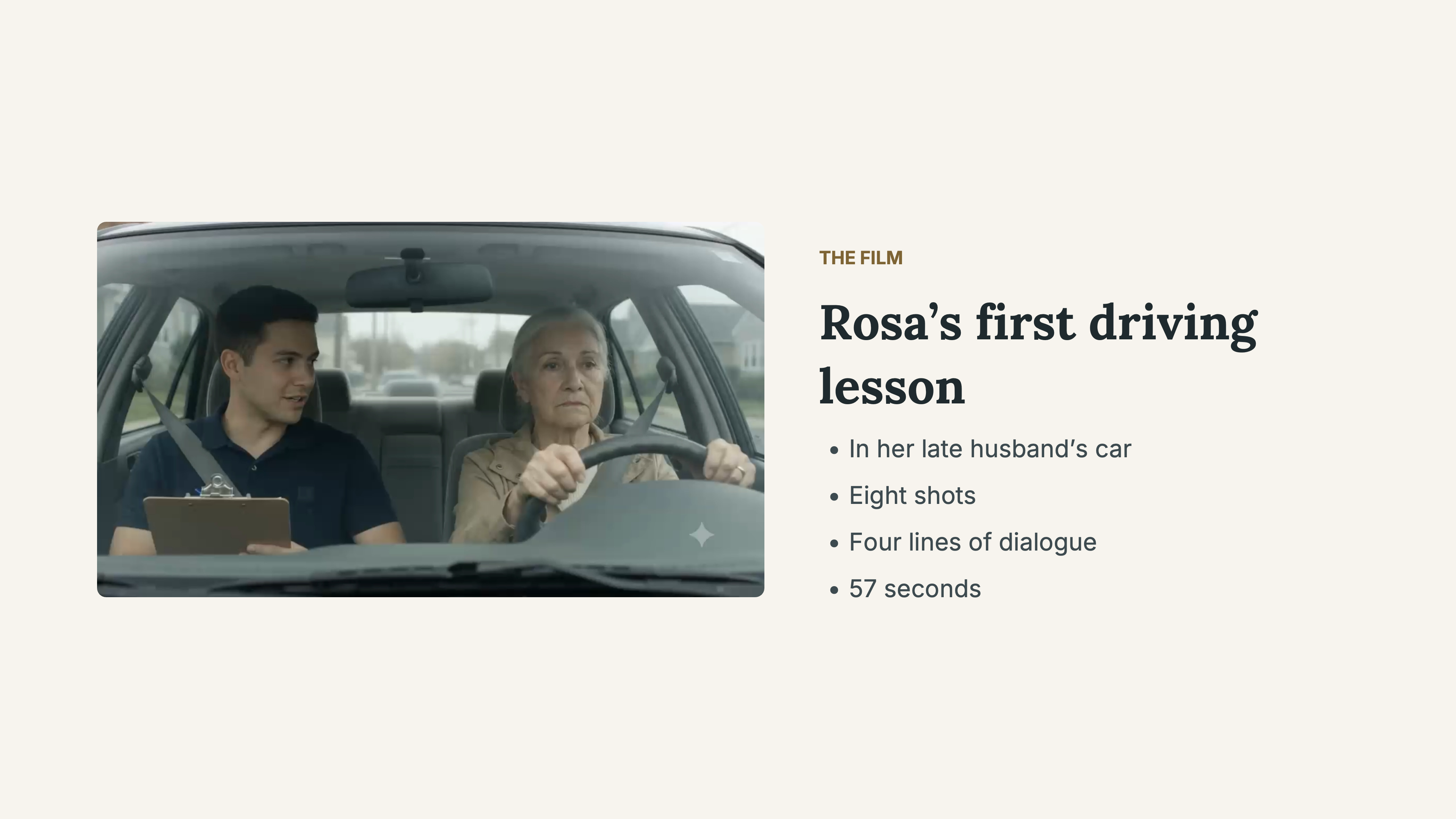
First Lesson follows Rosa, a woman in her seventies learning to drive in her late husband’s car.
The story unfolds during one lesson, on an overcast morning in a Pacific Northwest neighborhood.
I made it for an AI filmmaking workshop at Bellevue College. I wanted to open the session with a small, complete film that we could then examine together.
It has eight shots, four lines of dialogue, and a running time of 57 seconds. Within that space, the challenge was to suggest a life beyond what we see.
Before generating anything, I use a question from the AICR Production Manual: can I complete the sentence, “This exists because…”?
That sentence gives me something to return to when I evaluate the material. A generation might look beautiful or technically convincing. But does it belong in this film?
For First Lesson, I needed to understand why this driving lesson mattered. What made it worth asking an audience to spend time with Rosa?
The sentence I arrived at was: “Love survives, and it wants us to live.”
That became the film’s thematic spine—the central idea guiding its decisions.
It shaped how I understood the husband’s presence and the meaning of Rosa driving away. His peace mattered because I wanted her continuing life to feel welcome.
The film had to carry that idea through its images and gestures, without having a character explain it.
My father died a few months before I made this film.
That loss shaped its central images. The green light became permission to go on. The husband’s smile carried the wish that the person left behind would keep living.
That is where the film’s purpose came from, and it guided what I chose to keep.
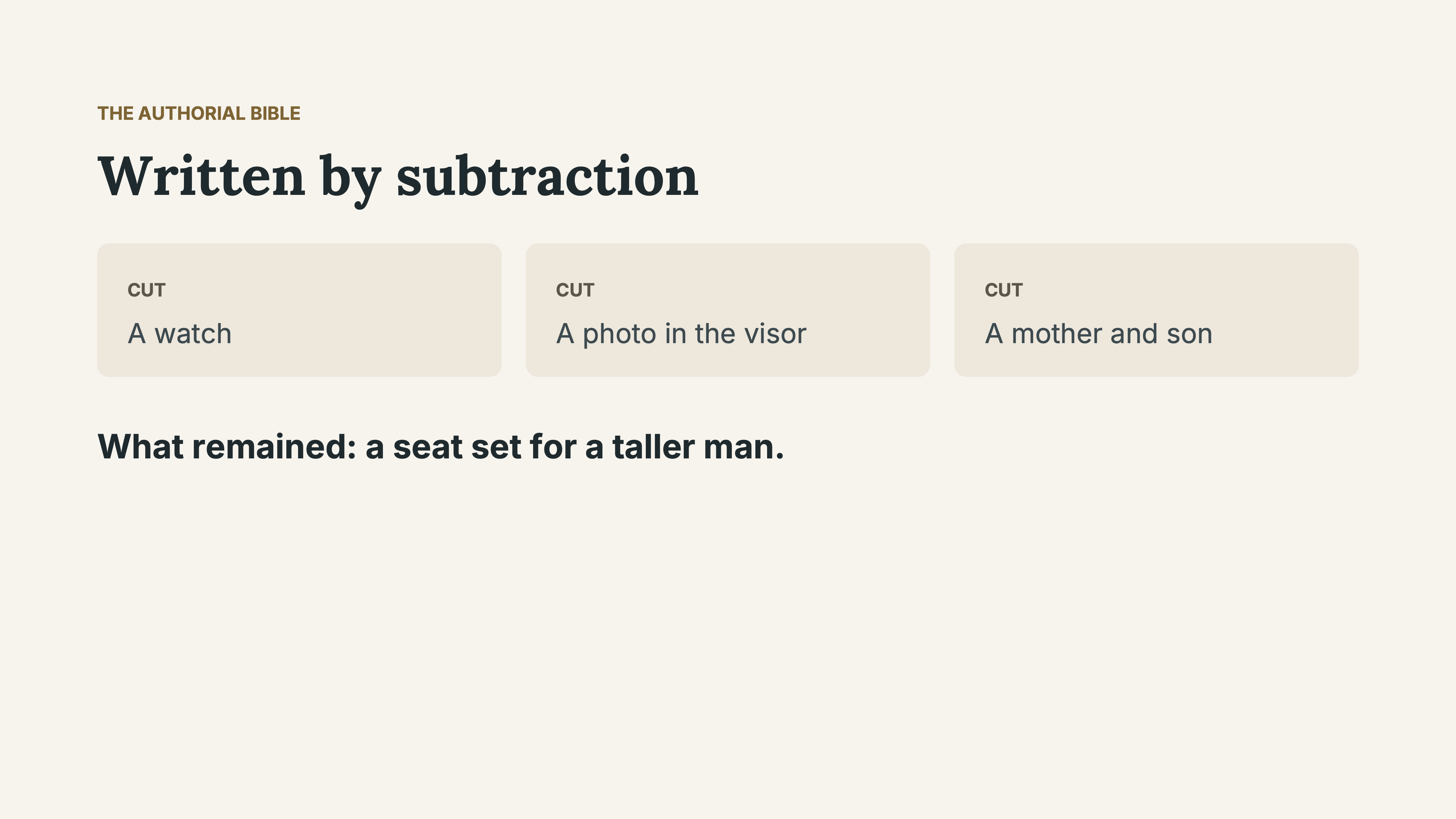
Much of the film took shape by removing things.
Early versions included a watch, a photograph tucked into the visor, and a mother-and-son relationship. As I developed the concept, those details felt too explanatory. They made the loss more explicit than I wanted.
What remained was a seat set for a taller man.
That detail belonged naturally to a driving lesson. Adjusting the seat was something Rosa needed to do, and it also made her husband’s absence felt.
The ordinary action could carry the emotional meaning.
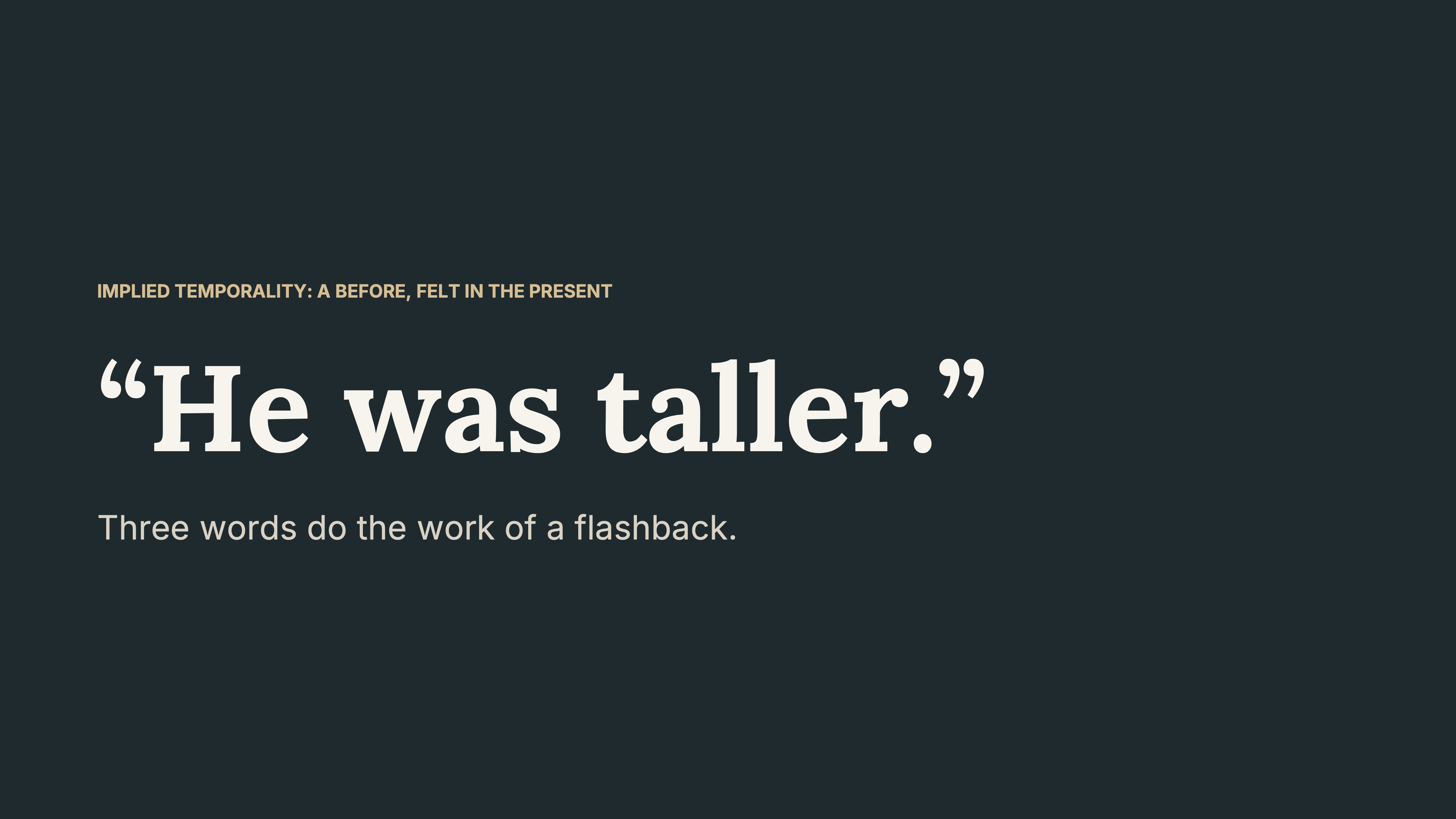
“He was taller.”
Those three words suggest a past without showing a flashback. Someone else occupied this seat. It was adjusted for his body, and now Rosa has to change it.
In AICR, I call this implied temporality: the sense that what we see has a before and an after.
Here, that sense of time emerges from the relationship between an object, a line of dialogue, and the situation. The seat begins to carry a shared history.
That was the kind of meaning I wanted the production to protect. The next question was how to carry those intentions into the generation process.
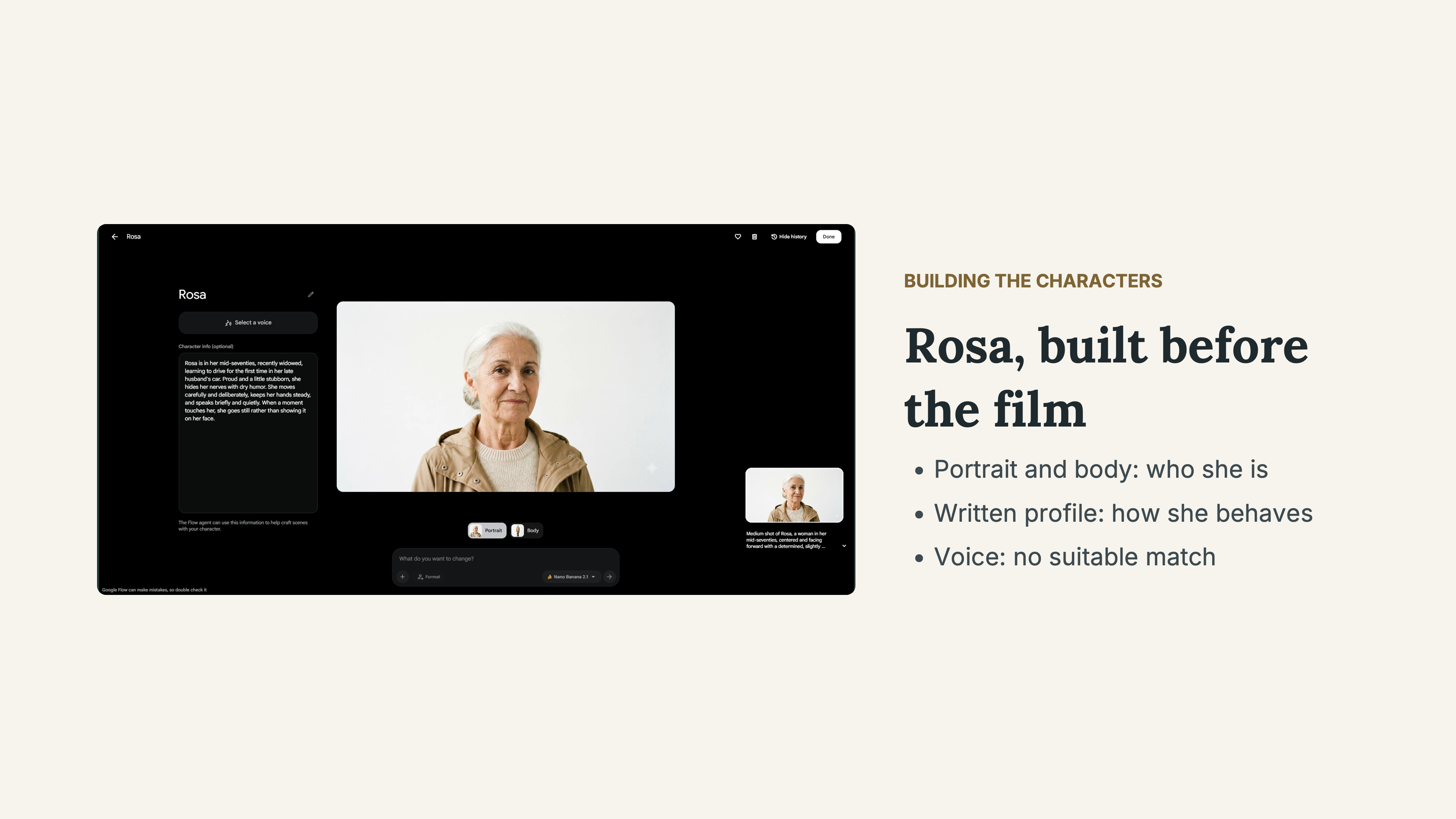
Before generating the scenes, I built Rosa and the instructor in Flow’s character builder. Each had a portrait, a body reference, and a written profile.
The images helped preserve their appearance. The profiles described how they behaved. Rosa, for example, was proud, a little stubborn, and quiet when something touched her emotionally.
The car also had its own reference because it needed to remain recognizable across shots.
Voice was more difficult. Among the available presets I explored, I couldn’t find a suitable match for Rosa. That became a question of representation: how well did the available choices support the older person I wanted to portray?
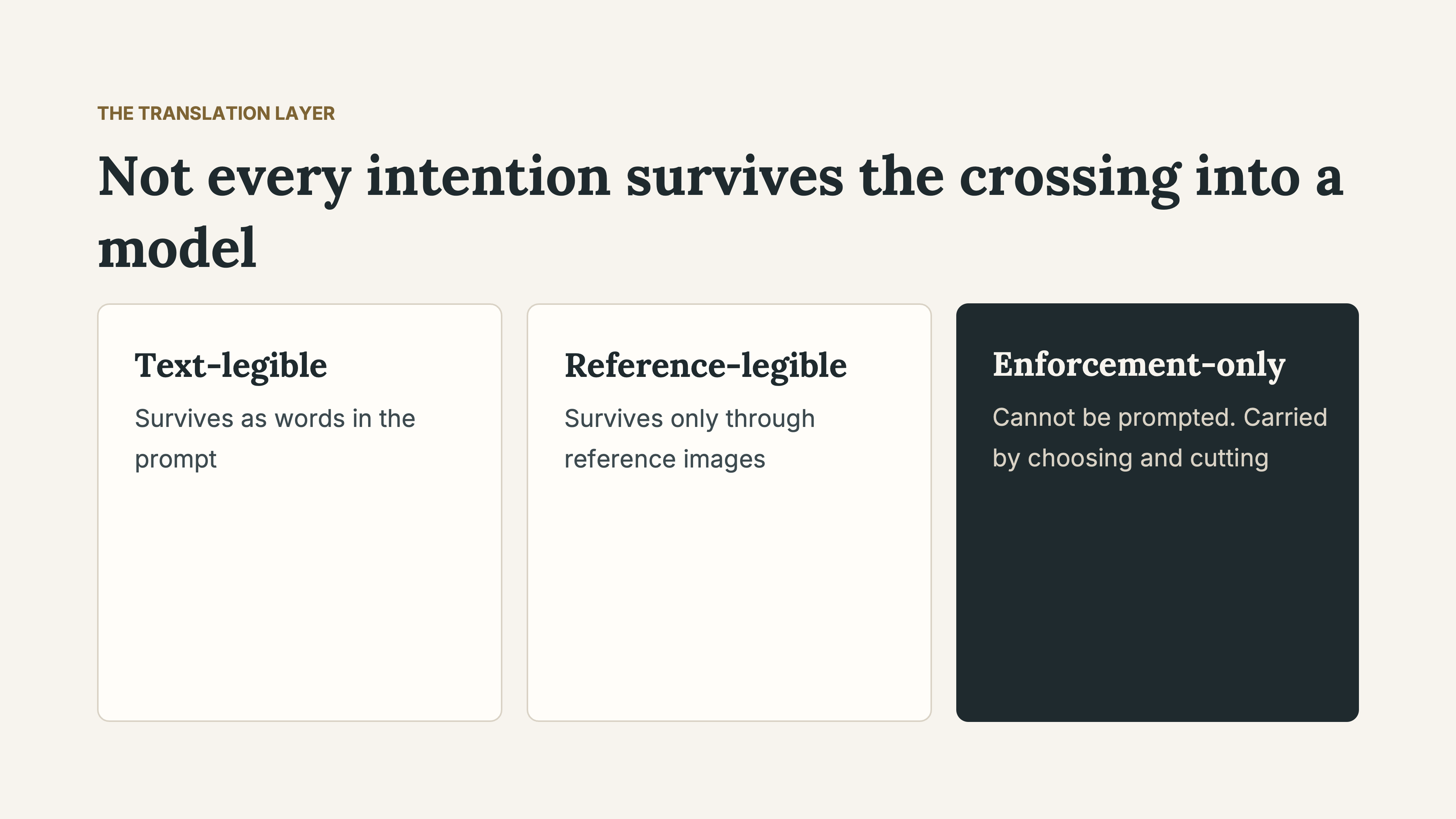
These preparations bring us to what AICR calls the translation layer.
It asks what an intention needs in order to survive the crossing into generation.
Some instructions are text-legible: words in the prompt can carry them.
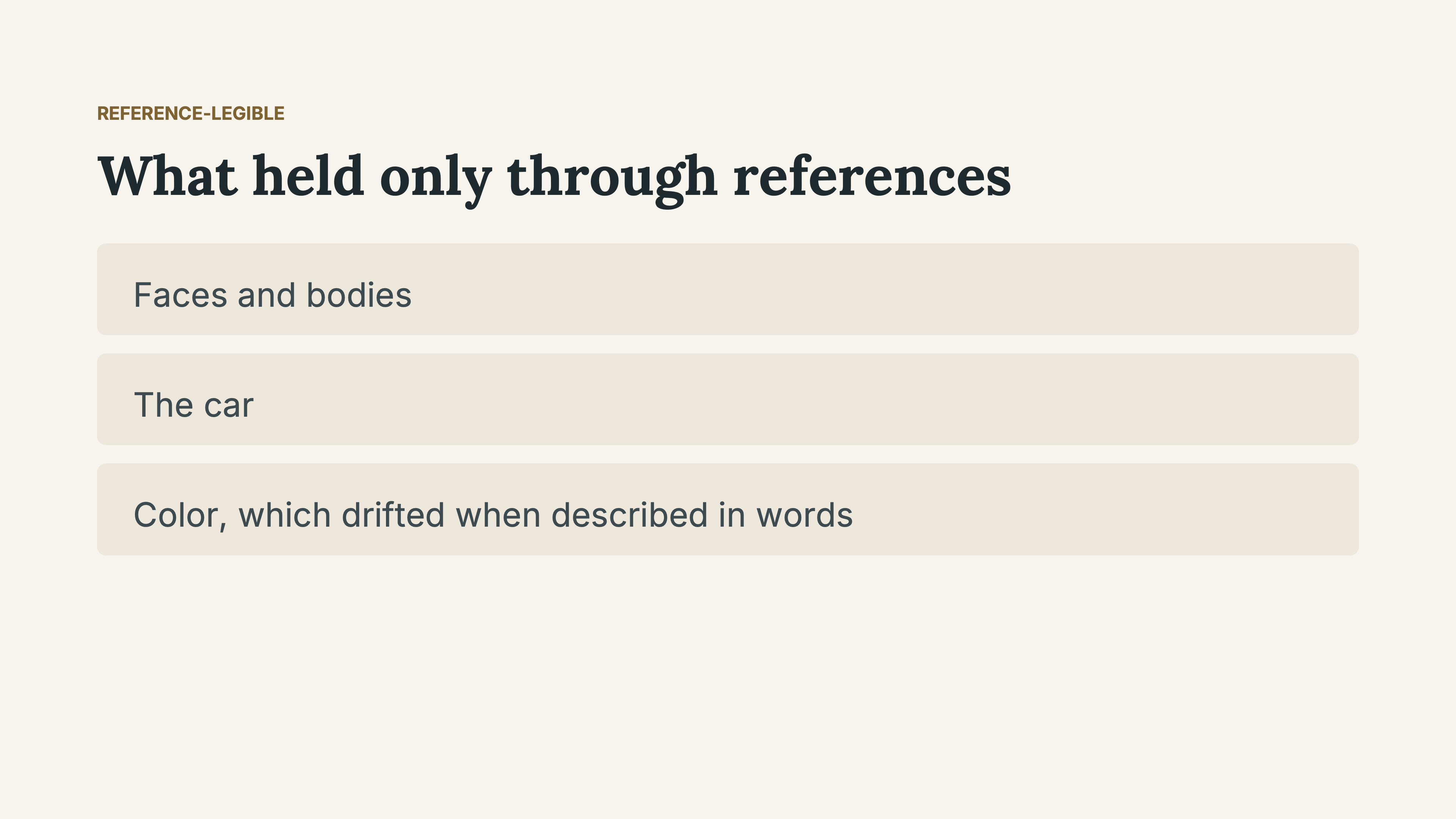
Others are reference-legible: they need an image or another reference to preserve something specific.
And some are enforcement-only: the filmmaker has to realize them through evaluation, selection, and editing.
The practical question is where to put the work. Do I need clearer language, a stronger reference, or a different decision about the material I’ve received?

In this production, several visual instructions held through language.
Overcast light, wet leaves, and eye-level framing gave the scenes a consistent direction. I could describe those conditions and evaluate whether the result followed them.
Sound also needed explicit instructions. I repeated “No music” throughout the production and specified “No dialogue” for the silent shots. Where someone spoke, I supplied the scripted lines.
Those instructions helped protect the restraint I wanted. The model still needed checking, but the words gave me a workable way to request those conditions.
Other details needed visual references.
Describing Rosa in words could produce an older woman, but I needed the same Rosa from one shot to the next. The portraits and body references helped preserve that identity.
The car presented a similar problem. A description could suggest a green sedan, while a reference gave the model a particular car to work from.
Color was revealing. I initially expected words to carry it, but it drifted between generations. References proved more dependable.
The production helped me revise my assumptions about which kind of instruction each detail needed.
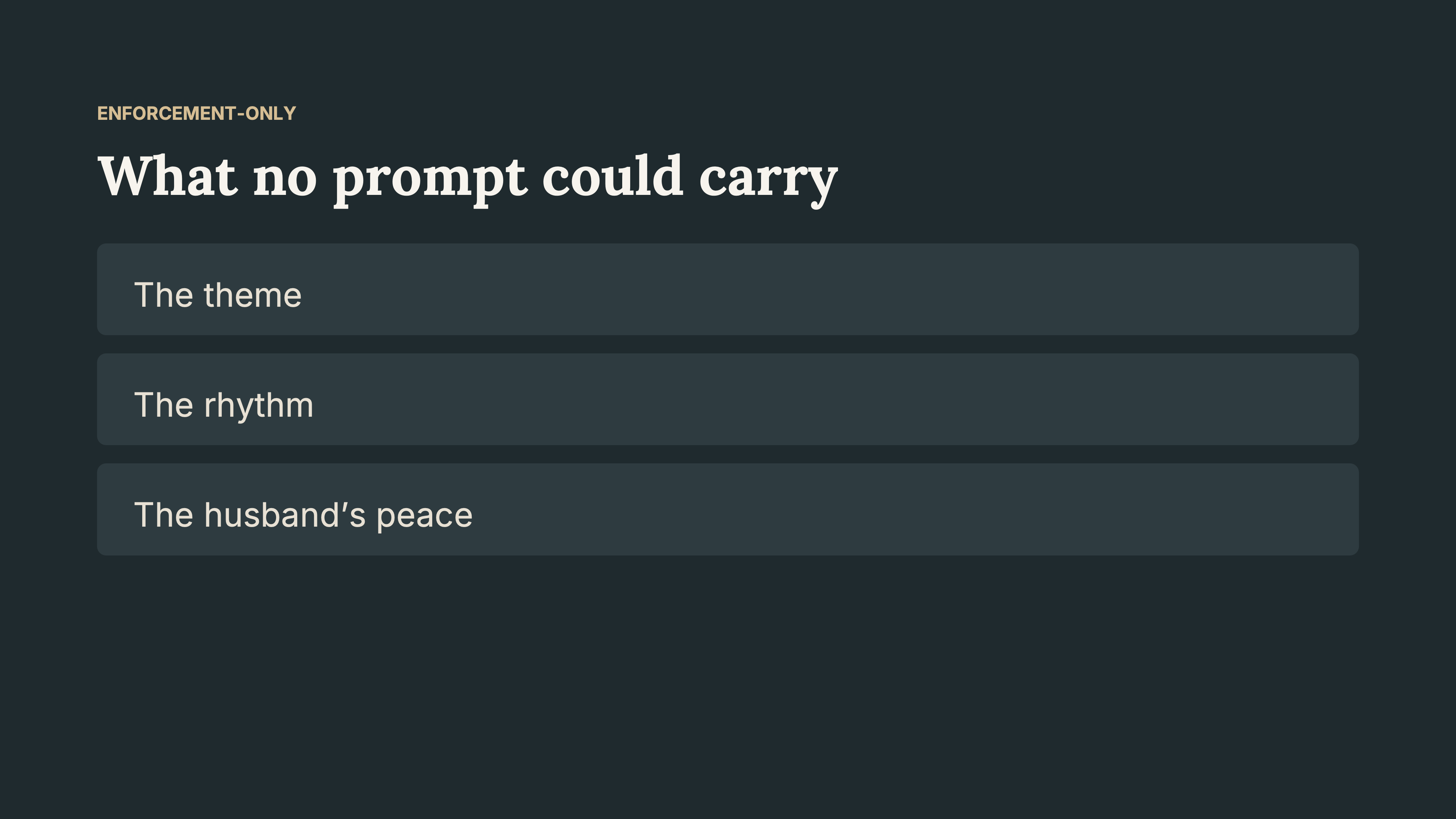
The film’s theme and rhythm required another kind of work.
I could describe the husband’s expression and ask for a peaceful smile. But whether a particular smile carried the meaning I intended depended on how it played within the film.
The same was true of Rosa’s nod. Its timing and its relationship to the surrounding shots shaped whether it felt like a decision.
This is what I mean by enforcement-only. I remained responsible for recognizing whether the material fulfilled the intention, then choosing and cutting accordingly.
The model could give me a smile. I had to decide which smile the film needed.
Once generation began, I needed a way to respond to failures.
The AICR Production Manual describes a loop: generate, evaluate, correct, and regenerate.
The important step here is correction. Before trying again, I needed to identify what had failed. Was it the action, the spatial arrangement, or the relationship between the shot and the film’s purpose?
I kept a rejects log to record those problems and the decisions that followed. These next examples show how that process worked.
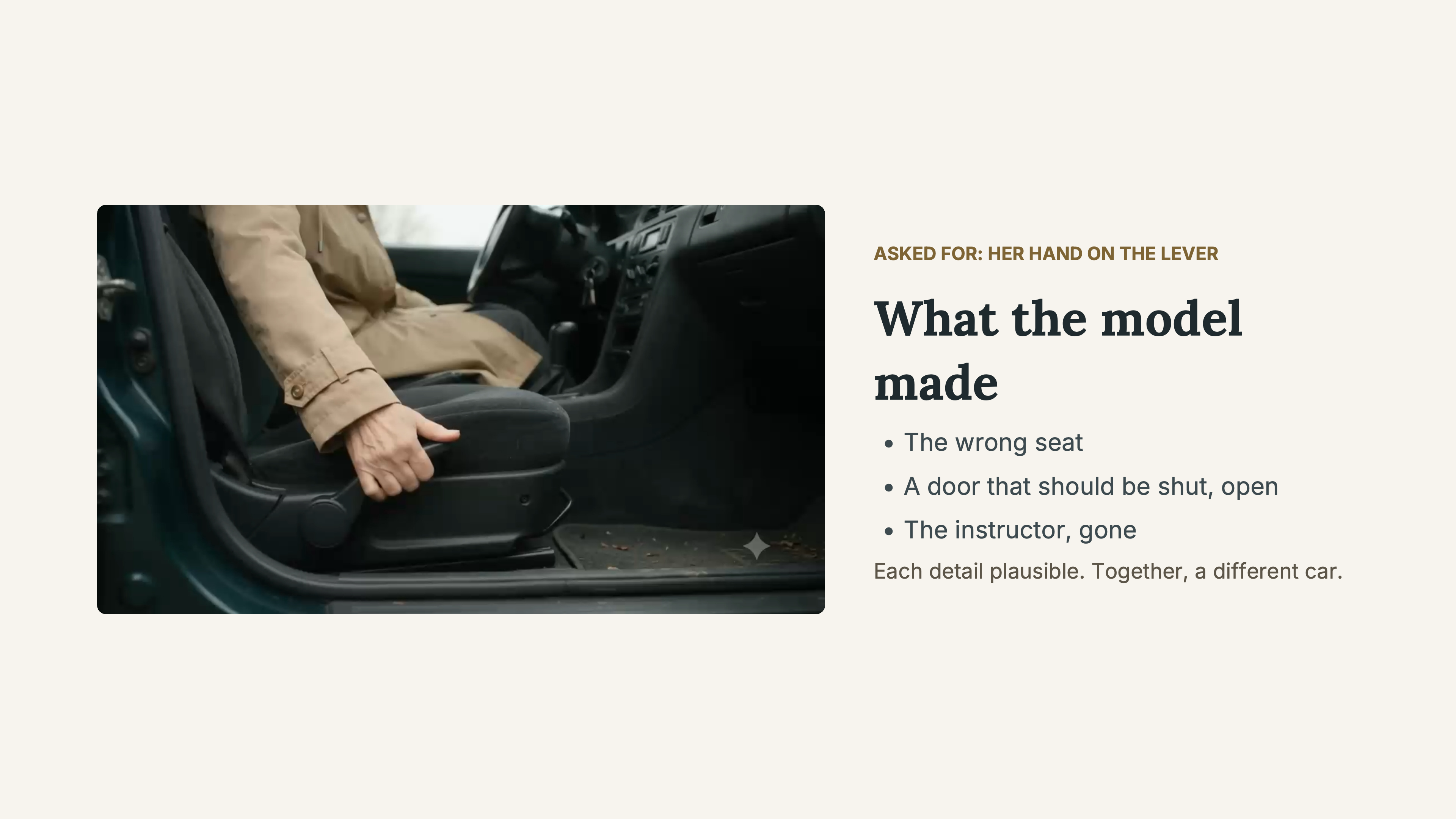
One of the simplest actions became surprisingly difficult: Rosa adjusting her seat.
I asked for her hand on the seat lever. In this result, the model moved her to the passenger seat, opened a door that should have remained closed, and removed the instructor.
Each detail could look plausible in isolation. Together, they disrupted the situation established in the surrounding shots.
The seat’s movement was a problem of material plausibility. The changed seating arrangement was a problem of spatial coherence. Identifying both helped me decide what to do next.
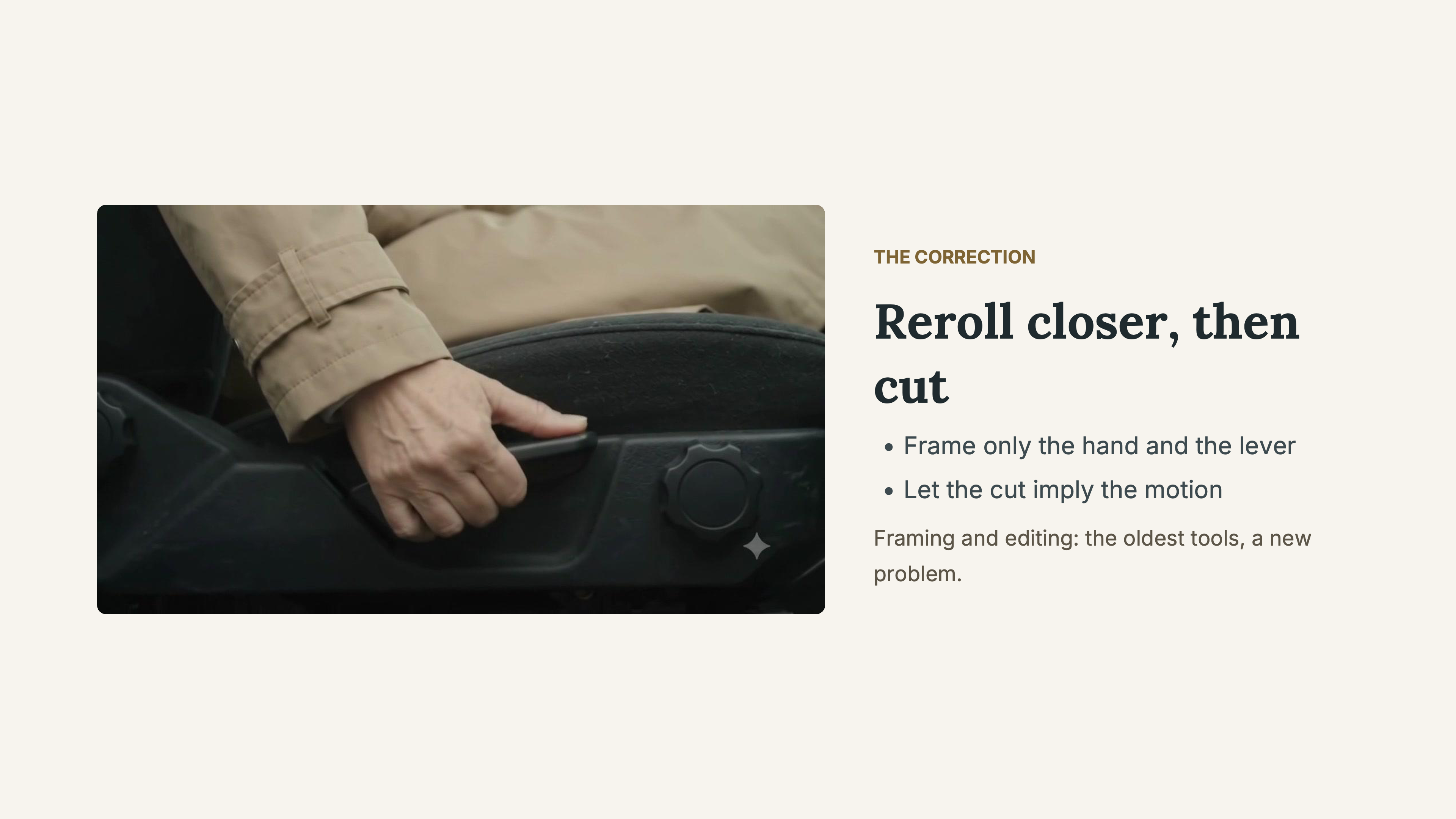
I changed the framing.
I generated a closer shot of the hand and the lever, reducing how much of the surrounding space the model had to maintain. Then I used the cut to imply the adjustment.
The audience could connect the action without seeing the seat complete its movement.
This is familiar cinematic craft: deciding what a shot needs to show and what an edit can allow the viewer to infer.
The technical limitation prompted a decision about how to tell the moment.
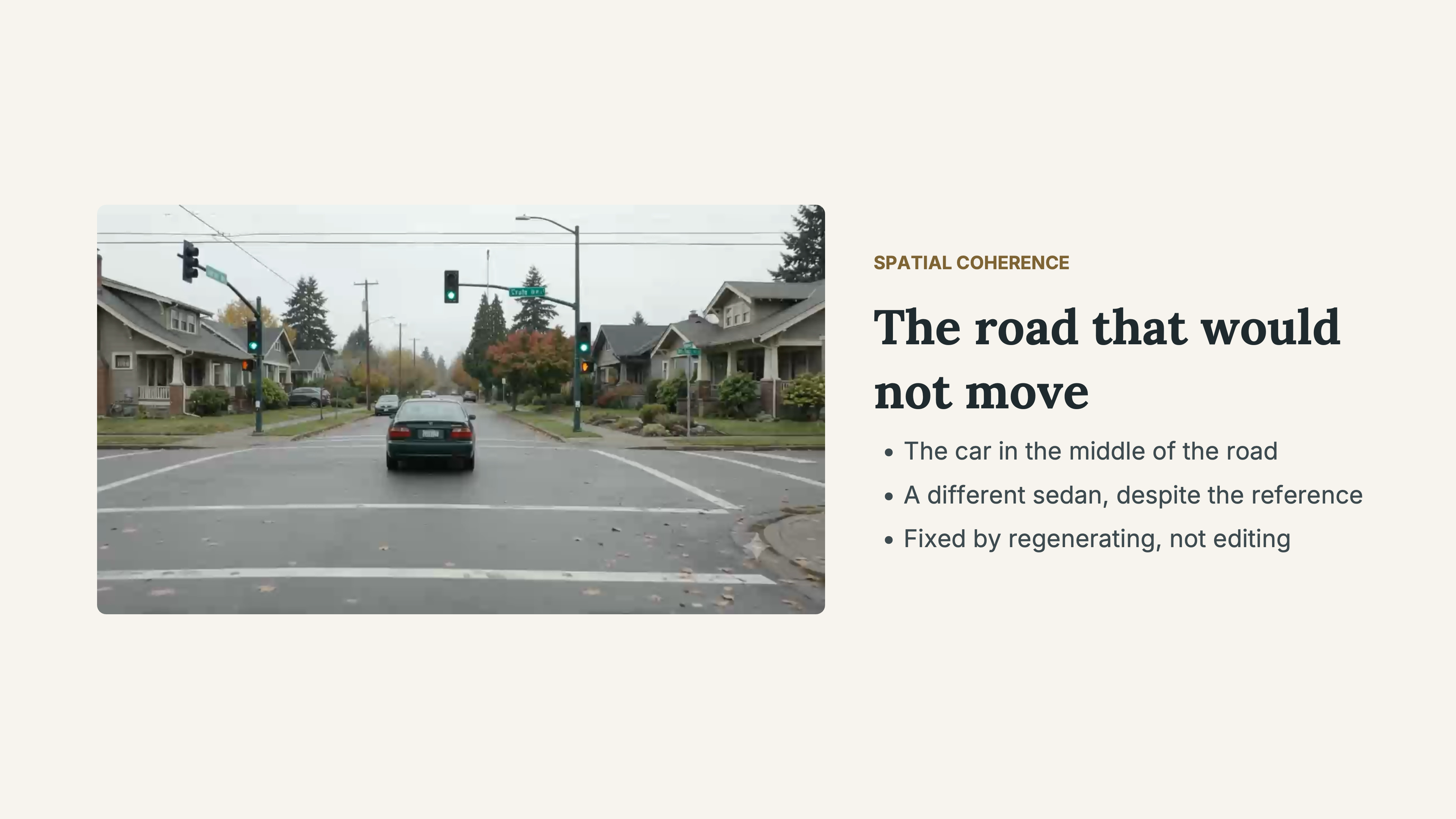
The street created another spatial problem.
The car repeatedly appeared in the middle of a two-way road. In this rejected take, it was also a different sedan from the reference.
The image could look convincing at a glance while failing to preserve the particular world of the film.
My attempts to edit it changed the framing without correcting the street layout, so I had to regenerate the shot.
That experience also shaped later instructions. The phrase “in the right-hand lane” became a response to a failure I had already encountered.
Sound required the same attention.
The model added music and dialogue I hadn’t asked for. Those additions changed the emotional register of the scenes.
I wanted a quiet street, ambient sound, and enough space for the four spoken lines to matter.
So I defined a silence policy: no music, no additional dialogue, and “No dialogue” for shots intended to remain unspoken.
Silence needed to be specified and checked. Leaving it undefined allowed the model to fill the space with choices that pulled the film away from its intended restraint.
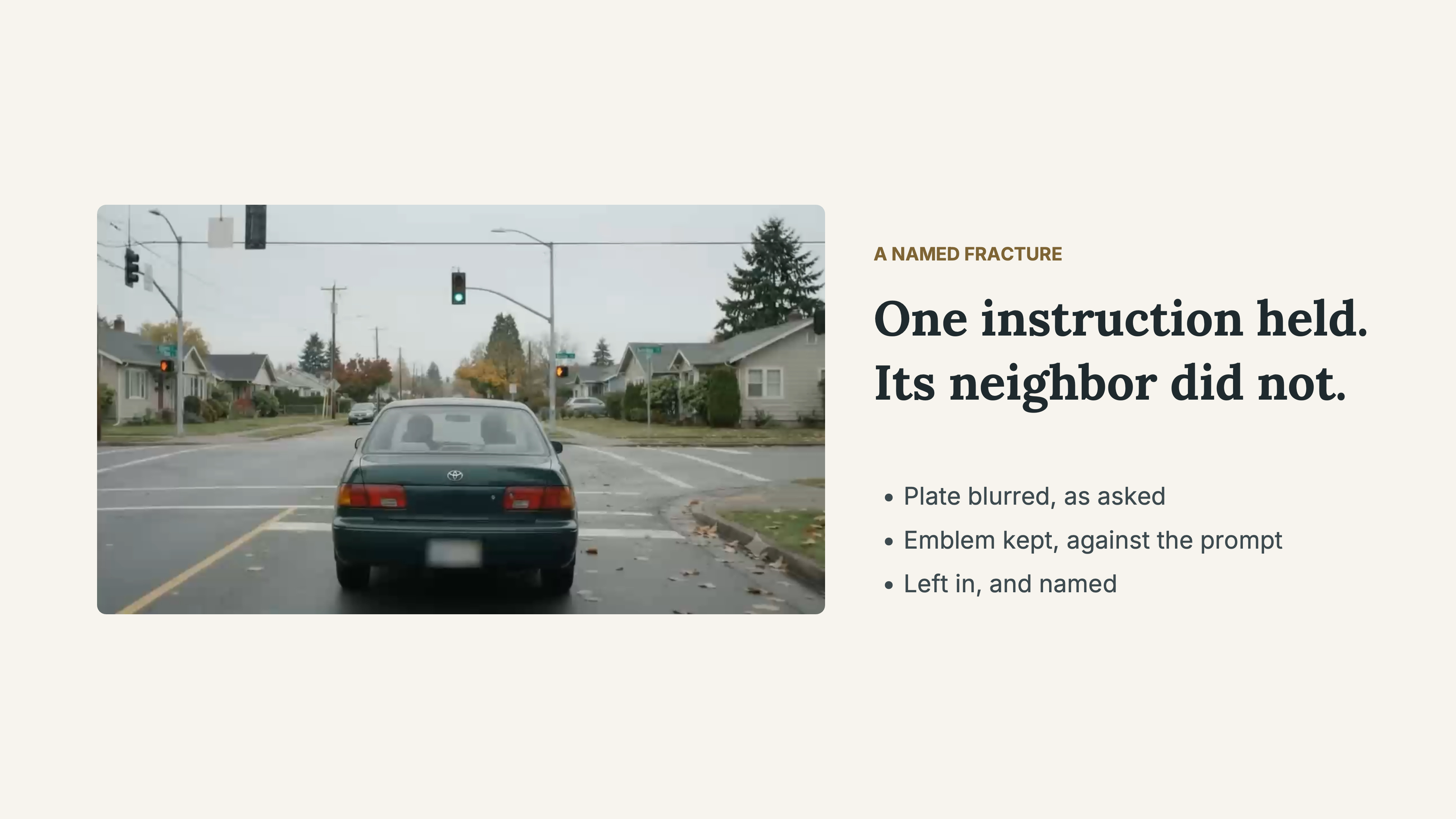
In another shot, the model followed one instruction and ignored another.
It blurred the license plate as requested, but retained the Toyota emblem despite the instruction to include no logos.
I kept the take because the rest of it served the film. But I also recorded the deviation in the published Study.
There is a distinction between requesting a detail and accepting a detail that appeared without being requested.
Keeping the emblem was my decision. Its original appearance was a failure to follow the prompt. I wanted the production account to preserve that distinction.
Across these attempts, a pattern emerged: the model handled how things looked more reliably than some of the small actions that made them work.
It could produce a convincing hand beside a lever. Showing the mechanism operating was harder. Turning a key also proved difficult.
This is an observation from this particular production. Those capabilities will change.
What mattered to the film was how I responded: which actions needed to be shown, which could be implied, and which attempts I had to reject.
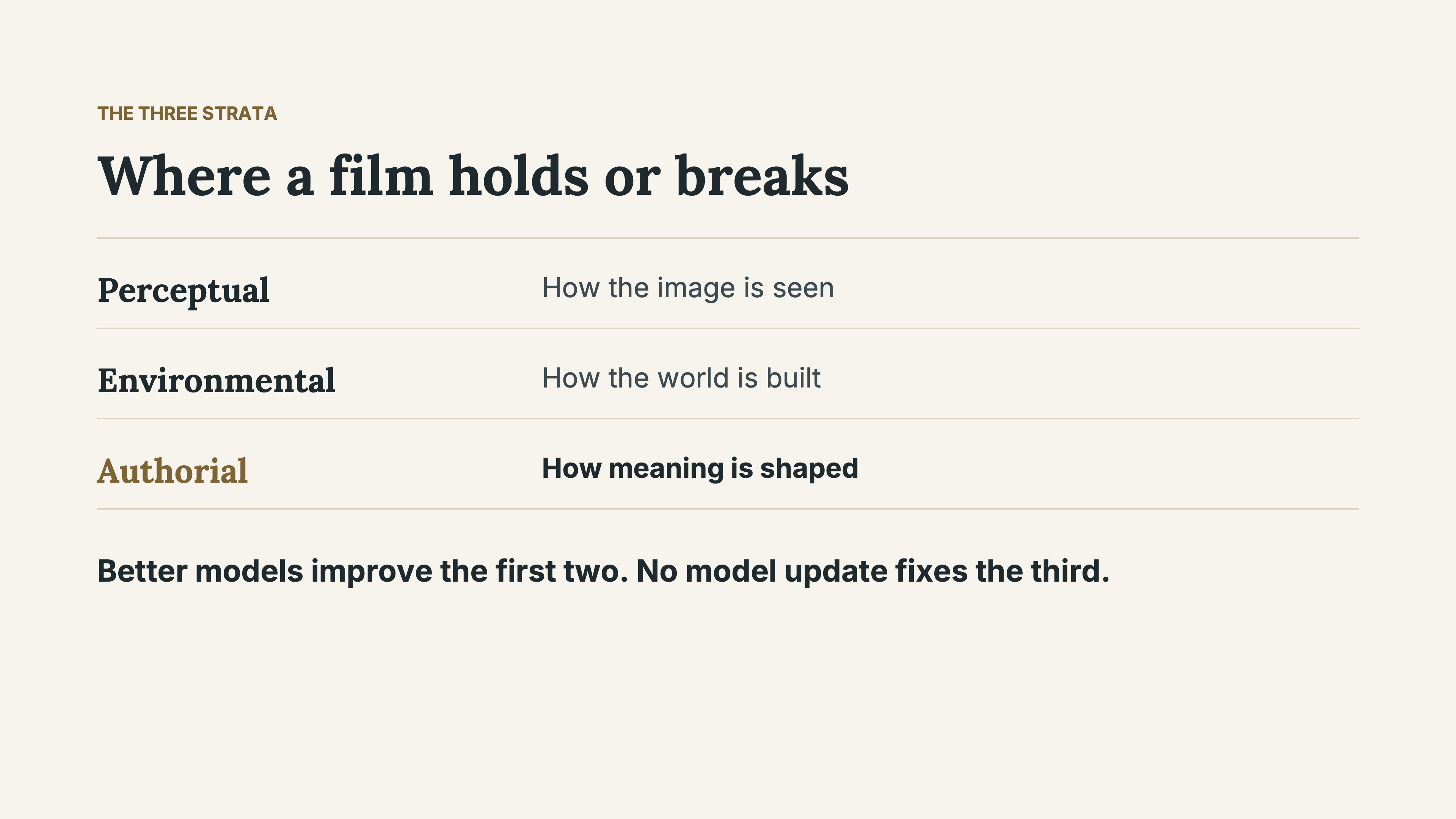
We can now return to the three strata with concrete examples.
The mechanical actions tested the perceptual stratum: whether materials and movements felt plausible.
The seating arrangement and the road tested the environmental stratum: whether the space held together across shots.
The authorial stratum concerns what those choices contribute to the film’s meaning.
A better model might render the seat adjustment correctly on the first attempt. I would still have to decide how that moment belongs in Rosa’s story.
That is the distinction behind the statement on this slide. Technical improvement does not settle the question of what the film should mean, or who answers for its choices.
I considered having sunlight break through the clouds.
It would have given the film a familiar visual signal of hope. But I felt it would explain the emotion too directly.
Keeping the light gray also helped the separately generated shots belong to the same morning.
The change could happen within that ordinary world, through Rosa’s expression and her decision to drive.
This is what I mean by atmospheric continuity: sustaining the conditions that allow the film’s emotional movement to register.
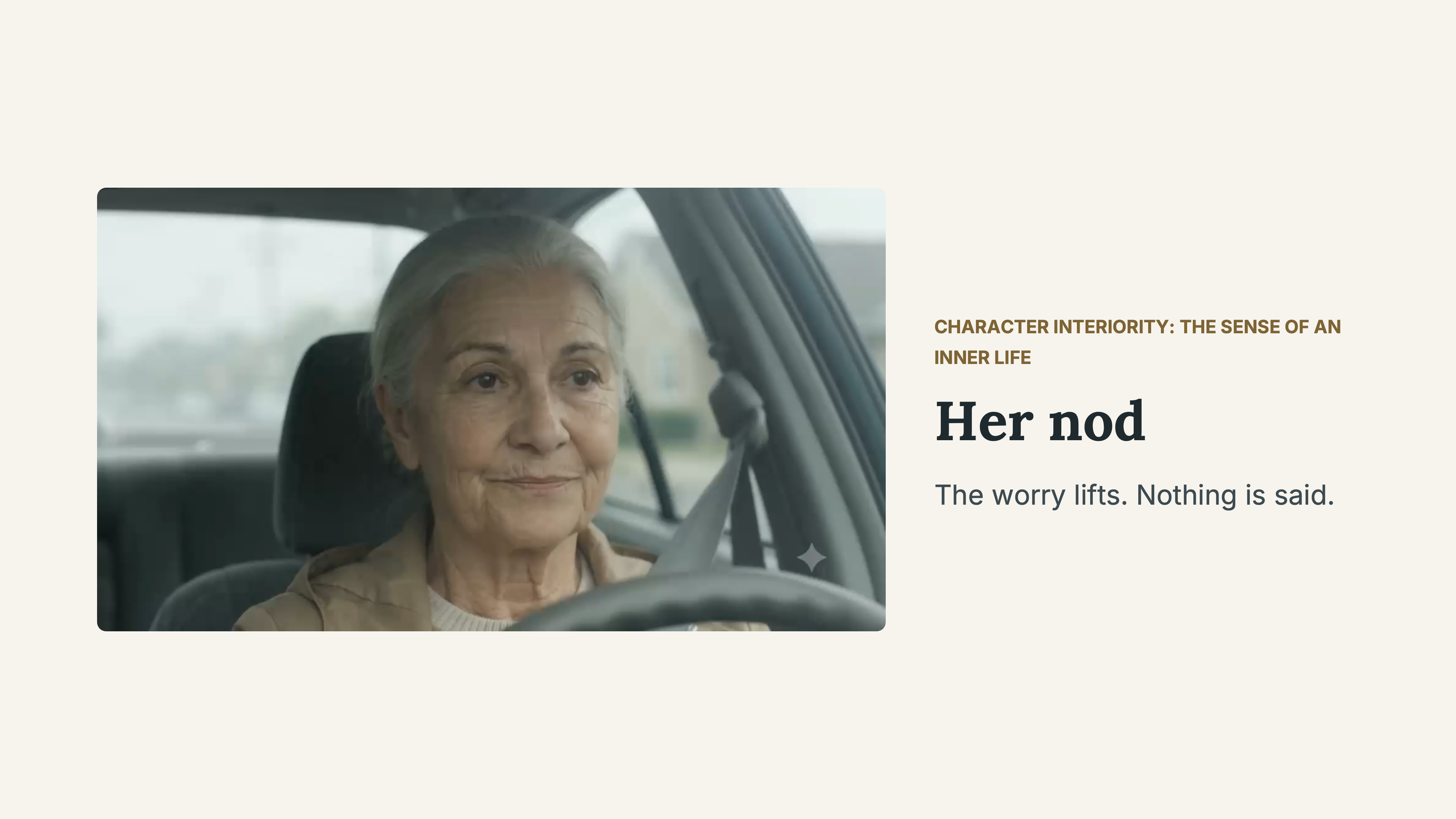
Rosa’s nod carries a small but important change.
Her character profile described someone who becomes still when a moment touches her. I wanted the gesture to remain consistent with that restraint.
She has asked, “Now what?” The instructor has answered, “Now you drive.” The nod is where I wanted that instruction to become her decision.
That is character interiority: the sense that something is happening within her, even when she says nothing.
The question in choosing the take was whether that small gesture could carry the change.
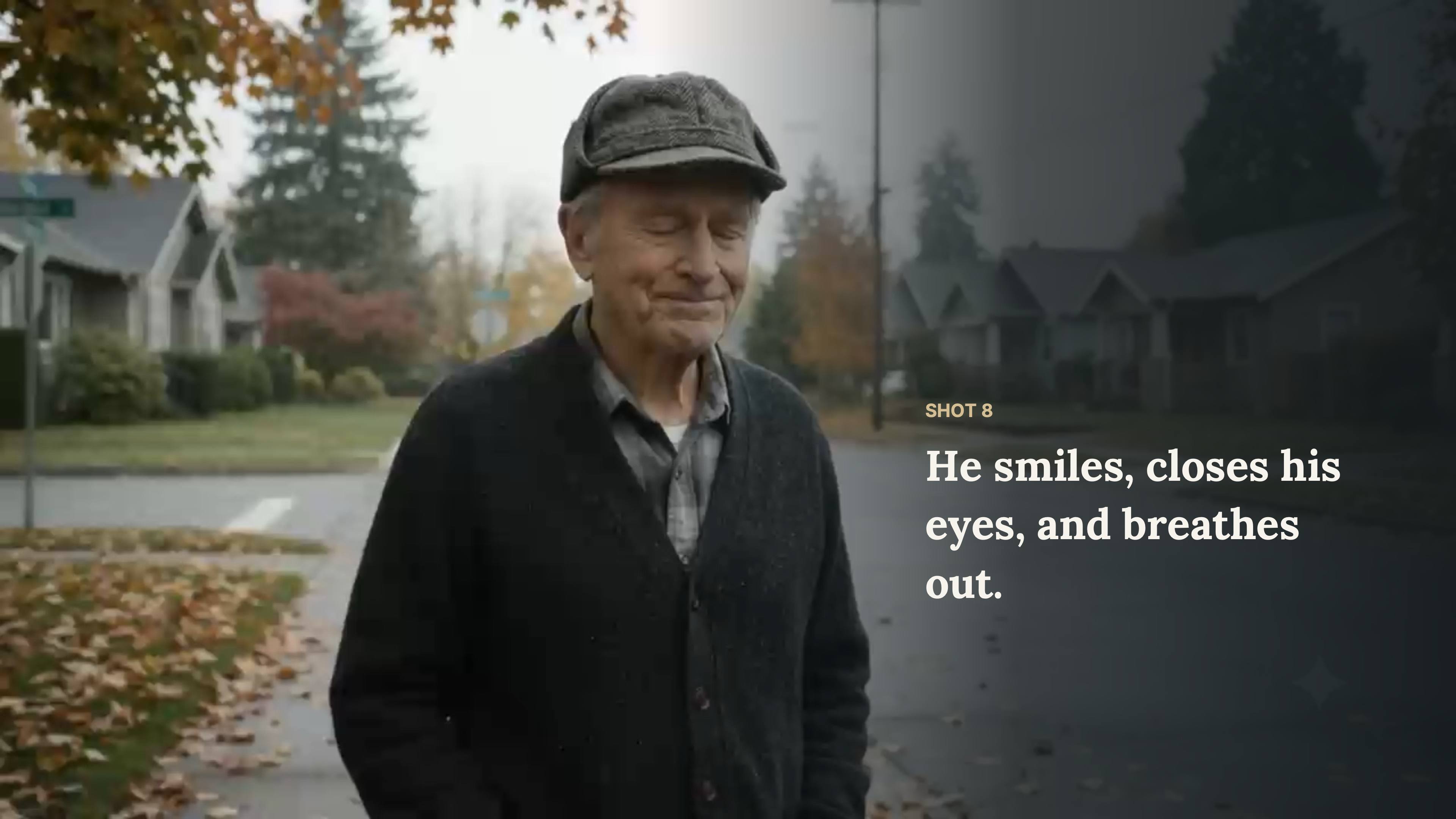
The husband appears only in this final shot, so I generated him directly within the scene.
His emotional presence needed particular care. I wanted him to seem unhurried and at peace, with a smile that supported the sense of Rosa’s life continuing.
He stands on an ordinary corner, in the same weather as the rest of the film. I wanted his presence to feel quiet and dignified.
The film leaves his presence unexplained. That ambiguity gives the audience room to encounter the image in their own way.
For me, his smile carries the film’s central wish: that love wants us to keep living.
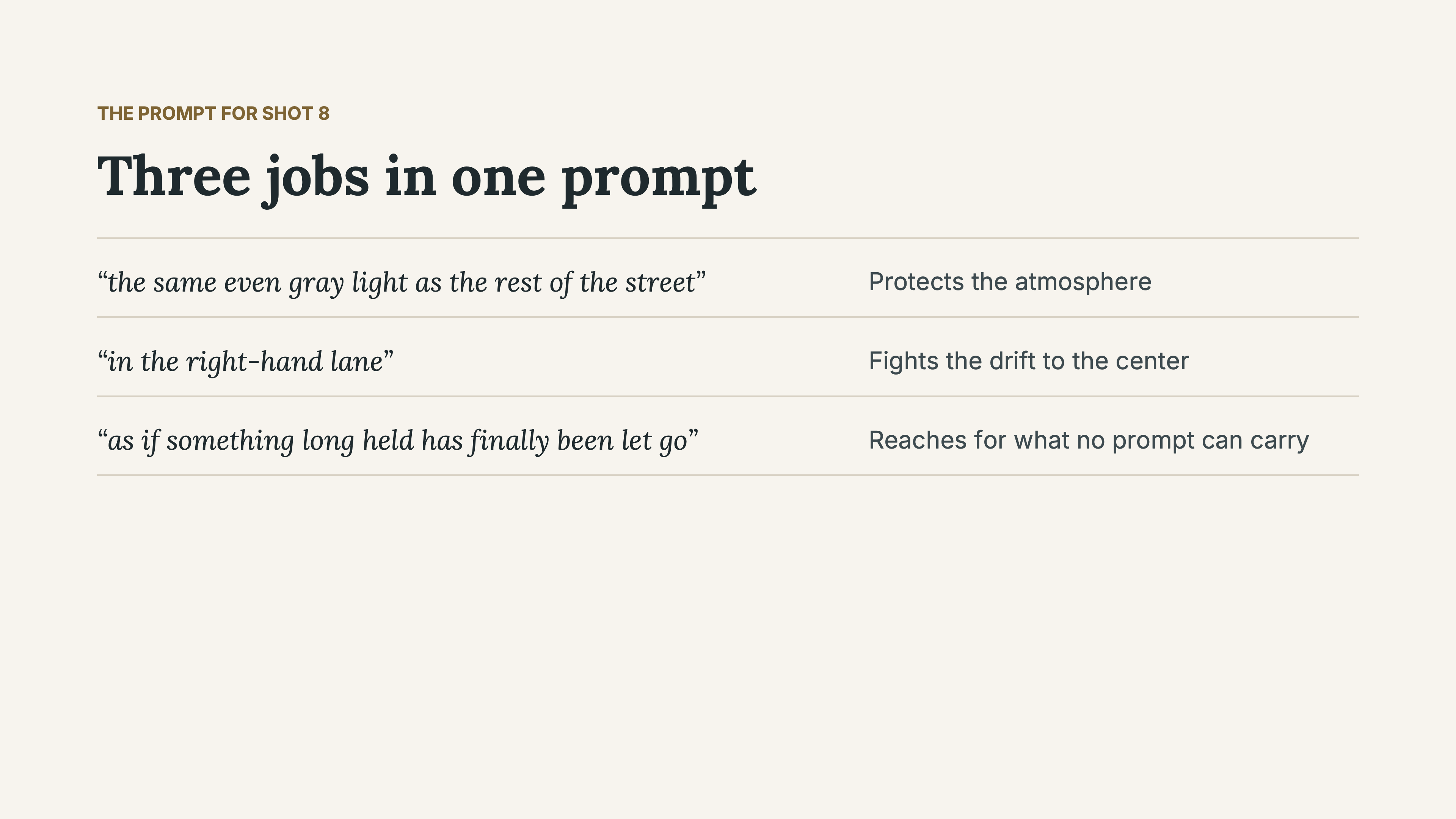
You can see those intentions working at different levels within the prompt.
“The same even gray light as the rest of the street” asks for atmospheric continuity.
“In the right-hand lane” responds to the spatial problem I had already encountered.
Then there is the phrase “as if something long held has finally been let go.”
That phrase tries to describe the emotional quality I wanted. It could guide the generation, but I still had to judge the result.
Did the smile, the breath, and the moment of closed eyes carry that feeling within this film? That decision happened through watching, choosing, and cutting.
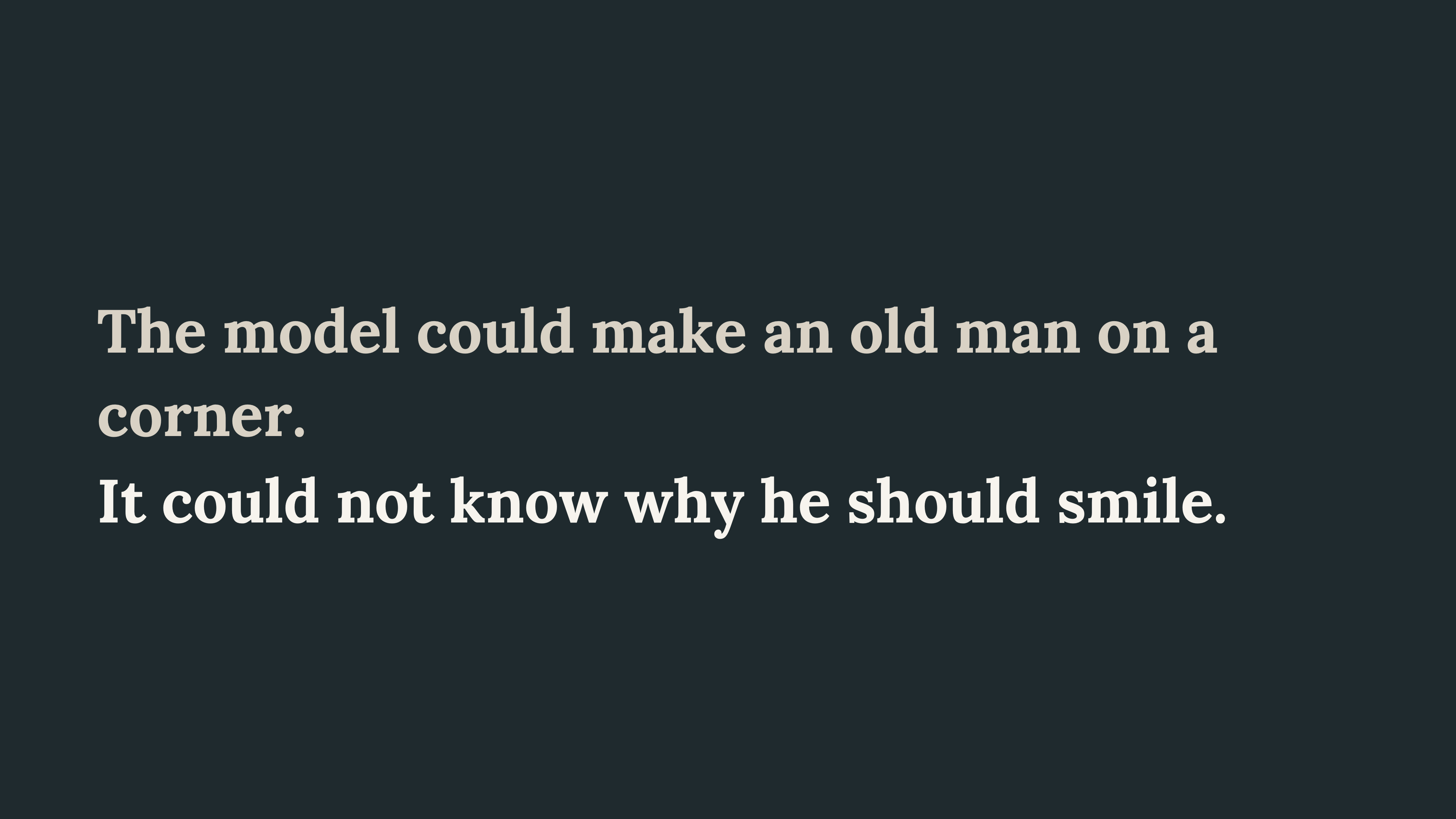
The model could make an old man on a corner.
It could not know why he should smile.
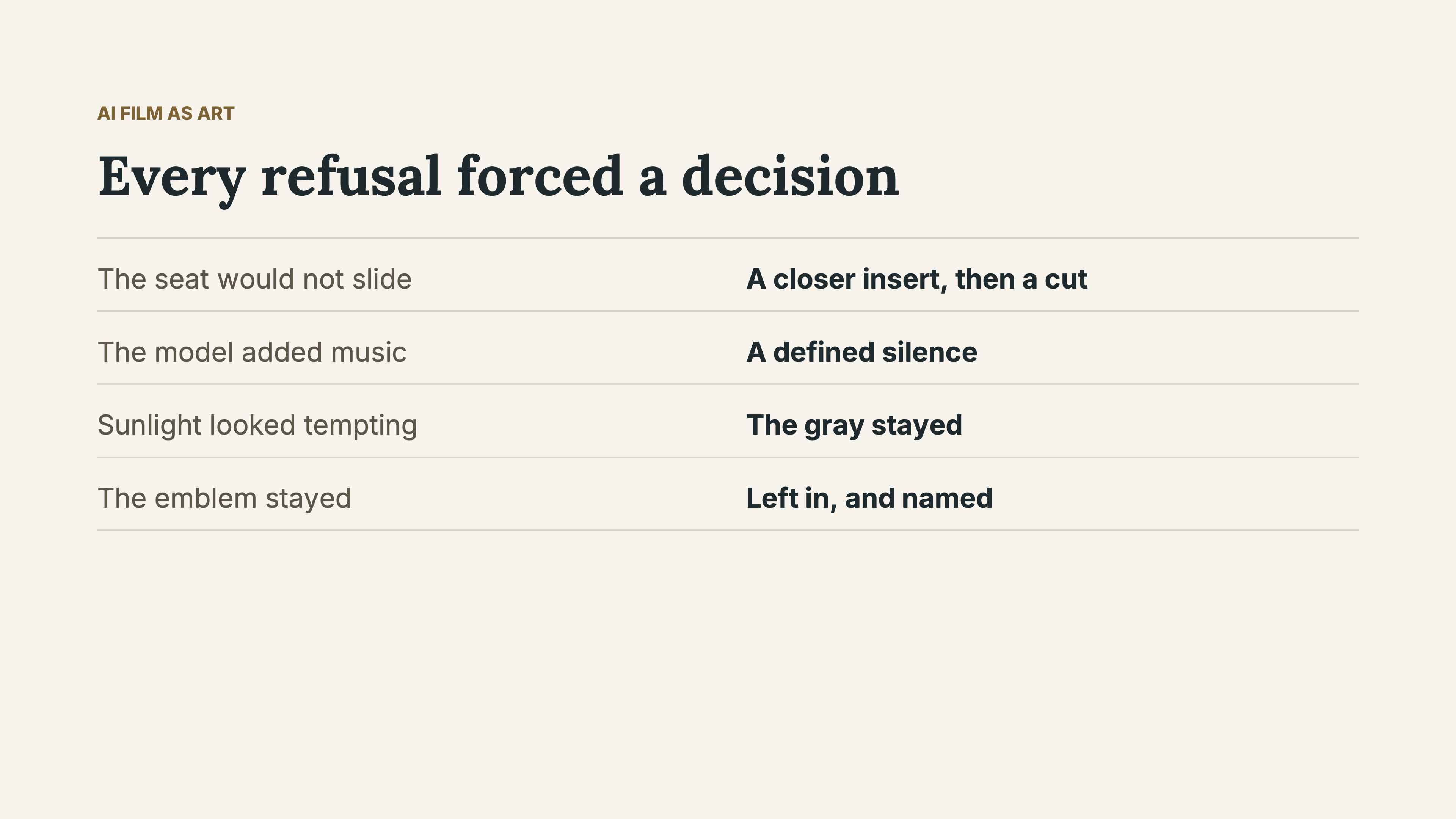
Looking back across the production, each difficulty required a judgment.
When the seat would not slide, I used a closer insert and a cut.
When the model added music, I defined and enforced the silence.
I considered sunlight, then chose to keep the gray.
And when the emblem remained, I accepted the take and documented the deviation.
These decisions shaped the film the audience encountered. Some responded to technical failures. Others protected an intention that the tools could easily have carried in another direction.

I prompted the material, selected the takes, assembled the film, and published it.
Those actions make me responsible for the choices I accepted, including details I did not originally request.
When I claim authorship here, I am claiming a creative contribution and accepting responsibility for the finished work.
I can explain why Rosa appears as she does, why the scene remains quiet, and why her husband smiles.
An audience can then question those decisions. Putting my name on the film means making myself available to that questioning.
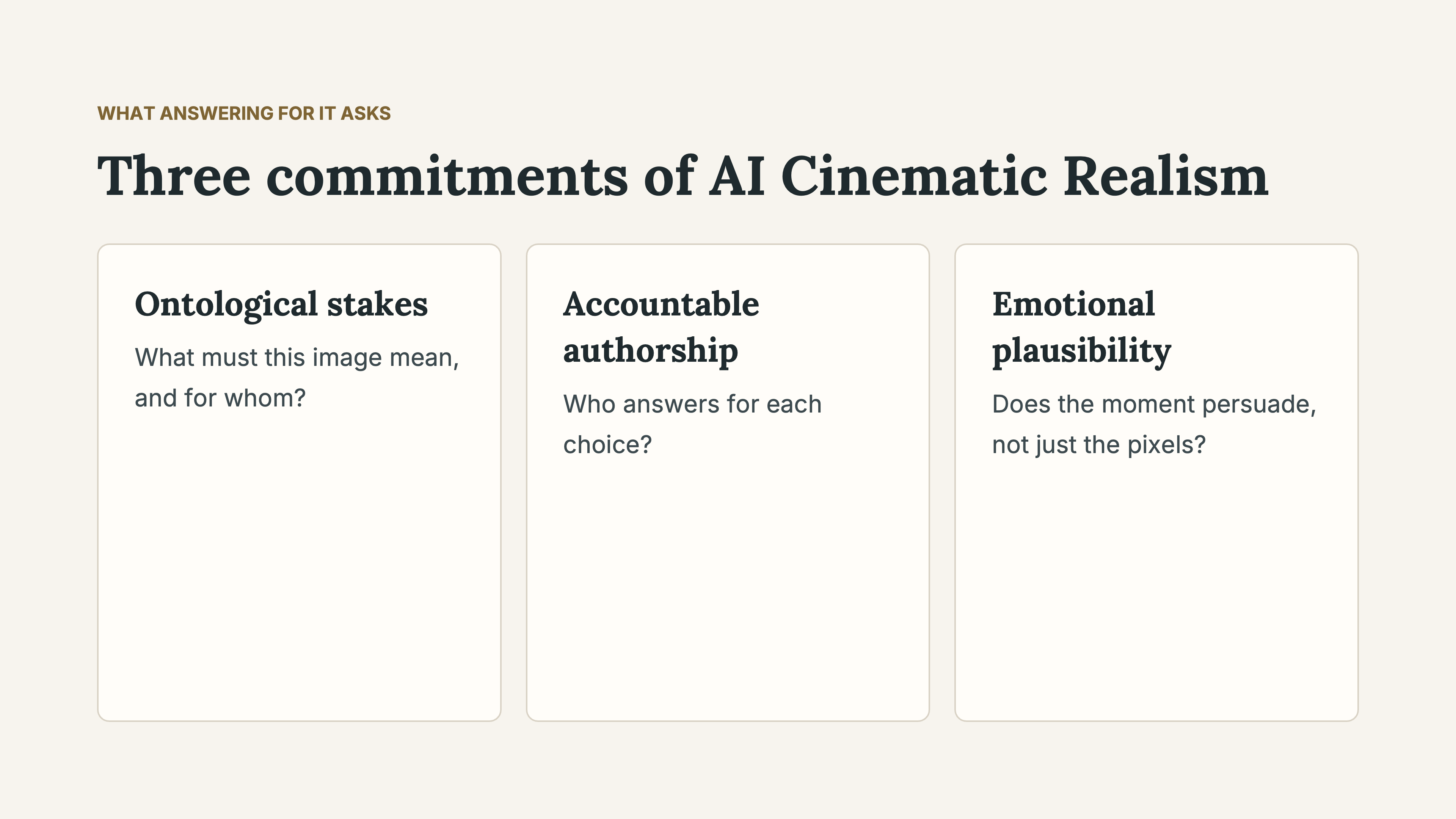
AICR brings that responsibility into focus through three commitments.
Ontological stakes asks what the image means and for whom. In First Lesson, the generated world carries an experience of loss that comes from my own life.
Accountable authorship asks who answers for the choices. That includes how I portray an older woman learning something new, and the dignity I give the husband’s presence.
Emotional plausibility asks whether the moment persuades. Does Rosa’s nod feel like a decision? Does his smile support the meaning the film has been building?
These questions connect the production process to the experience of watching the film.
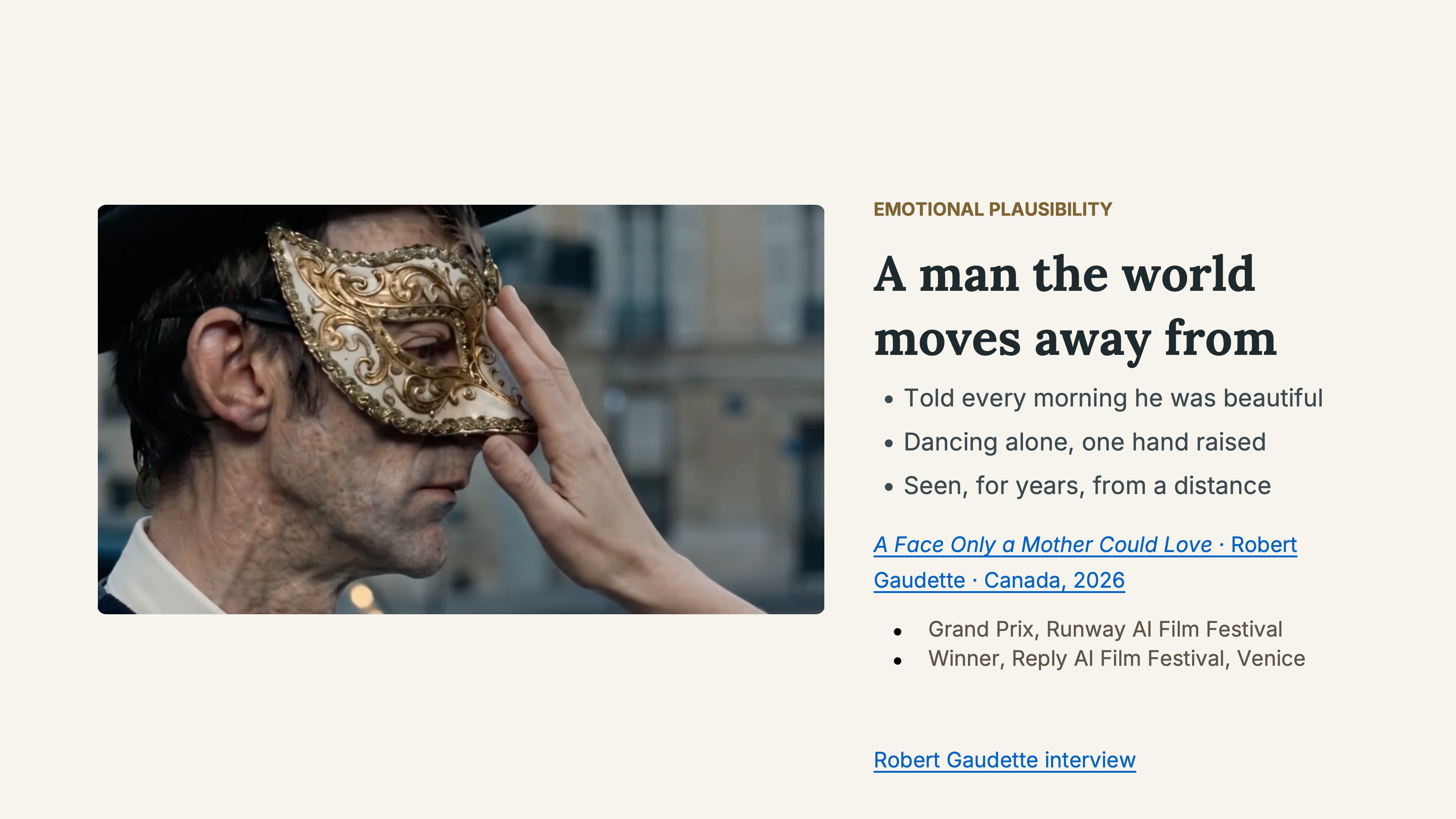
Robert Gaudette’s A Face Only a Mother Could Love offers another example of that care.
Its central character, Marcel, moves through Paris with a belief in his own worth that survives the way others treat him. Each evening, he dances with an imagined partner.
In his Envato interview, Gaudette describes rejecting technically impressive shots when Marcel’s behavior no longer felt consistent with the person he was creating.
His phrase is “prompting is not directing.”
What interests me is the judgment behind those rejections. Preserving a recognizable inner life required attention to gestures, pauses, and behavior across the film.
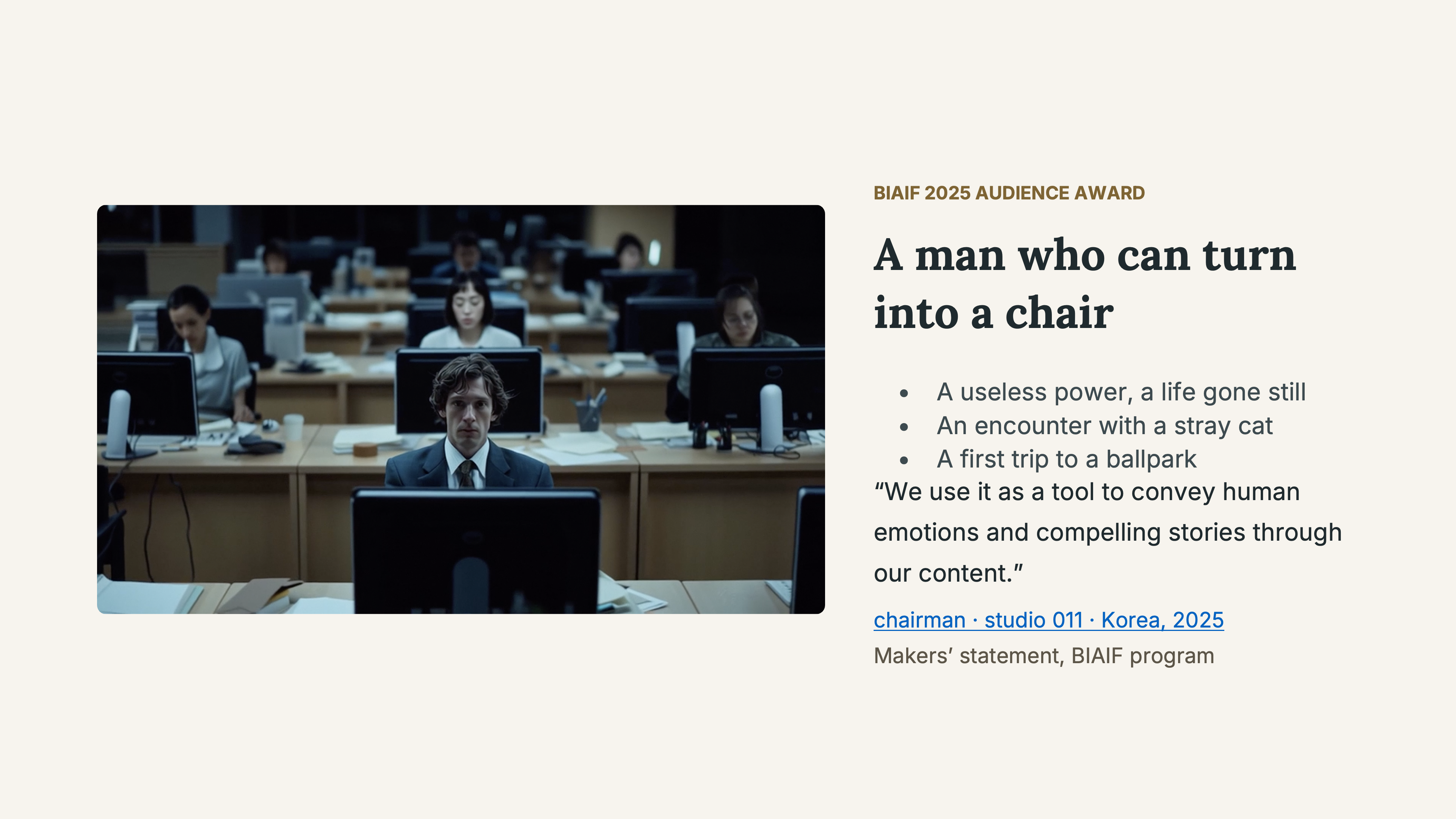
Studio 011’s chairman, which received the BIAIF 2025 Audience Award, begins with an impossible ability: a man can turn into a chair.
As his life loses meaning, that ability becomes a way of withdrawing from the world. An encounter with a stray cat prompts him to reconsider, and he eventually visits a baseball stadium for the first time.
The premise is fantastical, but the feelings it explores are recognizable: isolation, purposelessness, and the possibility of connection.
The makers’ statement in the BIAIF program places human emotions and storytelling at the center of their use of AI.
This is why AICR’s concern with realism can extend to fantasy. We can ask how an impossible world sustains an experience that feels true.
This brings me back to the question of authorship.
Across these examples, filmmakers give the material a direction, recognize what belongs, and shape what an audience encounters.
That is the sense of authorship I have been arguing for.
Images can be generated.
Cinema must be authored.
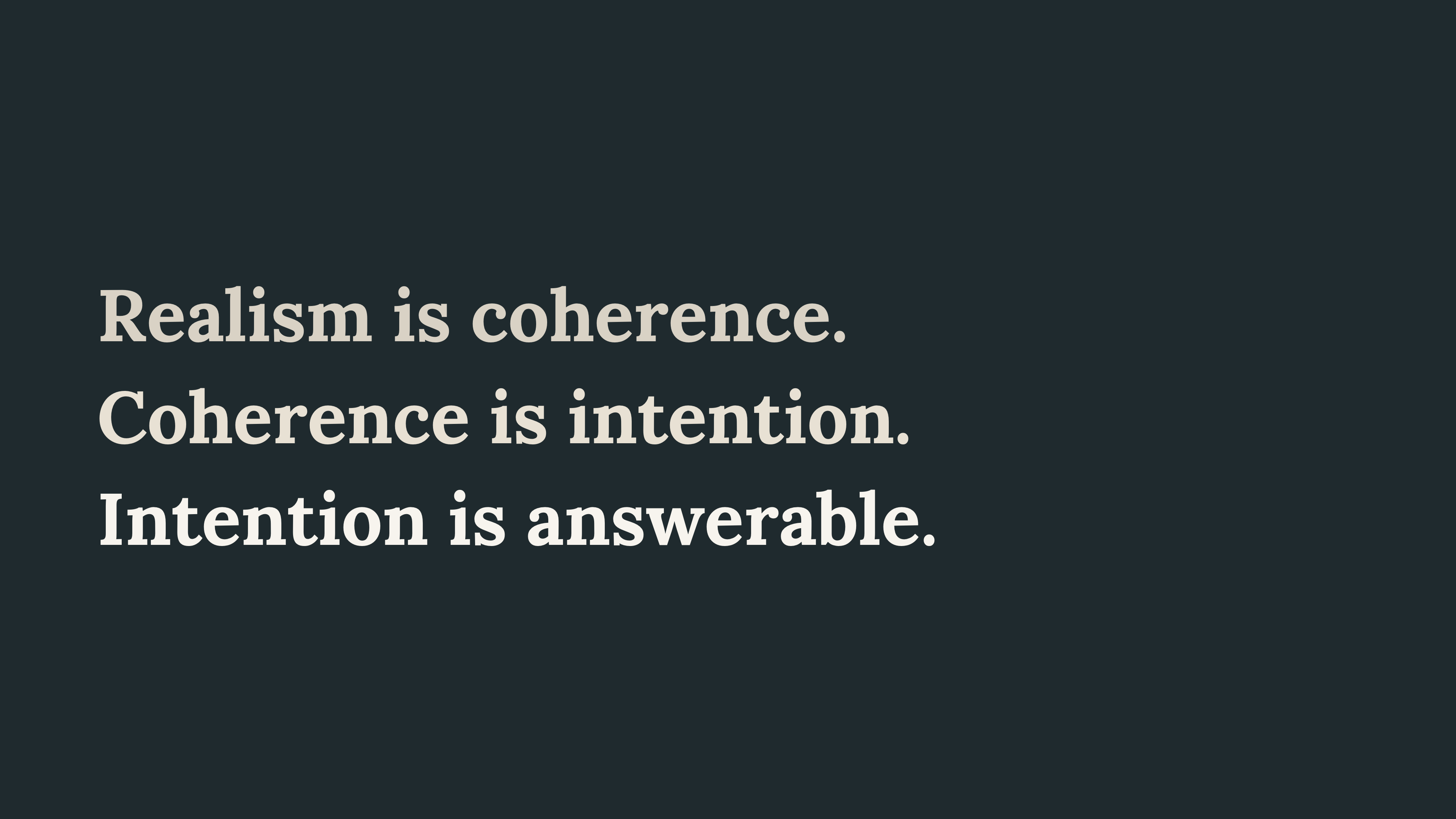
In AI Cinematic Realism, I bring that argument together this way:
Realism is coherence.
Coherence is intention.
Intention is answerable.
The full Study 33 is available, including the production account, the failures, and the decisions we’ve discussed.
Watch AI Cinematic Realism (AICR): The Framework in Full on YouTube


Leave a Reply